
Video
Let’s watch this short video for a quick overview.
Source: gokigen japanese official YouTube Channel
Introduction
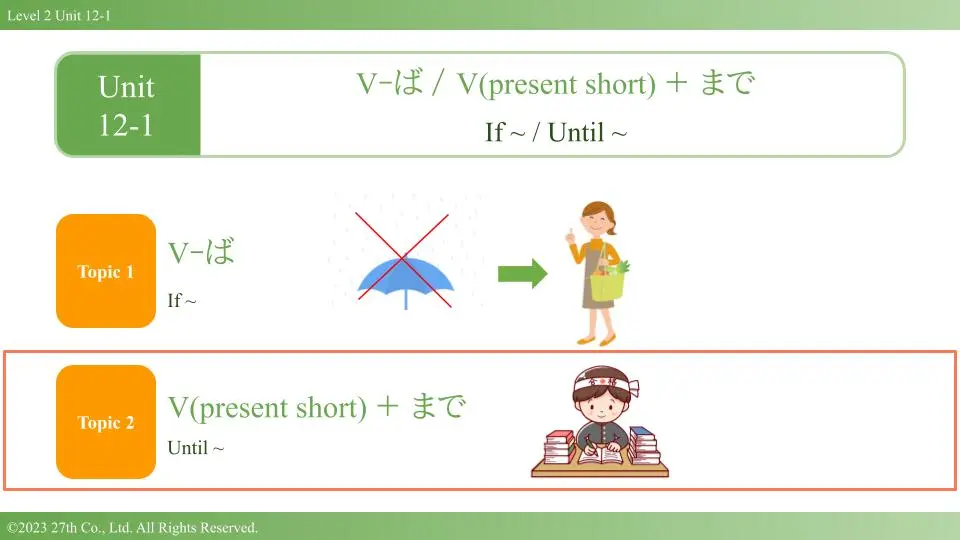
V-ば expresses a general “If X, then Y” relationship. It’s a core conditional you’ll use for rules, tendencies, and good-result expectations (e.g., “If you study, you’ll pass”).
1. Meaning & Basic Pattern
- Pattern: X ば、Y。
- Meaning: If X is the case, Y is/will be the case.
Examples:

早く行けば、電車に間に合います。
If we go early, we’ll make it on time.

もっと勉強すれば、試験に合格するでしょう。
If you study more, you’ll probably pass.
In an X ば Y sentence, usually X ends up with a good result in Y.
2. How to Form the ば-form (Verbs)
Affirmative
Take the final -u of dictionary form and add -eba.
| Verb | ば-form |
|---|---|
| 行く (iku, to go) | 行けば (ikeba) |
| 食べる (taberu, to eat) | 食べれば (tabereba) |
| する (suru, to do) | すれば (sureba) |
| 来る (kuru, to come) | 来れば (kureba) |
Negative
Take the final い of the short negative form and add ければ.
| Verb | ば-form |
|---|---|
| 行かない (ikanai, not to go) | 行かなければ (ikanakereba) |
| 食べない (tabenai, not to eat) | 食べなければ (tabenakereba) |
| しない (shinai, not to do) | しなければ (shinakereba) |
| 来ない (konai, not to come) | 来なければ (konakereba) |
3. Comparison with similar conditional expressions
Let’s compare the usage of ば with similar expressions たら, なら and と.
Quick Review
- V-ば: general condition, tendencies, often good outcomes.
- たら: “If / When ~” for conditions, sequences, hypotheticals
- [Conditions] 暑かったら、ネクタイをしません。= If it’s hot, I won’t wear a tie.
- [Sequences] 授業が終わったら、電話します。= I’ll call you when class ends.
- [Hypotheticals] 私が鳥だったら、空を飛びたいです。= If I were a bird, I’d want to fly in the sky.
- Noun + なら: “When it comes to ~” / “As for ~” / “If it’s ~”
- 週末ならひまです。= As for weekends, I’m free.
- Event A [short (plain) / present] + と、Event B: Constant condition & result “when A happens, B happens.”
- 春になると、桜が咲きます。= When spring comes, the cherry blossoms bloom.
Hypothetical situation
When talking about “what if,” not knowing if they will actually happen, all expressions are OK except と.
Example: If I had money, I would buy a car.
- ✅ お金が あれば [あったら/あるなら] 車を買います。
- ✖ お金があると…。
General conditions
For a condition that definitely comes true, なら cannot be used.
Example: When winter comes, snow falls.
- ✅ 冬に なれば [なったら/なると] 雪が降ります。
- ✖ 冬になるなら…。
Past conditions
You can only use ~と and ~ば for this meaning.
Example: In spring, I went to see the cherry blossoms.
- ✅ 春に なれば [なると] 桜を見に行きました。
- ✖ 春に なったら [なるなら]…。
Using an expression of intent at the end of a sentence
と sentences cannot end with an expression that involves a person’s intent or will. (e.g. “to ask”)
Example: If you have any questions, I’ll answer them.
- ✅ 質問が あれば [あったら/あるなら] こたえます。
- ✖ 質問があると…。
4. Model Sentences

雨が降れば、川の水が増えます。
When it rains, the river water rises.

薬を飲めば、よくなるでしょう。
If you take medicine, you’ll feel better.

たくさん食べなければ、大きくなれません。
You won’t grow big unless you eat a lot.

田中さんが来なければ、会議を始められません。
We can’t start the meeting until Mr. Tanaka arrives.
5. Practice
Turn each cue into an X ば Y sentence.
| Cue | Example answer | English |
|---|---|---|
| 春になる/桜が咲く | 春になれば、桜が咲きます。 | When spring comes, the cherry blossoms bloom. |
| 雨が止む/買い物に行く | 雨が止めば、買い物に行きます。 | When the rain stops, I’ll go shopping. |
| 時間がある/釣りをしたい | 時間があれば、釣りをしたいです。 | If I have time, I’d like to go fishing. |
| 勉強しない/合格できない | 勉強しなければ、合格できません。 | If you don’t study, you won’t pass. |
6. Tip: How to Form the ば-form (Adjectives & Nouns)
You can also use this “if” pattern with adjectives and nouns.
い-adjectives: Drop the final い (i) and add ければ (kereba).
- 寒い (samui) → 寒ければ (samukereba / If it’s cold)
- 高くない (takakunai) → 高くなければ (takakunakereba / If it’s not expensive)
Important exception: いい becomes よければ (not いければ).
な-adjectives & Nouns: Add なら(ば). nara is the modern, common form.
- 静か (shizuka) → 静かなら(ば) (shizuka naraba / If it’s quiet)
- 学生 (gakusei) → 学生なら(ば) (gakusei naraba / If [someone is] a student)
FAQ
- QIs it true that ~ba (〜ば) can only be used for good results?
- A
No, this is a common misunderstanding. While ~ba is often used to give advice (which usually leads to a good result, like 勉強すれば合格する = If you study, you will pass the exam), it can be used for any logical or natural consequence, including bad ones.
Example (Bad Result): そんなことをすれば、先生に怒られますよ。 = If you do such a thing, you will be scolded by the teacher.
- QWhat’s the real difference between ~ba (〜ば) and ~tara (〜たら)?
- A
~ba (〜ば) is for general or logical conditions. Think of it as “If A is true, B is the logical result.” It’s perfect for giving advice, stating rules, or talking about general truths. Example (Advice): 薬を飲めば、よくなります。= If you take the medicine, you will get better.
~tara (〜たら) is for specific, one-time conditions or sequences. Think of it as “When/If this specific A happens, then B will happen.” It’s the most versatile conditional. Example (Specific Event): 家に帰ったら、電話します。= When I get home, I will call you.
- QHow is ~ba (〜ば) different from ~to (〜と)?
- A
~to (〜と) is for automatic or natural results (like a law of nature, a machine, or an unavoidable consequence). Example: 春になると、花が咲きます。 (When spring comes, flowers always bloom.)
~ba (〜ば) is for logical or conditional results that are highly likely but not necessarily 100% automatic. It’s often used for giving advice, which ~to cannot do.
Conclusion
V-ば is your go-to conditional for general conditions, rules, and expected (often positive) results.
Master the forms (…ば / …なければ), remember when not to use と or なら, and you’ll sound natural when explaining “If X, then Y.”