
Video
Let’s watch this short video for a quick overview.
Source: gokigen japanese official YouTube Channel
Introduction
Want to say “Whenever I drink coffee, I can’t sleep” or “When spring comes, cherry blossoms bloom”?
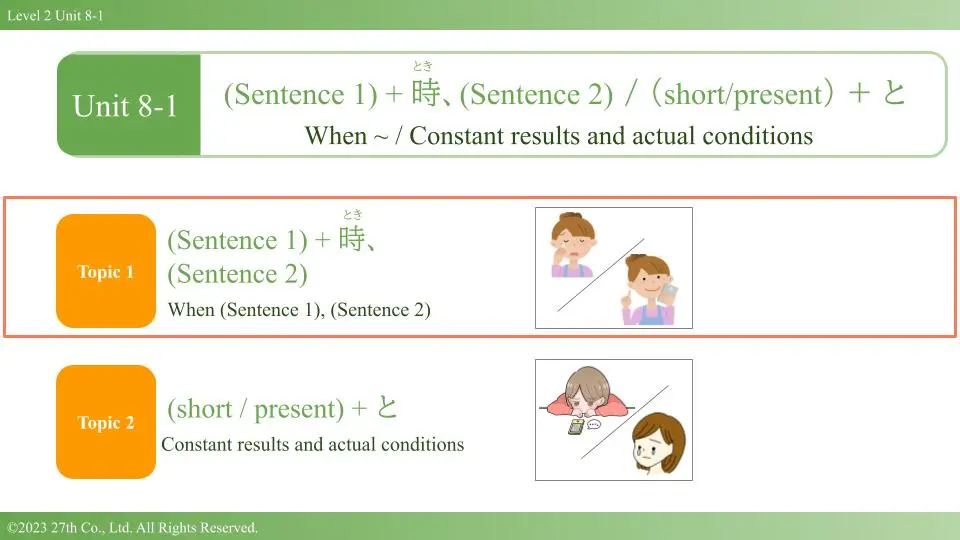
Japanese uses Event A (short [plain] form, present) + と、 Event B to talk about automatic results, laws of nature, habitual actions, or programmed outcomes.
Think of it as the Japanese “whenever/if A, then B (always).”
Let’s master the form, its rules, and how it differs from 時 (When Sentence 1, Sentence 2).
1. Structure & Core Meaning
Pattern: Event A [short (plain) / present] + と、Event B
Meaning: Constant condition & result “when A happens, B happens.”
Example:

春になると、桜が咲きます。
When spring comes, the cherry blossoms bloom.
| Part | Form | Role | Example |
|---|---|---|---|
| Event A | short [plain] form, present verb / adj. / noun + と | Cause / trigger | 春になると |
| Event B | any tense but usually present | Guaranteed result | 桜が咲きます。 |
2. Conjugation Rules
| Word type before と | A-clause form | Example |
|---|---|---|
| Verb | Dictionary (present) | 雨が降ると … |
| い-adj. | Present short (~い) | 暑いと … |
| な-adj. | だと | 静かだと … |
| Noun | だと | 学生だと … |

A is always present tense, even when both actions happened in the past.
Put と immediately after A; never use に or で here.
3. Example Sentences
| Situation | Sentence | Translation |
|---|---|---|
| Natural law | 春になると桜が咲きます。 | When spring comes, cherry blossoms bloom. |
| Habit | かなさんと話すと元気になります。 | Whenever I talk with Kana, I feel uplifted. |
| Programmed action | このボタンを押すと電気がつきます。 | If you press this button, the light turns on. |
| Automatic feeling | 恥ずかしいと顔が赤くなります。 | When I’m embarrassed, my face turns red. |
| Conditional advice | 甘い物を食べすぎると太りますよ。 | If you eat too many sweets, you’ll gain weight. |
Conversations

最近、あまり寝られないんです。
Lately, I haven’t been able to sleep very well.

運動すると、よく眠れますよ。
If you exercise, you’ll sleep better.

すぐ緊張しちゃうんだ。
I get nervous really easily.

音楽を聴くと、リラックスできるよ。
If you listen to music, you can relax.
4. Practice Drill
Convert each cue into an A (short/present) + と、B sentence.
| Cue | Example Answer |
|---|---|
| (fall arrives) / trees turn red | 秋になると木が赤くなります。 |
| (press switch) / hot water boils | スイッチを押すとお湯が沸きます。 |
| (friend doesn’t reply) / feel lonely | 友だちから返事が来ないとさみしくなります。 |
| (evening comes) / sky gets dark | 夕方になると空が暗くなります。 |
| (run) / lose weight | 走るとやせられます。 |
Challenge: Create two of your own—one natural phenomenon, one habitual routine.
5. Common Mistakes
| ❌ Wrong | Why | ✅ Fix |
|---|---|---|
| 冬になったと雪がふります。 | A-clause can’t be past. | 冬になると雪がふります。 |
| 友だちが来たとき、元気になります。 | と expresses constant result; 時 suits one-time event. | 友だちが来ると元気になります。 (if it’s every time) |
Critical Rule: The second clause cannot be your will or command.
The most important rule for the A と B pattern is that the result (Clause B) must be a natural, automatic, or uncontrollable outcome.
You cannot use と if Clause B expresses your own intention, desire, hope, command, or suggestion.
春になると、桜が咲きます。 (A natural event)
春になると、日本へ行きたいです。 (Your desire/hope)
→ Correct version: 春になったら、日本へ行きたいです。
6. Contrast with 時 (A 時、B)
| Aspect | A と、B | A 時、B |
|---|---|---|
| Main use | Constant / habitual / automatic result | Specific time reference (“when A happened, B happened”) |
| Tense in A | Always present | Present or past, chosen by relative timing |
| Example | 春になると桜が咲きます。= When spring comes, cherry blossoms bloom. | 日本に行った時、桜を見ました。= When I went to Japan, I saw cherry blossoms. |
| English cue | Whenever A, B | When A (one time), B |
7. FAQ
- QAre there any rules for the sentence after と? Can I say anything there?
- A
Yes, there is one critical rule. The clause after と cannot express your personal will, desire, command, or suggestion. It must be a natural or uncontrollable result.
- OK: まっすぐ行くと、右に駅があります。 (If you go straight, the station is on the right. – A fact)
- WRONG: まっすぐ行くと、右に曲がってください。 (If you go straight, please turn right. – A command)
- CORRECT WAY: まっすぐ行ったら、右に曲がってください。
- QI saw a sentence like 窓を開けると、雪が降っていた (mado o akeru to, yuki ga futte ita). Why is the second verb past tense?
- A
This is the second key function of
と: “the discovery pattern.” It’s used when you do action A and, as a direct result, you discover an unexpected situation B.- General Truth: このボタンを押すと、電気がつきます。 (If you press this button, the light turns on. – It always does.)
- Specific Discovery: 家に帰ると、猫がいなかった。 (When I got home, [I discovered that] my cat was gone. – A one-time, surprising event.)
- QHow do I correctly use a negative verb with to? Is it ~nai to?
- A
Yes, you can use
とwith negative verbs to mean “If X does not happen, then Y is the result.” Simply attachとto the short-form negative (-nai).- 練習しないと、上手になりません。 (If you don’t practice, you won’t get good.)
- 野菜を食べないと、健康に悪いです。 (If you don’t eat vegetables, it’s bad for your health.)
Be careful not to confuse this with the casual phrase ~ないと (e.g., 行かないと), which is short for ~ないといけない and means “I have to…” or “I must…”.
- QCan と (to) also just mean “and”?
- A
Yes. When used between two nouns, と is the particle for “and.” The grammar is completely different.
- Conditional: 春になると… (When spring comes…)
- Listing Nouns: パンと牛乳 (bread and milk)
- QWhat’s the quick difference between と (to), たら (tara), ば (ba), and 時 (toki)?
- A
- to (と): Automatic Result. If A, then B always happens. Used for natural laws, machine functions, and involuntary habits.
- tara (たら): One-Time Condition. “If/After A happens, then B.” This is the most versatile conditional and can be used for almost any situation, including expressing will or commands in the second clause.
- ba (ば): Hypothetical/Logical Link. “If A were true, then B would be the logical outcome.” Often used for giving advice. The condition (A) and result (B) must have a logical connection.
- toki (時): Time Frame. “When A… / At the time of A…” Focuses on the timing of the action, not the conditional link.
Conclusion
You can now:
- ✅ Form A (short/present) + と、B to express constant results or habitual consequences.
- ✅ Keep A in present tense; add だと for nouns & な-adjectives.
- ✅ Distinguish と from 時 and たら.
Write three new sentences describing natural laws, machine operations, or your own habits—your Japanese will sound clear and logical!