
Video
Let’s watch this short video for a quick overview.
Source: gokigen japanese official YouTube Channel
Introduction
Need to say “We use scissors for cutting paper” or “This laptop is handy for writing reports” in Japanese?
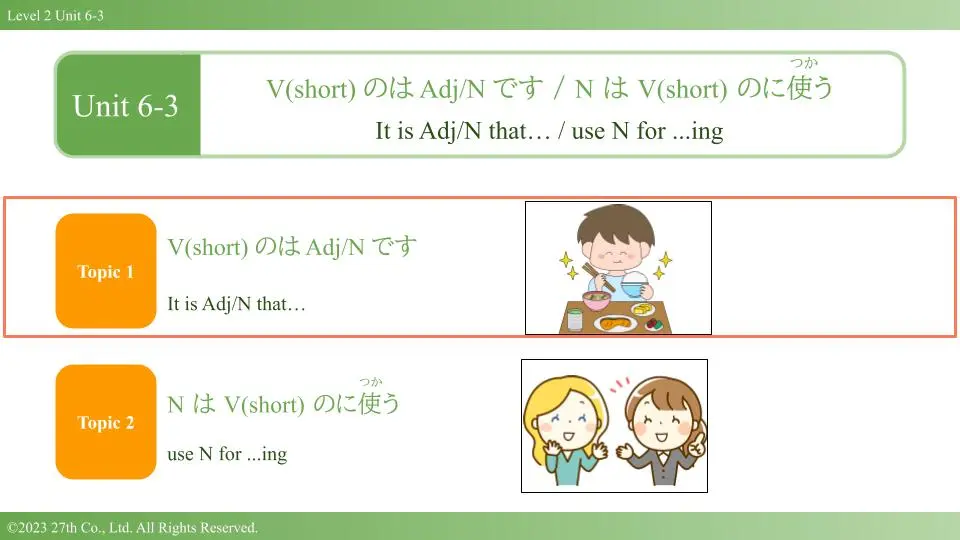
The go-to expression is N は V-のに つかいます/べんりです/いいです.
Here, のに means “for …-ing,” and it lets you describe the purpose or usefulness of any tool or object.
Let’s break it down!
1. Structure and Meaning
Core pattern
Pattern: N は V(plain) + のに つかいます
Meaning: We use N for V-ing
Example:

この はさみ は 紙を 切るのに 使います。
These scissors are used for cutting paper.
The の here acts as a nominalizer, turning the preceding verb phrase into a noun-like clause, which then functions as the object of に to indicate purpose.
So, V-るの literally means ‘the act of V-ing’.
Evaluation variants
We can also talk about “evaluation” of objects by using words such as いいです (good) and 便利です (convenient) in the latter part of the sentence.
Pattern: N は V(plain) + のに べんりです / いいです
Meaning: N is convenient / good for …-ing
Example:

このスマホは大きいので、映画を見るのに便利です。
This smartphone is large, so it’s convenient for watching movies.
2. How to Form It
- Choose the tool (Noun) and the action (Verb).
- Put V into its plain (short) form, then add のに.
- Add つかいます (or べんりです / いいです) after のに.
Example: この辞書は 日本語を調べるのに つかいます。= We use this dictionary for looking up Japanese.
N は N に つかいます vs. N は V-のに つかいます
- N は N に つかいます: Used when the purpose is a direct noun. Use に (no のに).
- この辞書は 日本語の勉強に つかいます。= This dictionary is used for Japanese study.
- N は V-のに つかいます: Used when the purpose is an action described by a verb.
- この辞書は 日本語を調べるのに つかいます。 = This dictionary is used for looking up Japanese.
- V-のに vs. V-ために: Both can express purpose, but they are used a little differently.
- V-ために is more general and often expresses the goal or purpose of an action.
- V-のに often highlights the usefulness, suitability, or necessity of something for doing that action.
- V-のに commonly appears with verbs and adjectives such as:
- つかいます
- べんりです
- いいです
3. Example Sentences

このスプーンはスープを飲むのにつかいます。
We use this spoon for drinking soup.

ノートパソコンはレポートを書くのにべんりです。
A laptop is convenient for writing reports.

クレジットカードはオンラインで買い物をするのにいいですよ。
A credit card is good for shopping online.

スマホは地図を見るのに欠かせません。
A smartphone is indispensable for checking maps.

飛行機は海外へ旅行するのに最速です。
An airplane is the fastest way for traveling abroad.

このアプリはスペイン語を勉強するのに役立ちます。
This app is useful for studying Spanish.
4. Practice Time!
Make sentences with the pattern “NはVのに…“
| Tool (N) | Action (V) | Evaluation | Example sentence |
|---|---|---|---|
| めがね (glasses) | 文字を読む (read characters) | べんり | めがねは文字を読むのにべんりです。 |
| パソコン (personal computer) | 仕事をする (do one’s job) | つかう | パソコンは仕事をするのにつかいます。 |
| 辞書 (dictionary) | 単語を調べる (Look up a word) | いい | 辞書は単語を調べるのにいいです。 |
5. Common Mistakes
| ❌ Wrong | Why it’s wrong | ✅ Fix |
|---|---|---|
| ご飯を食べるにスプーンをつかいます。 | A verb phrase needs のに, not に. | ご飯を食べるのにスプーンをつかいます。 I use a spoon to eat rice. |
| この辞書は日本語の勉強のにいいですよ。 | Use に (no のに) for a direct noun. | この辞書は日本語の勉強にいいですよ。 This dictionary is good for studying Japanese. |
6. FAQ
- QCan I use past tense or negative forms with the verb before のに?
- A
In this pattern, the verb immediately before のに is normally put in the plain non-past form.
That is because this part expresses the purpose / action itself (for example, “to cut,” “to read,” “to study”), not the tense of the whole sentence.
So the tense of the sentence is usually shown by the final part of the sentence, such as:
- つかいます / つかいました
- 時間がかかります / 時間がかかりました
Example:
- この辞書は日本語を調べるのにつかいます。= We use this dictionary for looking up Japanese.
- 日本語を勉強するのに時間がかかりました。= It took time to study Japanese.
- QIs it always つかいます? Can I use other verbs or adjectives with N は V-のに?
- A
つかいます is just one common pattern. You can also use V-のに with other verbs and adjectives to talk about usefulness, suitability, necessity, or evaluation.
- N は V-のに便利です (N is convenient for V-ing)
- N は V-のにいいです (N is good/suitable for V-ing)
- N は V-のに役立ちます (N is useful for V-ing)
- N は V-のに必要です (N is necessary for V-ing)
Conclusion
Now you can confidently explain purposes and usefulness with N は V-のに つかいます / べんりです / いいです:
- ✅ Remember のに = “for …-ing” with verb phrases.
- ✅ Use plain V before のに; use に (no のに) when the purpose itself is a noun.
- ✅ Watch out for common particle mix-ups.
Pick three items around you and describe what each is used for using today’s pattern—your Japanese will become instantly more descriptive!