
Video
Let’s watch this short video for a quick overview.
Source: gokigen japanese official YouTube Channel
Introduction
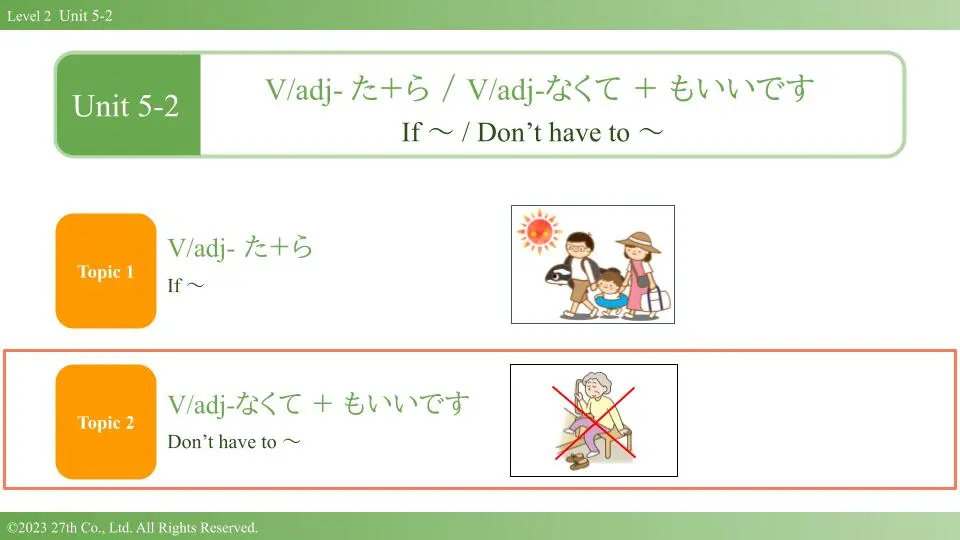
Want to say “If…” or “When…” in Japanese?
Then it’s time to learn the たら-form:
👉 V / adj / noun (short past) + ら
This grammar lets you express conditional situations or what happens after a certain event.
Let’s look at how it works!
1. Meaning
💡 Pattern: V / adj / noun (short past) + ら, 〜 = If / When 〜
This pattern is used for:
- Conditions: “If it rains, I won’t go.”
- Sequences: “When I get home, I’ll call you.”
- Hypotheticals: “If I were a cat, I’d sleep all day.”
In an A たら B sentence, A has to occur before B. Or to put it another way, A has to occur in order for B to occur and B will always occur after A.

A たら B implies that B is true provided A is true / happens. Depending on context, this could be translated as ‘if A then B’, or ‘when A, then B’.
2. How to Form the たら Form
- Step1: Take the short past form of a verb , adjective or noun
- Step2: add ら
Affirmative
| Base Form | Short Past | たら-form |
|---|---|---|
| 行く (to go) | 行った | 行ったら |
| する (to do) | した | したら |
| 高い (expensive) | 高かった | 高かったら |
| 雨 (rain) | 雨だった | 雨だったら |
Negative
| Base Form | Short Past | たら-form |
|---|---|---|
| 行かない (not to go) | 行かなかった | 行かなかったら |
| しない (not to do) | しなかった | しなかったら |
| 高くない (not expensive) | 高くなかった | 高くなかったら |
| 雨じゃない (it’s not rainy) | 雨じゃなかった | 雨じゃなかったら |
If you need a refresher on plain past tense conjugation, see these articles.
- Past Tense Plain Form (Short Form) – Verbs
- Past Tense Plain Form (Short Form) – Adjectives and Nouns
3. Example Sentences
Hypotheticals

私が鳥だったら、空を飛びたいです。
If I were a bird, I’d want to fly in the sky.

私が猫だったら、一日中 寝ているでしょう。
I would sleep all day if I were a cat.
Conditions

暑かったら、ネクタイをしません。
If it’s hot, I won’t wear a tie.

高くなかったら、その靴を買います。
If it’s not expensive, I’ll buy those shoes.

雨が降らなかったら、公園に行きます。
If it doesn’t rain, I’ll go to the park.
Sequences

授業が終わったら、電話します。
I’ll call you when class ends.

宿題が終わったら、遊びましょう。
Let’s play once we finish the homework.
4. Practice Time!
Talk about what you would do in the following situations, using たら.
| Situation | Answer |
|---|---|
| 友だちが家に来る / お茶をいれる | 友だちが家に来たら、お茶をいれます。 If my friends come over, I’ll make some tea. |
| ショッピングモールに行く / シャツを買いたい | ショッピングモールに行ったら、シャツを買いたいです。 If I go to the shopping mall, I want to buy a shirt. |
| 高くない / そのかばんを買う | 高くなかったら、そのかばんを買います。 If it’s not expensive, I’ll buy that bag. |
| 暑い / ネクタイをしない | 暑かったら、ネクタイをしません。 If it’s hot, I won’t wear a tie. |
| 宝くじに当たる / 車を買いたい | 宝くじに当たったら、車を買いたいです。 If I win the lottery, I want to buy a car. |
| 日本語が上手になる / 日本語のマンガを読みたい | 日本語が上手になったら、日本語のマンガを読みたいです。 If I become good at Japanese, I want to read Japanese manga. |
5. Common Mistakes
Using dictionary form instead of short past
- 宿題が終わったら → ✅ OK
- 宿題が終わるら → ❌ NG
Using たら for reversed sequence
- 「スピーチがあったら、練習したほうがいい」→ ❌ NG
- ✅ Use なら instead, because B happens before A
Using past tense in B for a controllable action
In AたらB, B usually comes after A.
If B is in the past tense, it often describes something uncontrolled / unexpected that you noticed after A happened (a discovery), not a deliberate action.
✅ Natural (discovery / not controlled):
- 外に出たら、雨が降っていました。= When I went outside, it was raining.
- 家に帰ったら、だれもいませんでした。= When I got home, nobody was there.
❌ Unnatural (intentional action in past):
- 宿題が終わったら、アニメを見ました。(This sounds odd because “watching anime” is a controllable action you chose to do.)
- ✅Better ways to describe a past sequence you did intentionally: 宿題が終わった後、アニメを見ました。/ 宿題が終わってから、アニメを見ました。
- ✅ For future / planned sequence, non-past B is fine: 宿題が終わったら、アニメを見ます。= When I finish my homework, I’ll watch anime.
6. Advanced Note: たら vs なら
- AたらB = A happens first, then B happens
- AならB = If A is true, then B applies
⛔ So don’t use たら if B happens before A!
Example: If you have a speech presentation next week, you should practice.
- Wrong: 来週スピーチがあったら、練習したほうがいい。
- Correct: 来週スピーチがあるなら、練習したほうがいい。
In this example, the order of actions is: first you practice (B), and then you have a speech (A).
たら cannot be used for this sentence, because B (you practice) happens before A (have a speech).
7. Note: “もし” is optional
You can optionally add もし at the beginning of a たら sentence to emphasize “if”.
However, もし is not required—a sentence is still natural without it.
もし雨が降ったら、キャンプに行きません。 / 雨が降ったら、キャンプに行きません。
If it rains, I won’t go camping.
FAQ – Frequently Asked Questions
- QHow is 〜たら different from other “if” conditionals like 〜と (to) and 〜ば (ba)?
- A
- 〜たら: Implies a definite completion of the preceding action/condition before the consequence. It’s versatile for both specific, one-time conditions (“If/When I arrive…”) and hypothetical situations.
- 〜と: Implies an automatic or natural result every time the condition is met (“When/If you turn the key, the car starts”). It’s often used for universal truths or regular occurrences.
Example: その薬を飲むと、元気になりますよ。= If you take that medicine, you’ll feel better. - 〜ば (ba): Often expresses a general condition or a suggestion (“If you study, you’ll pass”). It can sound slightly more formal or academic than 〜たら in some contexts.
Example: その薬を飲めば、元気になりますよ。= If you take that medicine, you’ll feel better.
- QCan I use 〜たら for things that didn’t happen (counterfactuals) or for wishes?
- A
Yes, 〜たら is commonly used for counterfactuals (things that didn’t happen) or to express wishes for something different, especially when combined with expressions like 〜よかった (yokatta – “it would have been good if…”) or 〜のに (noni – “even though/despite”).
- もし時間があったら、もっと勉強したかった。 (Moshi jikan ga attara, motto benkyō shitakatta.) – “If I had had time, I would have wanted to study more.”
- 雨が降らなかったらよかったのに。 (Ame ga furanakattara yokatta noni.) – “I wish it hadn’t rained (but it did).”
- QCan 〜たら be used for requests or commands in the result clause?
- A
Yes, absolutely! 〜たら is very commonly used when the result clause is a request, suggestion, command, or prohibition.
- Example (request): もし時間がなかったら、連絡してください。 (Moshi jikan ga nakattara, renraku shite kudasai.) – “If you don’t have time, please contact me.”
- Example (suggestion): 疲れたら、休んだほうがいいですよ。 (Tsukaretara, yasunda hō ga ii desu yo.) – “If you’re tired, you should rest.”
- Example (command): そこに行ったら、これを渡して。 (Soko ni ittara, kore o watashite.) – “When you go there, hand this over.”
- QWhat’s the difference between “〜たらどうしますか” and “〜たらどうですか”?
- A
- 〜たらどうしますか asks about your reaction or action: “What will you do if/when A happens?”
- 宝くじに当たったら、どうしますか。= What will you do if you win the lottery?
- 〜たらどうですか is a suggestion/advice: “Why don’t you…?” / “How about…?”
- 少し休んだらどうですか。= Why don’t you take a short break?
- 〜たらどうしますか asks about your reaction or action: “What will you do if/when A happens?”
Conclusion
Now you can:
✅ Use 〜たら to express conditions and sequences
✅ Conjugate verbs and adjectives into たら-form
✅ Create natural “if/when” sentences in Japanese!
🎯 Challenge: What would you do if you won the lottery? Try answering in Japanese with “〜たら“.