
Video
Let’s watch this short video for a quick overview.
Source: gokigen japanese official YouTube Channel
Introduction
You already know basic “please” in Japanese—〜てください.
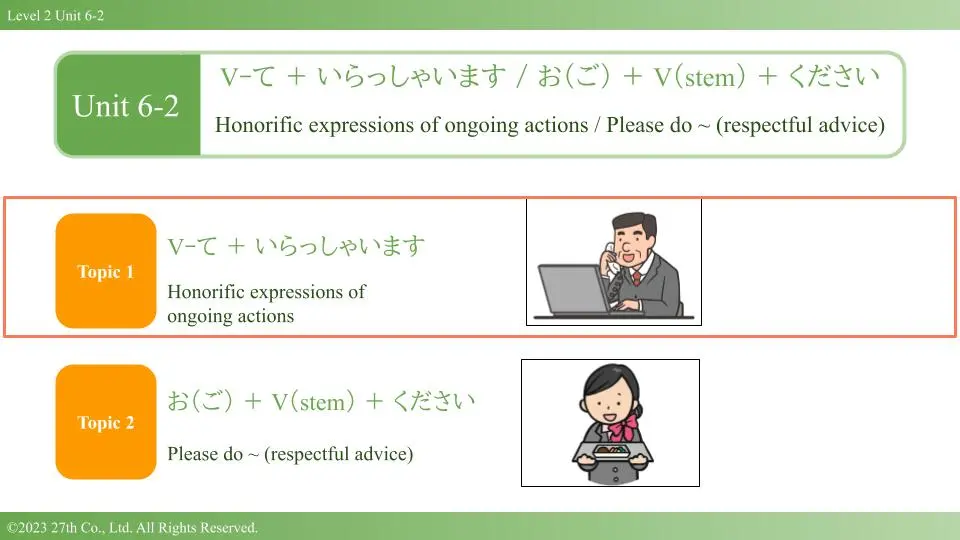
But when you must ask a customer, guest, or professor to do something, you upgrade to the respectful pattern お/ご + verb-stem + ください. It sounds gracious without being stiff. Let’s learn how to use it!
1. Structure & Meaning
Pattern
- お + verb-stem + ください
- ご + noun-する stem + ください
To create respectful requests or advice, use the お + verb stem + ください structure.
Generally speaking, verbs with two kanji characters (XXする verbs) are rather irregular;
some of them take ご, and ください follows directly after the kanji part.
Meaning
“Please kindly do … (respectfully)”
| Verb | Plain request | Respectful request | Translation |
|---|---|---|---|
| 使う (to use) | 使ってください | お使いください | Please use it. |
| 注意する (to be careful) | 注意してください | ご注意ください | Please be careful. |
| 読む (to read) | 読んでください | お読みください | Please read. |
| 召し上がる (honorific of 食べる) | 召し上がってください | お召し上がりください | Please eat it. |

Crucially, this pattern is used when you are making a request or giving an instruction to a person you respect (e.g., a customer, a teacher, your boss). The subject of the action is the listener.
2. How to Form It
- Find the verb-stem (drop ます from the polite form).
- Add お in front (or ご for many する compounds).
- Add ください after the stem.
| Step | Example (書く, to write) |
|---|---|
| ます-form | 書きます |
| Stem | 書き |
| Add お + ください | お書きください (Please write) |
Choosing お vs ご
- お → native Japanese verbs (e.g. 読む、待つ)
- Correct: お読みください、お待ちください
- We never say ご読みください、ご待ちください
- ご → most kanji + する verbs (e.g. 説明する、連絡する)
- Correct: ご説明ください、ご連絡ください
- We never say お説明ください、お連絡ください
3. Example Sentences
Train station announcement

まもなく発車します。扉にご注意ください。
The train will be departing shortly. Please be careful of the doors.
At the hotel front desk

こちらに お名前をご記入ください。
Please write your name here. (“記入 Kinyuu” means to fill in or write down information in a designated space, such as on a form, application, or document.)

チェックアウトの際は、フロントへお電話ください。
At check-out, please call the front desk.
At a cake shop, speaking to a customer

こちらは当店で 一番 人気の商品です。どうぞお召し上がりください。
This is our most popular item. Please enjoy it. (“当店” here refers to the cake shop where the speaker works.)
4. Practice Time!
Convert each cue into a respectful request.
| Plain cue | Honorific answer |
|---|---|
| 立ってください。 | お立ちください。 |
| 使ってください。 | お使いください。 |
| 相談してください。 | ご相談ください。 |
| 読んでください。 | お読みください。 |
| 連絡してください。 | ご連絡ください。 |
Challenge: Make polite requests with 入れる, 呼ぶ, 注意する.
5. Common Mistakes
| Mistake | Why it’s wrong | Fix |
|---|---|---|
| × ご座りください。 | 座る takes お, not ご. | ✓ お座りください or お掛けください (special honorific verb) |
| × お連絡してください。 | 連絡する is a する compound → ご | ✓ ご連絡ください |
| △ お食べください。 | 食べる has a special honorific 召し上がる. | ✓ お召し上がりください |
The phrase “otabe kudasai” (お食べください) is sometimes used in casual or informal speech among native Japanese speakers, and its meaning is generally understood.
However, “omeshiagari kudasai” (お召し上がりください) is a more polite and appropriate honorific expression, especially in formal settings such as restaurants or when speaking to guests. It is generally preferred.
6. FAQ
- QHow is お/ご〜ください different from the basic 〜てください?
- A
Both patterns ask someone to do something, but お/ご〜ください is significantly more respectful and formal than 〜てください.
- 〜てください is a general polite request. You use it when you want the listener to do something for your benefit, or simply because you need them to do it.
- お/ご〜ください is not just a “more polite request.” It is often used when you are encouraging the listener to do something for the listener’s own good, convenience, safety, or benefit. That is why it is common in announcements, notices, guidance, customer service, and respectful advice.
Compare:
- 三階のボタンを押してください。= Please press the button for the third floor.
- A normal request. The listener is doing something for the speaker’s purpose or need.
- 扉にご注意ください。= Please be careful of the doors.
- This is guidance/advice for the listener’s safety.
Because of this difference, you should not automatically replace every 〜てください request with お/ご〜ください.
For example, in a situation where you want someone to press the elevator button for you, these are natural:
- 三階のボタンを押してください。
- 三階のボタンを押してくれませんか。
- 三階のボタンを押していただけますか。
But 三階のボタンをお押しください sounds unnatural, because お/ご〜ください is not normally used for this kind of personal request.
Note: Unlike 〜てください, お/ご〜ください does not normally have a negative form. So instead of saying something like “Please don’t …” with this pattern, Japanese uses other expressions, such as:
- 入らないでください。= Please do not enter.
- ご遠慮ください。= Please refrain from it.
- QCan I use お/ご〜ください to ask my friend or family member to do something?
- A
No, you should not. Using お/ご〜ください with friends or family members would sound overly formal, unnatural, and even sarcastic or distant. This pattern is reserved for showing respect to those above you in social status. For friends and family, stick to 〜てください or more casual request forms.
- QIs ご利用ください the same as お使いください?
- A
Yes—ご利用ください (goriyo kudasai) sounds a touch more formal and is common on public notices.
Conclusion
With お/ご + verb-stem + ください you can:
- ✅ Give respectful advice and requests to customers, teachers, or seniors
- ✅ Choose お for native verbs, ご for most する compounds
- ✅ Avoid double honorifics and prefix errors
Practice turning everyday instructions into this pattern—soon your polite Japanese will sound smooth and professional!