
Video
Let’s watch this short video for a quick overview.
Source: gokigen japanese official YouTube Channel
Introduction
Want to say “Make the room brighter,” “Make the soup spicier,” or “I made my hair shorter”?
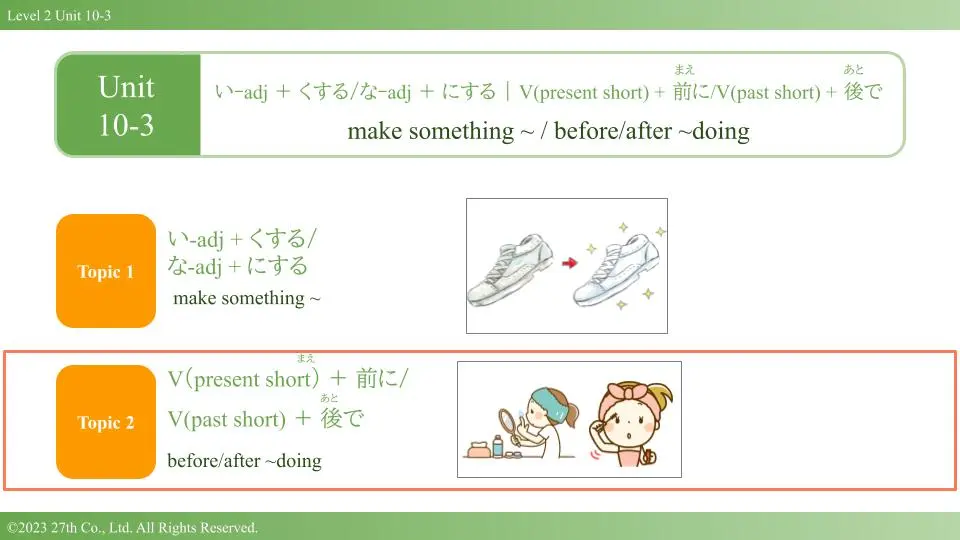
Use い-adj + くする and な-adj + にする to express “make something ~ / change something to ~.”
1. Structure & Meaning
Meaning
- To make something [adjective]
- To change something into a certain state
Form
- い-adjective (stem) + く + する
- Example: 大きくする = make (it) big
- な-adjective (stem) + に + する
- Example: きれいにする = make (it) clean
Model sentences

先生がテストを難しくしました。
The teacher made the exam difficult.

部屋をきれいにします。
I’ll make the room clean.
2. How to Form It
- Take the adjective stem (drop final い from い-adjs; drop nothing from the な-adj stem).
- Add く (for い-adjs) or に (for な-adjs).
- Add する (or any conjugation: します/しました etc.).
| step | i-adj. | na-adj. |
|---|---|---|
| 1 | おおきい (big) → おおき | しずか (quiet) |
| 2 | おおき → おおきく | しずか → しずかに |
| 3 | おおきく → おおきくする | しずかに → しずかにする |

Remember the Adjective Stems!
This is a crucial step. Always drop the final い from i-adjectives before adding く, and simply take the stem of na-adjectives before adding に. You will never see 大きいにする or 静かなにする in this pattern.
3. Example Sentences

スープをもっと辛くします。
I’ll make the soup hotter/spicier.

音を大きくしました。
I turned up the volume (made the sound louder).

待ち合わせの時間を早くしました。
We moved the meeting time earlier.

トイレをきれいにしました。
I made the restroom clean.

髪を短くしました。
I made my hair shorter.
4. Usage Notes
When to use
Use this pattern to change an object’s state (you are doing the changing).
Conjugation
You can conjugate する for tense/politeness: します/しました/してください, etc.
Idiomatic use
- 明るくする = make bright
- 静かにする = make quiet / keep quiet
- 簡単にする = simplify / make easy
- 新しくする = make (it) new → get a new one
- 優しくする = make (it) nice → be nice
- 髪を短くする = make hair short → get a hair cut
The Importance of を (wo) and Omission
The particle を (wo) clearly marks the object that you are changing.
While it can sometimes be omitted in casual conversation if the context is clear (e.g., 明るくして! – Make it bright!), remember that the underlying meaning of causing a change remains.
Active Change vs. Natural Change
When talking about changes, Japanese has two main patterns:
~ku suru / ~ni suru (You make it ~)
This pattern is for transitive (active) changes, meaning you are the one intentionally causing the change in an object.
Example: 部屋を明るくします。
I will make the room brighter.
~ku naru / ~ni naru (It becomes ~)
This pattern is for intransitive (natural/spontaneous) changes, meaning the object changes on its own or through external factors, without your direct action.
Example: 部屋が明るくなりました。
The room became brighter.
If you want to review “〜くなる / 〜になる“, read this article: How to Say “Become ~” in Japanese | Using 〜くなる and 〜になる
5. “Make it ~, please.” (polite requests)
Turn the pattern into a natural request with 〜してください:
- 部屋を明るくしてください。
Please make the room brighter. - カレーを辛くしてください。
Please make the curry spicy. - 試験を簡単にしてください。
Please make the exam easy.
If you want to review “~てください“, read this article: How to Use te kudasai(〜てください) in Japanese | Polite Request Form Explained
6. Practice Time!
Ask for a favor in the following situations using ~くする、~にする form.
Example: 部屋/明るい → 部屋を明るくしてください。
| Clue | Example Answer | Meaning |
|---|---|---|
| コーヒー/甘い | コーヒーを甘くしてください。 | Please sweeten the coffee. |
| 部屋/暖かい | 部屋を暖かくしてください。 | Please make the room warmer. |
| 待ち合わせの時間/遅い | 待ち合わせの時間を遅くしてください。 | Please make the meeting time later. |
| アプリのUI/シンプル | アプリのUIをシンプルにしてください。 | Please simplify the app’s UI. |
| 声/小さい | 声を小さくしてください。 | Please lower your voice. |
7. Common Mistakes (and quick fixes)
| Incorrect | Correct | Note |
|---|---|---|
| ❌ スープを辛いにします。 | …辛くします。 | い-adj needs く |
| ❌ この部屋をきれいくします。 | …きれいにします。 | な-adj needs に |
8. FAQ
- QWhat is the main difference between V-ku suru / V-ni suru and V-ku naru / V-ni naru?
- A
~ku suru / ~ni suru (Make it ~): You (or someone) are actively causing the change. It’s a transitive action.
~ku naru / ~ni naru (It becomes ~): The change happens naturally or spontaneously, without a direct agent, or the agent isn’t emphasized. It’s an intransitive change.
- QCan I use this pattern to change a noun into something?
- A
This pattern is specifically for changing adjectives into verbs that mean “to make something [adjective].” If you want to change a noun into another noun, you use Noun + にする (ni suru), which means “to decide on Noun” or “to make (something into) Noun.” The nuance is slightly different.
- 今日の夕食はカレーにする (kyo no yushoku ha kare ni suru / I’ll decide on curry for dinner today.)
- 水を氷にする (mizu o kori ni suru / To make water into ice.)
This uses にする, but the に here implies “into,” not the adjective-changing particle.
- QCan I say きれいにしました (kirei ni shimashita) without an object like 部屋を (heya o)?
- A
Yes, in conversation, if the object is clear from context, you can omit を + object.
- QCan I use this pattern with verbs?
- A
No, this pattern is only for adjectives. To express “make someone do something,” you would use the causative form of a verb.
- QWhat are some common practical uses for ~ku suru / ~ni suru in daily life?
- A
This pattern is extremely useful for requests and descriptions of changes you actively cause:
- Making requests: 音を小さくしてください。 (Oto o chiisaku shite kudasai / Please lower the volume.)
- Describing adjustments: 髪を短くしました。 (Kami o mijikaku shimashita / I made my hair shorter.)
- Cleaning/Organizing: 部屋をきれいにします。 (Heya o kirei ni shimasu / I’ll clean the room.)
Conclusion
You can now make things ~ in Japanese with natural, beginner-friendly building blocks:
- い-adj → くする, な-adj → にする to express a change you cause.
- Use it in requests with 〜してください (明るくしてください/簡単にしてください).
- Watch the classic く/に mix-ups and drop the final い/な correctly.
Practice by rewriting three real-life tweaks you make today (lights, volume, schedule).
The pattern will stick fast once you use it in context!