
Introduction
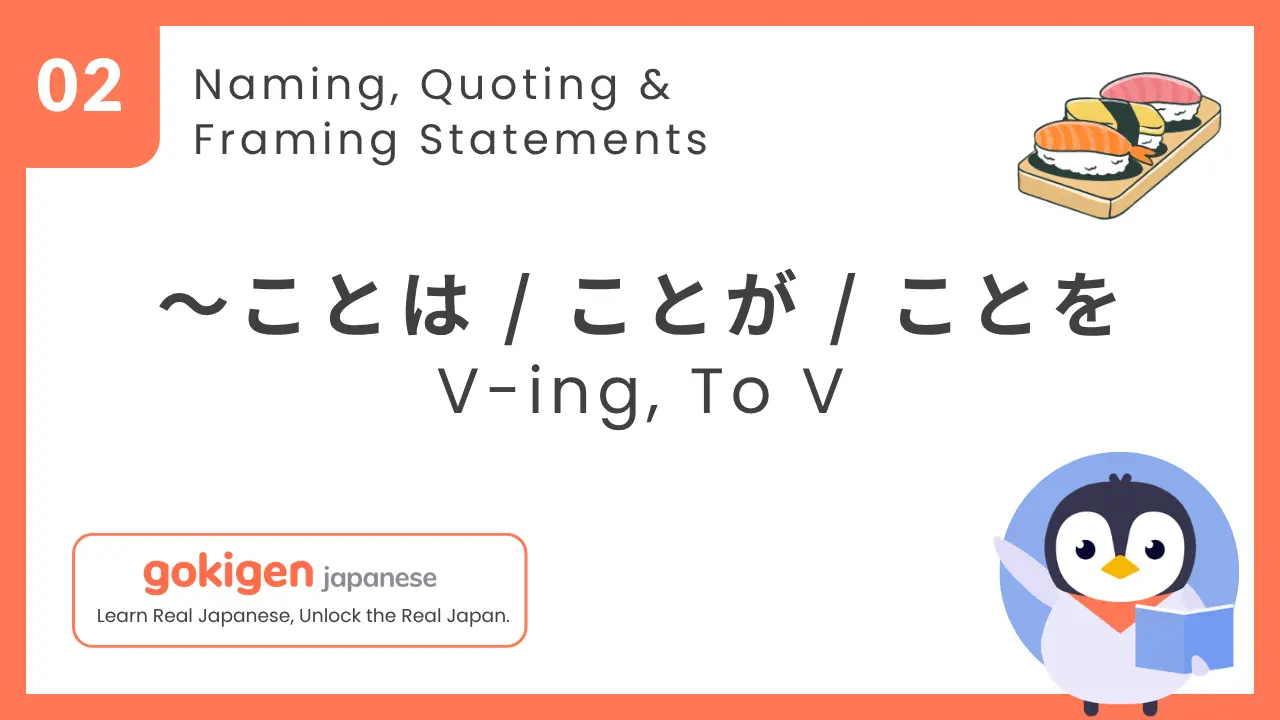
Have you ever wanted to express “the fact that [Sentence]” in Japanese?
For example:
- How do you say “Do you know that earthquakes happen every day in Japan?”
- How do you say “I was surprised that my son said he wants to study abroad”?
When you want to nominalize a whole sentence and treat it like “the fact that [Sentence]”, Japanese often uses …こと or …ということ.
1. Meaning: What do …こと / …ということ mean?
…こと and …ということ are used to turn a sentence into a noun-like expression.
They often mean: (the fact) that…
This grammar is often used with verbs such as:
- 知る / 知っている = know
- わかる = understand / realize
- 覚えている = remember
- 信じる = believe / cannot believe
Core idea
This pattern lets you take a full sentence and use it as:
- the object of a verb
- the subject of a sentence
- the topic of discussion
For example:
来月、ジョンが結婚することを知っていますか。
Did you know that John is getting married next month?
Here, “来月、ジョンが結婚する” is a full sentence, and こと turns it into something that can be the object of 知っている.
Difference between ~こと and ~ということ
Both ~こと and ~ということ can nominalize a clause, but the nuance is slightly different.
~こと refers more directly to the event, action, or state itself. It sounds more neutral and is often natural for concrete actions, habits, or experiences.
- 毎朝走ることが習慣だ。
Running every morning is my habit.
~ということ adds an extra layer of quoted or conceptualized content. It often treats the clause as information, an idea, a proposition, or a concept rather than just the event itself.
- 彼が来るということを知っていますか。
Do you know the fact / information that he is coming?
Because of this, ~ということ is often more natural when:
- the clause is long,
- the content is being treated as information,
- you are explaining a concept or definition,
- or the sentence is expressing hearsay, conclusion, or interpretation.
By contrast, for direct actions or everyday habits, ~こと is usually more natural:
- 泳ぐことが好きだ。
I like swimming. - 泳ぐということが好きだ。
→ This sounds too abstract in normal conversation.
So, in short:
- ~こと = the fact/event/action itself
- ~ということ = the content as information, an idea, or a concept
In many everyday sentences, both are possible, but ~ということ sounds a little more conceptual and less direct.
2. Formation
Basic pattern
Plain-form sentence + (という)こと
Once the sentence is nominalized, it can be followed by particles such as:
- を
- が
- は
- に
- について
By part of speech
Verb
- 午後に雨が降る(という)こと
- 彼が結婚した(という)こと
い-adjective
- あのレストランの料理がおいしい(という)こと
- 今回のJLPTが難しかった(という)こと
な-adjective
When a な-adjective is used as the predicate of a clause, である(という)こと or だということ is common.
- 家族が大切である(という)こと
- このプロジェクトが大変だということ
Note: You can also use 〜なこと like 家族が大切なこと in casual conversation, but you cannot use ❌だこと (e.g., 大切だこと). When in doubt, だということ is the safest and most natural choice for expressing facts.
Noun
When a noun is the predicate, use であること or だということ.
- ジョンさんが医者である(という)こと
- ナディさんが留学生だということ
Note: Do not use ❌だこと (e.g., 医者だこと) with nouns either.
3. Useful Examples

山田先生が結婚したことを知っていますか。
Do you know that Yamada-sensei got married?

リモートワークをする人が増えていることについて、どう思いますか。
What do you think about the fact that more people are working remotely?

一人暮らしを始めて、家事が大変であることがわかった。
After starting to live alone, I realized that housework is hard.

弟は医者だということを今日知った。
I found out today that my younger brother had become a doctor.
4. Related grammar (comparison)
…というN
…というN modifies a noun such as ニュース, うわさ, ルール.
- 子どもの数がへっているというニュース
the news that the number of children is decreasing
By contrast:
- 子どもの数がへっていることを知っていますか
Do you know the fact that the number of children is decreasing
So:
- …というN = the noun that has that content
- …ということ = the content itself as a noun-like unit
…ということだ
This looks similar, but it means “I heard that…” or “that means…”
- 天気予報によると、明日は雨だということです。
According to the weather forecast, it will rain tomorrow.
That is different from:
- 明日は雨だということを知っていますか。バーベキューは延期したほうがいいです。
Do you know it’s going to rain tomorrow? You should probably postpone the barbecue.
5. Practice
Translate the following English into Japanese using …こと or …ということ.
| English | Example Answer |
|---|---|
| I was surprised that this city is so quiet. | この町がこんなに静かだということにおどろいた。 |
| I realized that family is very important after moving abroad. | 海外に住んで、家族がとても大切であることがわかった。 |
FAQ
- QCan I use “の (no)” instead of “こと (koto)” to nominalize a sentence?
- A
Often, yes! In casual conversation, の is frequently used instead of こと (e.g., I like swimming = 泳ぐのが好き / 泳ぐことが好き).
However, when expressing complex ideas, hearsay, or using verbs like 伝える (convey) or 信じる (believe), こと / ということ is preferred.
Also, keep in mind that ということ cannot simply be replaced by というの in formal writing.
- QWhen should I definitely use “ということ” instead of just “こと”?
- A
You should use ということ when you are summarizing a long story, confirming what someone just said, or talking about a concept/definition.
It acts as a verbal “wrapper” that makes a long, complicated sentence much easier for the listener to process.
For simple, everyday physical actions (like eating, running, waking up early), just こと is more natural.
Conclusion
In this article, you learned how to use …こと and …ということ to express “the fact that [Sentence]” in Japanese.
With this grammar, you can now:
- turn whole sentences into noun-like expressions,
- say naturally that you know, remember, believe, or were surprised by something,
- and understand when longer content is often expressed more clearly with ということ.