
Video
Let’s watch this short video for a quick overview.
Source: gokigen japanese official YouTube Channel
Introduction
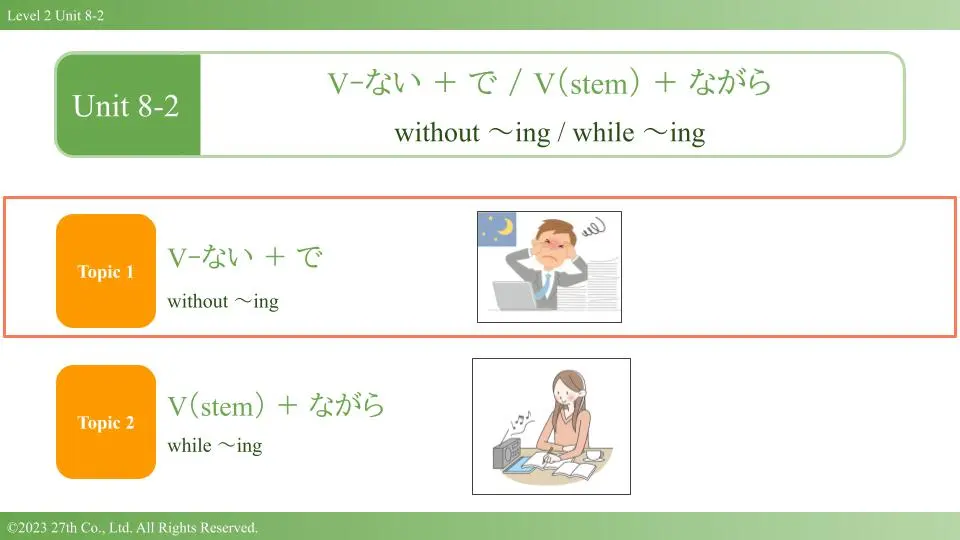
Want to say “I study while listening to music” or “Kenta is cooking while singing”?
Use V-stem + ながら.
This pattern links two actions that happen at the same time.
The action marked with ながら is the background/minor action; the clause after it is the main action you want to emphasize.
1. Structure & Meaning
Pattern: V1 (stem) + ながら, V2 (any form)
Meaning: “Do V2 while (also) doing V1.”
| Part | What it is | Example |
|---|---|---|
| V1 (stem) + ながら | Background/concurrent action | 音楽を聞きながら |
| V2 | Main action (tense/polarity as needed) | 勉強します。 |
| Full sentence | “While V1, [subject] V2.” | 音楽を聞きながら勉強します。 |

音楽を聞きながら勉強します。
I study while listening to music.

Key rule: Both actions must be performed by the same subject. If different people do the two actions, use another pattern.
Example: While Woody does shopping, Yumi cleans the room.
× ウディさんが買い物しながら、ゆみさんが部屋を掃除します。
✅ ウディさんが買い物する間、ゆみさんが部屋を掃除します。
2. How to Form It
- Take the verb’s ます-form, drop ます → this is the stem.
- Add ながら.
- Add the main clause (V2) in the tense you need.
| Dictionary | ます-form | Stem | ながら form |
|---|---|---|---|
| 食べる (to eat) | 食べます | 食べ | 食べながら |
| 話す (to speak) | 話します | 話し | 話しながら |
| 見る (to see) | 見ます | 見 | 見ながら |
| する (to do) | します | し | しながら |
| 歩く (to walk) | 歩きます | 歩き | 歩きながら |
3. Example Sentences

サラさんは歌いながら料理しています。
Sarah is cooking while singing.

歩きながら電話しないでください。
Please don’t make calls while walking.

朝ごはんを食べながらニュースを見ます。
I watch the news while eating breakfast.

アルバイトをしながら大学に通うのは大変です。
Attending college while working part-time is tough.
ラジオを聞きながら宿題をしていました。
I was doing my homework while listening to the radio.
4. Usage Notes
ながら expresses an action that occurs concurrently or simultaneously with another action.
It translates to “While doing X“.
Importantly, the action that is described with ながら is always secondary to the action expressed in the main clause.
Example:
- 飲みながら、話しましょう。(= Let’s chat while we drink.)
- In this case, chatting is the main action under discussion and drinking is a secondary action that occurs concurrently.
- 話しながら、飲みましょう。 (= Let’s drink while we chat.)
- In this case, drinking is the main action under discussion and chatting is a secondary action that occurs concurrently.
More notes:
- Same subject only: ながら cannot connect actions done by different people. Use A 時、B or two sentences instead.
- Tense lives in V2: Conjugate only the second verb. The ながら part stays in stem form.
- Example: そのとき私は、ラジオを聞きながら道を歩いていました。= At that time, I was walking down the street listening to the radio.
- Natural pairings: 歩きながら〜 / 音楽を聞きながら〜 / テレビを見ながら〜 are very common.
Note: ながら is not natural with momentary actions
ながら is used when two actions happen at the same time over some duration.
However, it is usually not natural with momentary actions such as:
- 電気をつける = to turn on the lights
- ドアを開ける = to open the door
These actions happen instantly, so they do not continue long enough to match the idea of “while doing X.”
For this type of situation, Japanese often uses ~たまま instead.
- I slept with the light on.
- ❌ 電気をつけながら寝ました。
- ✅ 電気をつけたまま寝ました。
- I talked with the door open.
- ❌ ドアを開けながら話しました。
- ✅ ドアを開けたまま話しました。
5. Practice Time!
Convert the cues using V-stem + ながら.
| Cue | Model answer |
|---|---|
| study / listen to music | 勉強しながら音楽を聞きます。 |
| watch a movie / eat popcorn | 映画を見ながらポップコーンを食べます。 |
| boil water / cut vegetables | お湯を沸かしながら野菜を切ります。 |
| walk / talk on the phone | 歩きながら電話します。 |
| work part-time / go to college | アルバイトをしながら大学に行きます。 |
Your turn: Make two of your own with 読む/運転する/掃除する.
6. Common Mistakes
| ❌ Wrong | Why it’s wrong | ✅ Fix |
|---|---|---|
| ウディさんが買い物しながら、ゆみさんが掃除します。 | Different subjects. | ウディさんが買い物する時、ゆみさんが掃除します。 When Woody goes shopping, Yumi cleans the house. |
| 食べますながらテレビを見ます。 | Use stem, not ます. | 食べながらテレビを見ます。 I watch TV while I eat. |
7. Related Grammar
- V-て + いる (progressive): describes one ongoing action, not two simultaneous actions.
- Example: 母が部屋で本を読んでいます。= My mother is reading a book in her room.
- A 時、B: use when different people do A and B, or when you want a time point (“when A, B”).
- Example: 私が部屋に入ったとき、母は本を読んでいました。= When I entered the room, my mother was reading a book.
- For Future Reference: The “Although” Meaning of ながら. While you should focus on the “while ~ing” meaning for now, be aware that ながら has a second, more advanced meaning: “although” or “despite.” This is used to show a contradiction. You’ll learn this at the intermediate level.
- Example: エミは学生でありながら、会社を経営しています。= Although Emi is a student, she runs a company.
8. FAQ
- QCan I put two ながら clauses in a row?
- A
It’s possible but heavy. Prefer one ながら + a simple connector (そして/て) for readability.
- QCan I use adjectives or nouns before ながら?
- A
No. ながら attaches to verb stems only.
- QCan two different people perform the actions in a nagara sentence?
- A
No. This is the most important rule for nagara. The subject for both verbs must be the same. If the subjects are different, you must use a different pattern like ~時 (toki) or ~間 (aida).
- QHow do I make a nagara sentence past tense or negative?
- A
You only conjugate the second (main) verb. The V-stem + nagara part never changes.
Past: 音楽を聞きながら勉強しました。 (I studied while listening to music.)
- QI’ve seen nagara used to mean “although.” Is that correct?
- A
Yes, you are correct! Nagara has two main meanings:
- While doing (simultaneous actions): This is the common beginner (N4) meaning. Example: テレビを見ながらごはんを食べました。 (I ate dinner while watching TV.)
- Although / Despite (contradiction): This is a more formal, intermediate (N3/N2) meaning. Example: ケンはそれを知りながら、何もしませんでした。 (Although Ken knew it, he did nothing.)
- QWhat is the difference between V-nagara and V-te (the te-form)?
- A
They describe the relationship between actions differently:
- V-nagara shows simultaneous actions. Both happen at the same time. Example: 歩きながら話す (to talk while walking)
- V-te shows sequential actions. One happens after the other. Example: 歩いて、話す (to walk, and then talk)
- QHow is ながら (nagara) different from 間に (aida ni)? They can both mean “while.”
- A
- nagara is for two actions happening concurrently, performed by the same person, for roughly the same duration. The main focus is on the second action.
- コーヒーを飲みながら、本を読みます。 = I read a book while drinking coffee.
- aida ni (間に) is used when a shorter action takes place during a longer background action or state. The two actions do not have to have the same duration, and the subjects can be different.
- ナンシーさんが日本にいる間に、一緒に食事に行きたいです。 = I would like to go out to eat with Nancy while she is in Japan.
- nagara is for two actions happening concurrently, performed by the same person, for roughly the same duration. The main focus is on the second action.
Conclusion
You can now:
- ✅ Build V-stem + ながら to say “while ~ing.”
- ✅ Keep the same subject rule and place the main action after ながら.
- ✅ Conjugate only the second verb for tense/politeness.
Practice by describing three things you regularly do at the same time (e.g., commute + listen to podcasts).
With ながら, your Japanese will sound natural and efficient.