
Video
Let’s watch this short video for a quick overview.
Source: gokigen japanese official YouTube Channel
Introduction
Want to say “This phone is easy to use” or “The teacher was easy to talk to”?
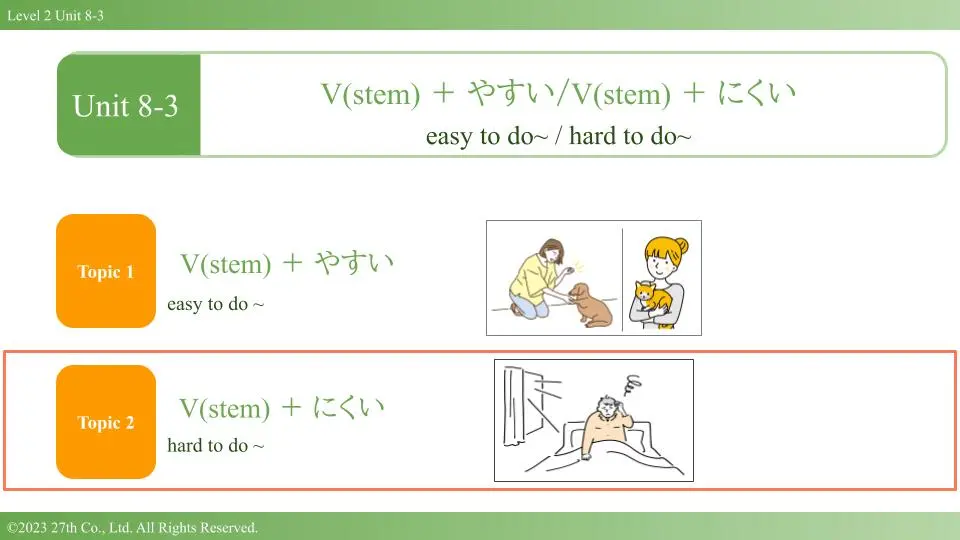
Use V-stem + やすい, a super-handy pattern that describes how easy an action is—often as a property of the thing or situation (phone, book, person, city).
1. Structure & Meaning
Pattern: V-stem + やすい
Meaning: “easy to V” / “V-able without difficulty”
Example:

このスマホは使いやすいです。
This phone is easy to use.

山田さんは とても 話しやすかったです。
Mr. Yamada was very easy to talk to.

Natural subject choice: we usually treat the thing/person/situation as the topic/subject (は/が) and describe its ease:
– この本は読みやすい。= This book is easy to read.
– この道は歩きやすい。= This road is easy to walk on.
2. How to Form It
To use the V-stem + やすい pattern, you should first change the verb to its stem form (also known as the ます-form without the ます).
Then, add やすい after it.
| Dictionary | ます-form | Stem | V-stem + やすい |
| 読む (yomu, to read) | 読みます | 読み | 読みやすい (easy to read) |
| 使う (tsukau, to use) | 使います | 使い | 使いやすい (easy to use) |
| 話す (hanasu, to speak) | 話します | 話し | 話しやすい (easy to talk/speak) |
| 飲む (nomu, to drink) | 飲みます | 飲み | 飲みやすい (easy to drink) |
| 住む (sumu, to live in) | 住みます | 住み | 住みやすい (easy to live in) |
| 食べる (taberu, to eat) | 食べます | 食べ | 食べやすい (easy to eat) |
| する (suru, to do) | します | し | しやすい (easy to do) |
| 来る (kuru, to come) | 来ます | 来 | 来やすい (easy to come) |
3. It Conjugates Like an い-Adjective
The やすい ending, as it looks, can be treated as an い-adjective and be conjugated as such:
| Form | Conjugation | Example |
|---|---|---|
| Present (polite) | 〜やすい | このペンは書きやすいです。 This pen is easy to write with. |
| Negative | 〜やすくない | このペンは書きやすくないです。 This pen is not easy to write with. |
| Past | 〜やすかった | このペンは書きやすかったです。 This pen was easy to write with. |
| Past negative | 〜やすくなかった | このペンは書きやすくなかったです。 This pen was not easy to write with. |
| Noun-modifier | 〜やすい + N | 書きやすいペン an easy-to-write-with pen |

このペンは書きやすいですか。ー はい。
Is this pen easy to write with? – Yes.
4. Examples You’ll Actually Say

エミさんの字は読みやすいです。
Emi’s handwriting is easy to read.

大阪は生活しやすいです。
Osaka is easy to live in.

このコップは持ち手が大きくて飲みやすいです。
This cup is easy to drink from because the handle is big.

リーさんは とても話しやすかったです。
Mr. Lee was very easy to talk to.
5. Nuance & Usage Tips
Property of the object/situation
読みやすい本 ≒ a book that (because of font/structure) is easy to read.
Common with tendencies
~やすい isn’t just for actions.
It’s perfect for describing an object’s or person’s natural tendency.
In English, this often translates to “-able,” “prone to,” or “tends to.”
- 壊れやすい (fragile)
- 汚れやすい (prone to getting dirty)
- 忘れやすい (forgetful)
- 太りやすい (prone to weight gain)
Spelling
Write やすい in kana (e.g. 読みやすい / easy to read).
Don’t use 安い (cheap).
Partner grammar
The opposite grammar is V-stem + にくい (hard to V).
If you want to learn more, read this article: V-stem + にくい: Beginner’s Guide to Saying “Hard to Do” in Japanese
Not only physical, but also psychological
~やすい is often used not only for physical ease, but also for psychological or social ease. For example:

あの居酒屋は、女性一人でも入りやすい雰囲気があります。
That izakaya (Japanese bar/pub) has an atmosphere that makes it easy even for a woman to go in alone.

田中先生はいつもおだやかなので、話しかけやすいです。
Mr. Tanaka is always calm, so it’s easy to talk to him.
6. Practice Time!
Change the prompts into V-stem + やすい sentences.
| Cue | Model answer | Meaning |
|---|---|---|
| このスマホ/使う | このスマホは使いやすいです。 | This smartphone is easy to use. |
| そのペン/書く | そのペンは書きやすいです。 | That pen is easy to write with. |
| トムさんの字/読む | トムさんの字は読みやすいです。 | Tom’s handwriting is easy to read. |
| 日本/生活する | 日本は生活しやすいです。 | Japan is easy to live in. |
| おにぎり/食べる | おにぎりは食べやすいです。 | Onigiri is easy to eat. |
Your turn:
- この道/歩く
- このアプリ/使う
- 先生/話す
7. Common Mistakes
| ❌ Wrong | Why | ✅ Fix |
|---|---|---|
| この本は読みやすです。 | Missing い (it’s an i-adj). | この本は読みやすいです。 |
| 読み安い本 | 安い = cheap. | 読みやすい本 = easy-to-read book |
8. FAQ
- QWhat is the opposite of V-yasui (easy to do)?
- A
The direct opposite is V-stem + にくい (nikui), which means “hard to do.” It follows the exact same grammatical rules: it attaches to the verb stem and conjugates like an i-adjective.
この本は読みやすいです。 (This book is easy to read.)
この本は読みにくいです。 (This book is hard to read.)
- QWhat’s the difference between やすい (yasui) and 簡単 (kantan)? They both mean “easy.”
- A
V-やすい attaches to a verb to describe the ease of a specific action related to an object or situation. It’s about doing something. Example: このパソコンはつかいやすい。 (This PC is easy to use.)
簡単 (かんたん, kantan) is a na-adjective that describes a task, problem, or process as a whole. It’s about the overall simplicity. Example: このテストは簡単でした。 (This test was easy.)
- QCan I use -yasui to describe my own ability, like “I find it easy to speak Japanese”?
- A
Not quite. Saying 日本語は話しやすいです (Nihongo wa hanashiyasui desu) means “Japanese is an easy language to speak” (a general property of the language). It doesn’t describe your personal skill. To talk about your own ability, it’s more natural to use words like 得意です (tokui desu; I’m good at it) or 上手です (jouzu desu; is skillful).
- QDoes こわれやすい (kowareyasui) mean someone finds it “easy to break”?
- A
It means the object itself is “prone to breaking” or “fragile.” This is a key nuance of -yasui. It can describe an inherent quality or tendency. For example, ガラスのコップはこわれやすい (Glass cups are fragile).
- QHow do I make V-yasui negative or past tense?
- A
You conjugate it exactly like a regular i-adjective (like oishii or atarashii).
Present Negative: 使いやすくないです (tsukaiyasukunai desu) – It’s not easy to use.
Past Tense: 使いやすかったです (tsukaiyasukatta desu) – It was easy to use.
Past Negative: 使いやすくなかったです (tsukaiyasukunakatta desu) – It wasn’t easy to use.
Conclusion
You can now:
- ✅ Build V-stem + やすい for “easy to do”
- ✅ Conjugate it like an i-adjective and modify nouns
- ✅ Use it naturally to describe objects/people/places (not your ability)
Next, contrast it with V-stem + にくい (hard to do) to describe difficulty with the same clarity.