
Video
Let’s watch this short video for a quick overview.
Source: gokigen japanese official YouTube Channel
Introduction
Want to say things like:
- “I intend to study tomorrow”
- “I don’t intend to eat mochi on New Year’s”
- “I plan to go to Japan someday”
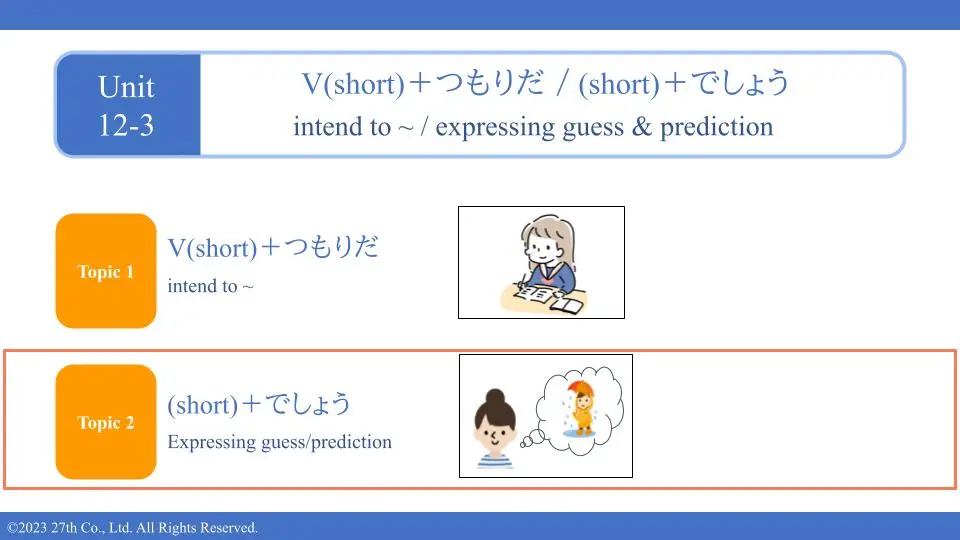
In Japanese, to express your intention or plan, you use:
V(short form)+つもりだ
= I intend to ~ / I plan to ~
Let’s break down how to use this form to talk about what you do — or don’t — plan to do!
1. Grammar Structure
Pattern
Verb (short form) + つもりです
〜つもりだ is the plain form and 〜つもりです is the polite form. This article will focus on the polite form.
Example
| English | Japanese |
|---|---|
| I intend to study. | 勉強するつもりです。 |
| I intend not to eat rice cakes. | おもちを食べないつもりです。 |
| I intend to go to the hospital. | 病院に行くつもりです。 |
2. How to Form It
To express what you intend to do using V(short) + つもりだ, follow these steps:
- Change the verb into the short present form (affirmative or negative)
- Add つもりです after the verb
Examples:
| Verb | つもり |
|---|---|
| 食べる (to eat) | 食べるつもりです。 I intend to eat. |
| 行かない (not to go) | 行かないつもりです。 I don’t intend to go. |
| 帰る (to return) | カナダに帰るつもりです。 I plan to go back to Canada. |
3. Positive & Negative Use
| English | Japanese |
|---|---|
| I intend to eat breakfast. | 朝ご飯を食べるつもりです。 |
| I don’t intend to go on a trip. | 旅行しないつもりです。 |
| I plan to make a cake. | ケーキを作るつもりです。 |
| I don’t plan to sleep early. | 早く寝ないつもりです。 |
4. Example Sentences

今年は日本語を勉強するつもりです。
I intend to study Japanese this year.

お正月はおもちを食べないつもりです。
I don’t intend to eat mochi on New Year’s.

来週、飛行機に乗るつもりです。
I plan to board a flight next week.

将来は、日本に住むつもりです。
I intend to live in Japan in the future.

来月、日本へ旅行するつもりです。
I’m planning to travel to Japan next month.
5. Practice Time!
Convert the following into つもりです form:
| Prompt | Answer |
|---|---|
| 朝ごはんを食べます。 | 朝ご飯を食べるつもりです。 |
| ピアノを練習します。 | ピアノを練習するつもりです。 |
| ケーキを作ります。 | ケーキを作るつもりです。 |
| 日本語を勉強します。 | 日本語を勉強するつもりです。 |
| 飛行機に乗ります。 | 飛行機に乗るつもりです。 |
Bonus – Negative Form Practice
| Prompt | Answer |
|---|---|
| 正月は旅行しません。 | 正月は旅行しないつもりです。 |
| お酒を飲みません。 | お酒を飲まないつもりです。 |
6. Advanced Tips
Past Intention
By using the past tense of つもり (つもりだった / つもりでした), you can express “I intended to / I planned to (in the past).” It’s important to note that this past intention might not have actually come to fruition.
Example: わたしは大学三年生のとき、銀行に就職するつもりでした。= When I was in my third year of college, I was planning to work for a bank.
This sentence implies that although he or she was considering getting a job at a bank at the time, that didn’t actually happen.
〜つもりです is not commonly used in questions
While 〜つもりです is not grammatically wrong in questions, it is less commonly used that way in natural conversation.
Example: asking a friend about their plans for this weekend.
- 今週末、何をするつもりですか。
- This is correct, but many native speakers feel that the simpler:
- 今週末、何をしますか。
- sounds more natural and casual.
However, using 〜つもりです in the answer is completely natural:
- 彼氏と映画を見に行くつもりです。
= I’m planning to go see a movie with my boyfriend.
In short, 〜つもりです is more natural for stating your intention than for asking about someone else’s plans.
Using 〜つもりです in responses
You can use 〜つもりです to respond to a question about future plans or intentions.

ゴールデンウィークは旅行に行きますか。
Are you going on a trip during Golden Week?

はい、そのつもりです。
Yes, that’s my plan.
This is a natural and concise way to confirm your intention without repeating the full sentence.
When 〜つもりです cannot be used
〜つもりです is used for intentions or plans that already exist. It is not used for decisions made on the spot.
A: あ、今日は図書館が休みですね。= Oh, the library is closed today.
B: じゃあ、カフェで勉強するつもりです。= Then, I plan to study at a cafe.
This sounds unnatural because the decision is being made right now.
In this situation, use a plain future or volitional expression instead:
B: じゃあ、カフェで勉強します。= Then I’ll study at the cafe.
B: じゃあ、カフェで勉強しよう。= Then let’s study at the cafe.
FAQ – Frequently Asked Questions
- QCan I use this form in polite conversation?
- A
Yes! Just say つもりです instead of つもりだ for politeness.
- QCan I use this to talk about other people?
- A
Yes, but be sure it’s based on what they said or expressed. Example:
山田さんはこの会社を辞めるつもりです。次の仕事先をさがしていると言っていました。= Mr. Yamada intends to quit this company. He said he was looking for his next job.
- QHow is this different from ~たい?
- A
~たい expresses desire (“I want to…”), while ~つもり expresses plan/intention.
- 行きたいです = I want to go
- 行くつもりです = I plan to go
- QHow do I say “I intended to ~” or “I planned to ~” (referring to a past plan)?
- A
When talking about a plan or intention you had in the past, use the past tense of つもり: つもりだった (plain) or つもりでした (polite). This form is often used when the past plan did not happen for some reason.
- 昨日、勉強するつもりでしたが、友達が来たのでできませんでした。(Kinou, benkyou suru tsumori deshita ga, tomodachi ga kita node dekimasen deshita.) = I intended to study yesterday, but my friend came over so I couldn’t.
- 早く帰るつもりだったのに、会議が長引いた。(Hayaku kaeru tsumori datta noni, kaigi ga nagabiita.) = Even though I intended to go home early, the meeting ran long.
- QDoes 「〜つもりだ」 always refer to a future plan? Can it have other meanings?
- A
While the most common meaning is expressing a future intention or plan, 「〜つもりだ」 (especially in the plain form) can also mean “believe that one is ~” or “act as if ~”, even if the reality is different.
Example: もう大人になったつもりで自分でやりなさい。(Mou otona ni natta tsumori de jibun de yarinasai.) = (A mother to her child) Act as if you are already an adult and do it yourself. (Uses the て-form, つもりで).
- QWhat is the difference in nuance between using 「〜つもりだ」 and just the plain/polite future tense (V-る / V-ます)?
- A
Using 「〜つもりだ / です」 generally expresses a firmer intention or more definite plan than simply using the plain or polite future tense (V-る / V-ます).
V-る / V-ない つもりだ/です: Clearly states the speaker’s personal intention or decision to do or not do something. Example: 明日、図書館に行くつもりです。(Ashita, toshokan ni iku tsumori desu.) = I intend/plan to go to the library tomorrow. (Emphasizes it is your firm plan).
V-る / V-ます: Can express a future event, a habitual action, or a weaker intention/possibility. Example: 明日、図書館に行きます。(Ashita, toshokan ni ikimasu.) = I will go to the library tomorrow. (Could be a plan, just stating a fact, or a likely event).
- QAre there any specific particles required before the verb when using 「〜つもりだ」?
- A
No, there are no special particles required before the verb specifically because you are using 「〜つもりだ」. You use the regular particles that naturally accompany the verb in its short form (e.g., を, が, に, へ, と, で, etc.) within the verb phrase, just as you would in a standard sentence or when the verb modifies a noun (relative clause). Examples:
- ケーキを作るつもりです。(Keeki o tsukuru tsumori desu.) – Uses を with 作る.
- 日本に行くつもりです。(Nihon ni iku tsumori desu.) – Uses に with 行く.
Conclusion
Now you can:
✅ Express your plans and intentions
✅ Use both affirmative and negative forms
✅ Sound natural and confident when talking about the future!
🎯 Try this:
- 来週、何をするつもりですか?
- 今度の休みにどこへ行くつもりですか?