
Video
Let’s watch this short video for a quick overview.
Source: gokigen japanese official YouTube Channel
Introduction
Want to casually list activities like:
- “I watched movies and played games”
- “I did such things as travel and eat sushi”
- “On weekends, I go running and play sports”
In English, we might say “I do things like…” or “such as…” — and in Japanese, we use:
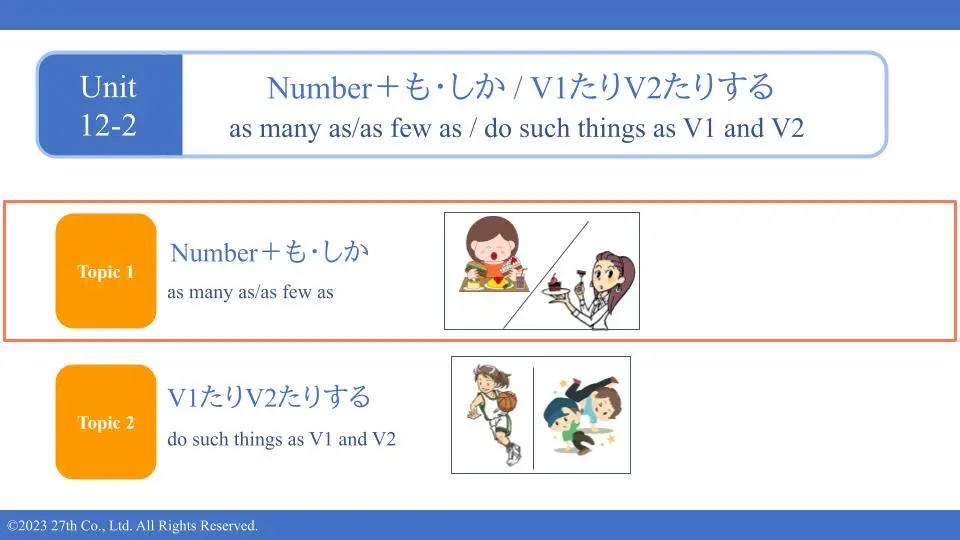
V1 たり V2 たり する
= Do such things as V1 and V2
This is a flexible and friendly way to list representative actions without naming every single thing. Let’s learn how to use it naturally!
1. Grammar Structure
Pattern
V1 (past tense short form) + たり、V2 (past tense short form) + たり する
| English | Japanese |
|---|---|
| I drink sake and chat with friends. | お酒を飲んだり、ともだちと話したりします。 |
| I went to hot springs and ate sushi. | 温泉に行ったり、すしを食べたりしました。 |
| I watched a movie and hung out with friends. | 映画を見たり、ともだちと遊んだりしました。 |
This pattern doesn’t show the exact order or everything you did — it just gives examples.
Important note about tense
Even though this pattern uses the past short form of verbs (V-た, V-だ), the overall tense of the sentence is determined by the final する.
For example:
- お酒を飲んだり、友だちと話したりします。
I drink sake and chat with friends. (habit / present) - お酒を飲んだり、友だちと話したりしました。
I drank sake and chatted with friends. (past)
The ~たり forms list example actions, but the sentence-ending verb decides whether the meaning is present, past, or future.
2. How to Form the たり-Form
Step-by-step:
- Change the two verbs into their past tense short forms.
- Replace the final た / だ with たり for each verb.
- End the sequence with する to indicate the action.
Examples:
| verb | past tense short form | たり form |
|---|---|---|
| 見る (to see) | 見た | 見たり |
| 遊ぶ (to play) | 遊んだ | 遊んだり |
| 食べる (to eat) | 食べた | 食べたり |
| 行く (to go) | 行った | 行ったり |
| 飲む (to drink) | 飲んだ | 飲んだり |
3. Variations
| Expression | Use |
|---|---|
| 〜たりします | present polite (habit) |
| 〜たりしました | past polite |
| 〜たりする | present plain |
| 〜たりしたいです | want to do such things |
4. Example Sentences

休みの時は何をしますか。
What do you do in your time off?

料理をしたり、洗濯をしたりします。
I do such things as cooking and doing the laundry.

この前の旅行で、どんなことをしましたか。
What did you do on this last trip?

お土産を買ったり、温泉に入ったりしました。
I did things like buy souvenirs and go to hot springs.

京都に行ったら、何をしたい?
What would you like to do if you visit Kyoto?

神社に行ったり、写真を撮ったりしたい。
I want to do things like visit shrines and take photos.
5. Practice Time!
Convert the pairs of verbs into たり-form, present polite (habit):
| Prompt | たり Form |
|---|---|
| 映画を見る / 遊ぶ | 映画を見たり、遊んだりします。 |
| 踊る / 歌う | 踊ったり、歌ったりします。 |
| 話す / 飲む | 話したり、飲んだりします。 |
| 勉強する / 昼寝する | 勉強したり、昼寝したりします。 |
| スポーツをする / 音楽を聞く | スポーツをしたり、音楽を聞いたりします。 |
6. Common Mistakes to Avoid
| ❌ Wrong | ✅ Correct |
|---|---|
| 食べますたり | 食べたり |
| 飲みたりました | 飲んだりしました |
💡 Use the past short form (V-た / V-だ) before attaching たり!
FAQ – Frequently Asked Questions
- QCan I use たり with just one verb?
- A
While the typical pattern is to list two or more actions (V1たり V2たり), in natural, casual Japanese conversation, you will sometimes hear just one verb followed by たり and a form of する (like 〜たりする or 〜たりしていた).
This usage serves to give just one example of the activities you did, implying that you did other things as well without explicitly listing them all. Example:
- A: 休みの日、何してたの? = What were you doing on your day off?
- B: マンガ読んだりしてた。= I was doing things like reading manga.
- This implies you read manga, but also did other unmentioned things.
So, while grammatically listing just one can feel incomplete in formal or very structured contexts, it is a way to provide a single representative example in casual conversation.
- QCan I list more than two actions?
- A
Absolutely! You can list three, four, or more actions using the 〜たり form, followed by the final する.
Example: 休みの日には、映画を見たり、本を読んだり、音楽を聞いたりします。= I do things like watch movies, read books, and listen to music.
- QHow is this different from “て-form” listing?
- A
- Vて、Vて… : Lists actions, often implying a sequence or complete list of everything that happened. The actions usually occur in the order they are listed.
- Example: ご飯を食べて、シャワーを浴びて、寝ました。(Ate dinner, took a shower, and then slept.) – Implies this was the order of events.
- Vたり、Vたりする : Lists representative actions, suggesting these are examples of things that were done among potentially others. It does not imply a specific order or that this is a complete list.
- Example: ご飯を食べたり、シャワーを浴びたりしました。(I did things like eat dinner and take a shower.) – You might have done other things too, and the order of eating/showering isn’t specified as sequential.
- Vて、Vて… : Lists actions, often implying a sequence or complete list of everything that happened. The actions usually occur in the order they are listed.
- QWhat particles (like 「を」「が」「に」「で」) are used before the verb in each 「〜たり」 clause?
- A
The particles used within each 「〜たり」 clause are the same particles that would normally be used with that verb in a regular sentence. They indicate the relationship of other nouns to the verb in that specific part of the phrase. Example:
- 家でゴロゴロしたり (Ie de gorogoro shitari – loaf around at home) – uses で for the location of action.
- 映画を見たり (Eiga o mitari – watch a movie) – uses を for the direct object.
- 友だちと遊んだり (Tomodachi to asondari – hang out with friends) – uses と for the co-participant.
- 温泉に入ったり (Onsen ni haittari – enter a hot spring) – uses に for the location entered.
- QCan I use this 「〜たり〜たりする」 pattern to list adjectives or nouns?
- A
Yes, you can use a similar structure with adjectives and nouns, but it describes a situation where something is sometimes in one state and sometimes in another, or is sometimes one thing and sometimes another, rather than just listing examples.
- い-Adjectives: Use the past tense short form (〜かった) + り.
- Example: 天気が良かったり悪かったりしますね。(Tenki ga yokattari warukattari shimasu ne.) = The weather is sometimes good and sometimes bad, isn’t it?
- な-Adjectives & Nouns: Use 〜だった + り.
- Example (Na-adjective): 彼の態度は親切だったり冷たかったりします。(Kare no taido wa shinsetsudattari tsumetakattari shimasu.) = His attitude is sometimes kind and sometimes cold.
- Example (Noun): 週末の夜ご飯は、家だったり外食だったりします。(Shuumatsu no yoru gohan wa, iedattari gaishokudattari shimasu.) = Weekend dinners are sometimes at home and sometimes eating out. (Refers to alternating locations/scenarios)
- い-Adjectives: Use the past tense short form (〜かった) + り.
- QCan the final 「する」 be changed to another verb, or can it be omitted?
- A
The final 「する」 is a core part of the pattern, but it can be conjugated for politeness (します, した, しません, etc.) or changed to express desire (したい – want to do such things) as shown in section 3.
It is generally not replaced by a completely different main verb (like 見る or 食べる) at the end of the pattern. While 「する」 can be omitted in very casual or abrupt speech, especially when the context is extremely clear, it’s usually necessary for grammatical completeness.
Conclusion
Now you can:
✅ Talk about various activities
✅ Use V-たり V-たりする to list examples
✅ Express your weekend or holiday routines naturally
🎯 Try this:
Make 3 sentences about what you do or want to do using the たり-form!