
Video
Let’s watch this short video for a quick overview.
Source: gokigen japanese official YouTube Channel
Introduction
Want to say:
- “I got up and ate breakfast”?
- “I went to the library and studied”?
- “I watched a movie and then did some shopping”?
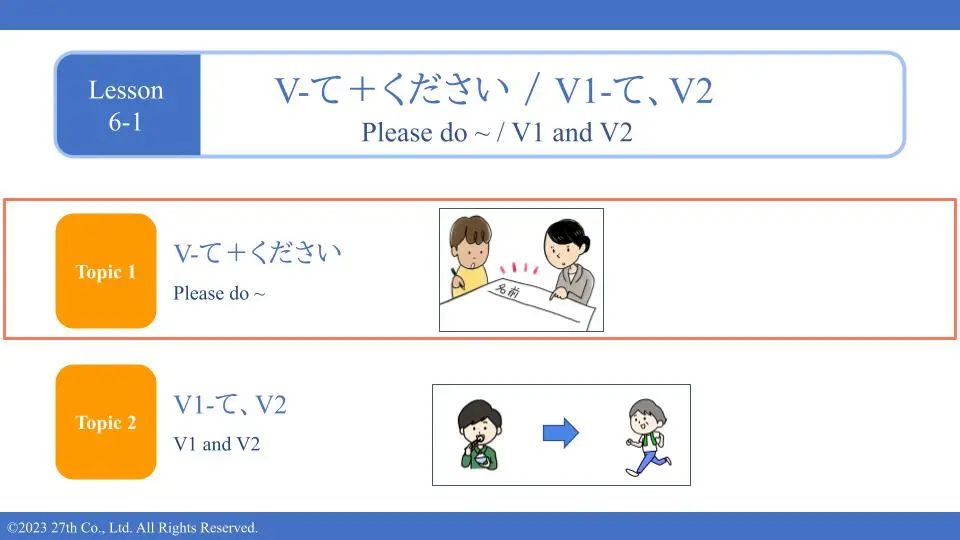
In Japanese, we use the V1-て、V2 structure to connect two or more actions that happen in sequence. It’s one of the most useful grammar patterns for everyday conversation!
In this guide, you’ll learn:
✔ How to use the て-form to connect actions
✔ When and why to use this pattern
✔ Common examples and variations
✔ How to build longer sentences like a native
1. What Is V1-て、V2?
This pattern lets you connect two verbs (V1 and V2). The first verb goes into the て-form, and the second stays in its normal form (present or past).
Basic Formula: V1 (て-form) + V2
Example:

七時に起きて、あさごはんを食べます。
I get up at seven, and then have breakfast.

図書館に行って、本を借ります。
I go to the library and borrow a book.

きのう、海に行って、泳ぎました。
I went to the beach and swam yesterday.
2. How to Make the て-form
This grammar uses the same て-form that we learned in V-てください. Here’s a quick recap:
For ru-verbs
Just drop る and add て.
| Verb | て-form |
|---|---|
| 食べる (to eat) | 食べて |
| 開ける (to open) | 開けて |
| 起きる (to wake up) | 起きて |
| 見る (to see) | 見て |
For u-verbs
| Ending | Change to… | Examples |
|---|---|---|
| う / つ / る | って | 立つ (to stand up) → 立って 帰る (to return) → 帰って |
| む / ぶ / ぬ | んで | 飲む (to drink) → 飲んで 遊ぶ (to play) → 遊んで |
| く* | いて | 書く (to write) → 書いて 聞く (to hear) → 聞いて |
| ぐ | いで | 泳ぐ (to swim) → 泳いで |
| す | して | 話す (to speak) → 話して |
* one exception (u-verbs ending with く)
| Verb | て-form |
|---|---|
| 行く (to go) | 行って |
Irregular Verbs
| Verb | て-form |
|---|---|
| する (to do) | して |
| くる (to come) | きて |
3. Important: V2 Sets the Tense (て-form doesn’t have tense)
The te-form itself doesn’t have tense. It only shows a connection or relationship between actions (like “and,” “then,” or “so”).
In Japanese, the tense of a sentence is decided by the final verb (or adjective) at the end of the sentence, not by the te-form.
Example:
| Sentence | Tense |
|---|---|
| 図書館に行って、本を読みます。 I go to the library and read books. | The te-form 行って has no tense. The final verb 読みます is present tense, so the whole sentence is present. |
| 図書館に行って、本を読みました。 I went to the library and read a book. | The past tense 読みました decides that the whole sentence is in the past. |
4. Common Examples
| V1 | V2 | Sentence | English |
|---|---|---|---|
| 朝 起きる | コーヒーを飲む | 朝起きて、コーヒーを飲みます。 | I wake up in the morning and drink coffee. |
| 新聞を読む | テレビを見る | 新聞を読んで、テレビを見ます。 | I read the newspaper and watch TV. |
| カフェに行く | 飲み物を買う | カフェに行って、飲み物を買います。 | I go to a cafe and buy a drink. |
| 電気をつける | カーテンを開けた | 電気をつけて、カーテンを開けました。 | I turned on the light and opened the curtains. |
5. Practice: Build Your Own Sentences
Try using this pattern to describe your day.
Example:
I’ll eat breakfast and go to work.
→ 朝ご飯を食べて、仕事に行きます。
I’m going to the library to study.
→ 図書館に行って、勉強します。
I went to see a movie with my friends and did some shopping.
→ 友だちと映画を見て、買い物をしました。
Last night, I listened to music and went to sleep.
→ 昨日の夜は、音楽を聞いて、寝ました。
6. FAQ – Frequently Asked Questions
- QCan I connect more than two actions?
- A
Yes! Just keep adding て-form verbs:
→ 起きて、顔を洗って、朝ご飯を食べます。
- QCan I use this with different verb tenses?
- A
Only V2 controls the overall tense. All previous verbs stay in て-form, even in past-tense sentences.
→ 学校に行って、先生に会いました。
- QCan this be used for simultaneous actions?
- A
Not exactly. V1-て、V2 shows sequence, not simultaneous actions. For simultaneous actions, use different grammar (like ~ながら for “while doing”).
- QDo I always need the comma?
- A
No — the comma is optional and mainly used in writing for readability.
Conclusion
Now you can connect actions in Japanese like a pro!
✅ Use て-form to join verbs in order
✅ Let the second verb decide the sentence tense
✅ Describe your routine, weekend, or day with natural flow
🎯 Try writing a few sentences using this pattern to describe your daily routine or your last weekend!