
Video
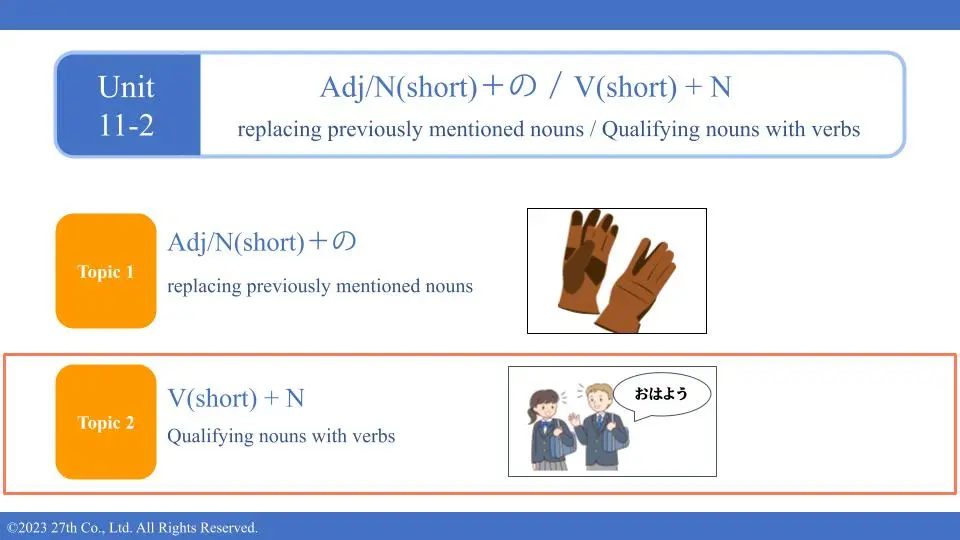
Let’s watch this short video for a quick overview.
Source: gokigen japanese official YouTube Channel
Introduction
Want to say things like:
- “I like the red one.”
- “I don’t like the expensive one.”
- “I have the brown ones.”
In English, we often drop repeated nouns by replacing them with words like “one” or “ones.” Japanese does the same — and does it beautifully — using the particle:
〜の
Let’s explore how to use adjective or noun + の to sound more natural and less repetitive in Japanese conversations!
1. Grammar Structure
Pattern: Adjective/Noun (short form) + の
| English | Japanese |
|---|---|
| I like the black car. I like the red one, too. | 黒い車が好きです。 赤いのも好きです。 |
| I often watch Japanese movies. I watch Chinese ones, too. | 日本の映画をよく見ます。 中国のも見ます。 |
| A: Do you have gloves? B: Yes, I have brown ones. | A: 手袋を持っていますか? B: はい、茶色いのを持っています。 |
Think of の like “one” in English — it replaces the noun when the meaning is clear from context.
2. When to Use This Form
✅ To avoid repeating a noun that’s already been mentioned
✅ To say “this one,” “that one,” etc., but not with demonstratives like この/その/あの
✅ With:
- い-adjectives: たかいの (expensive one)
- な-adjectives + な: しずかなの (quiet one)
- nouns: 日本の (Japanese one)
3. Examples in Action
Replacing with adjectives:

白い花が好きです。黄色いのも好きです。
I like white flowers. I like yellow ones too.

服を買いに行きましたが、いいの(=いい服)がありませんでした。
I went to buy clothes, but there were no good ones.
Replacing noun + noun:
You can also apply this to [Noun1+ Noun2] phrases, where you can omit the second noun if it’s obvious.

この店のピザはおいしいですが、あの店のはまずいです。
This shop’s pizza is delicious, but that shop’s isn’t.

私の腕時計は高くないですが、父のは高いです。
My watch isn’t expensive, but my father’s is.
[この/その/あの + Noun] phrases
Note that this sentence pattern can only be used with the [Adjective/Noun + Noun] structure. It cannot be extended to [この/その/あの + Noun] phrases.
この靴は高いですが、あれのは安いですよ。 ❌
→ × Incorrect!
この靴は高いですが、あれは安いですよ。 ✅
→ This pair is expensive, but that one is cheap.
4. How to Form It
| Example | Explanation |
|---|---|
| あかいの [red one] | い-adjective (あかい) + の |
| きれいなの [beautiful one] | な-adjective (きれい) + な + の |
| にほんの [Japanese one] | Noun (にほん) + の |
5. Practice Time!
Turn these into natural Japanese using の:
| English | Japanese |
|---|---|
| I like cold food more than hot one. | 冷たい食べ物のほうが、熱いのより好きです。 |
| A: Do you have any magazines in Japanese? B: Sorry. We do have English ones. | A: 日本語の雑誌はありますか? B: すみません。英語のはあります。 |
| I read Japanese novels. I read English ones too. | 日本語の小説を読みます。 英語のも読みます。 |
| I bought cheap meat. I also bought expensive one. | 安い肉を買いました。 高いのも買いました。 |
FAQ – Frequently Asked Questions
- QCan I use の to replace any noun?
- A
Only when the noun is already understood from context, and typically following adjectives or modifying nouns.
- QWhat’s the difference between “の” and “あれ/これ/それ”?
- A
の = replaces a noun that has been described or modified (e.g., 赤いの = the red one, 日本の = the Japanese one). It needs a word before it.
あれ/これ/それ = are demonstrative pronouns that stand alone to refer to “that one over there,” “this one,” or “that one near you,” respectively.
- QCan I use this for people?
- A
It’s possible, especially when distinguishing within a group (e.g., 背が高いの – the tall one), but it can sometimes sound less natural or slightly informal compared to keeping the noun (e.g., 背が高い人 – the tall person). For people, using the noun is often safer or more common.
- QWhy do な-adjectives require 「な」 before 「の」?
- A
This is because when a な-adjective directly modifies a noun, it requires 「な」 (e.g., きれいな花 – a beautiful flower). Even though 「の」 is replacing the noun, it acts like a stand-in noun here, so the な-adjective follows the same rule of needing 「な」 before it when preceding this noun-like 「の」.
- QCan I use this 「の」 after verbs?
- A
No, this specific use of 「の」 (replacing a noun after an adjective or modifying noun) cannot follow a verb directly. When 「の」 follows a verb, it typically acts as a nominalizer, turning the verb phrase into a noun clause (e.g., 日本語を勉強するのが好きです – I like studying Japanese). This is a different grammatical function of the particle 「の」.
- QWhat is the difference between this 「の」 and the possessive 「の」 (e.g., 私の)?
- A
They are different uses of the same particle.
- Replacement 「の」 (as covered here): Follows an adjective or modifying noun to stand in for a previously mentioned noun (e.g., 赤いの – the red one).
- Possessive 「の」: Connects a possessor to a possessed item (e.g., 私の本 – my book).
Conclusion
Now you can:
✅ Replace repeated nouns using adjective + の
✅ Speak more naturally and avoid repetition
✅ Understand when to use の vs. あれ・これ
🎯 Try this:
Make 3 pairs of sentences where you use の to avoid repeating a noun.