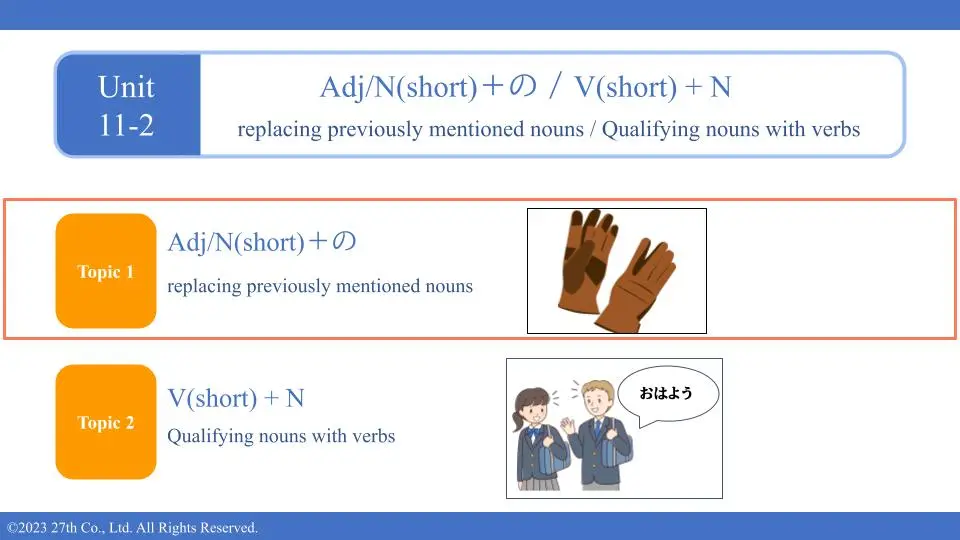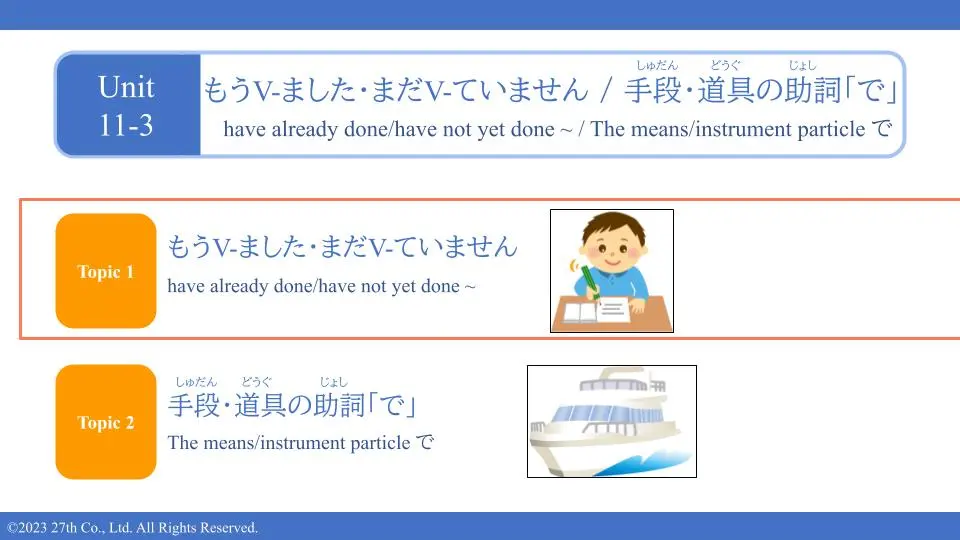

Video
Let’s watch this short video for a quick overview.
Source: gokigen japanese official YouTube Channel
Introduction
Want to say things like:
- “A student who speaks Japanese”
- “A person who doesn’t eat meat”
- “The cake I ate yesterday”
In Japanese, you can put a verb before a noun to describe it — no need for extra words like “who” or “that.”
This is called a relative clause, and the basic rule is simple:
Verb (short form) + noun
Let’s learn how to describe people and things in more detail using this powerful and natural grammar!
1. Grammar Structure
Pattern: [Verb in short form] + Noun
| English | Japanese |
|---|---|
| a student who speaks Japanese | 日本語を話す学生 |
| a person who doesn’t drink sake | お酒を飲まない人 |
| the cake I ate yesterday | きのう食べたケーキ |
No need for “who” or “that” — just place the verb before the noun!
2. What Is the Short Form?
This pattern uses the short form (a.k.a. plain form), not the polite ます-form.
| Verb Type | Example | Short Form |
|---|---|---|
| Present Positive | 食べます | 食べる |
| Present Negative | 飲みません | 飲まない |
| Past Positive | 行きました | 行った |
| Past Negative | 来ませんでした | 来なかった |
Need a review? Check back these articles: https://blog.gokigen.jp/tag/lesson-8/
3. Conjugation: How to Form the Phrase
- To qualify a noun using a verb, follow these steps:
- Conjugate the verb in its short form (either present or past tense).
- Place the noun immediately after the verb.
| English | Japanese |
|---|---|
| The person who reads manga | マンガを読む人 |
| The brother who doesn’t clean his room | 部屋を掃除しない兄 |
| The restaurant I always go to | いつも行くレストラン |
| The teacher who teaches Japanese | 日本語を教える先生 |
📝 Note: Don’t add の between the verb and noun. That’s a common mistake!
4. Expanding Your Sentences
A relative clause turns a simple noun into a “large noun phrase.” This allows you to add much more information to a single sentence.
Compare these examples:
| Level | Sentence | Meaning |
| Simple | これは写真です。 | This is a photo. |
| Detailed | これは去年 日本で撮った写真です。 | This is the photo I took in Japan last year. |
| Level | Sentence | Meaning |
| Simple | 会社に後輩がいました。 | There was a junior at work. |
| Detailed | 会社によく寝る後輩がいました。 | There was a junior who slept a lot at work. |
5. Examples
with Present Tense

中国語を話す学生がいます。
There’s a student who speaks Chinese.

毎週スキーに行く友だちがいます。
I have a friend who goes skiing every week.

ギターをひく人はかっこいいです。
People who play guitar are cool.
with Negative or Past Tense

お酒を飲まない人もいます。
There are also people who don’t drink alcohol.

きのう買ったスマホは高かったです。
The smartphone I bought yesterday was expensive.

昼ご飯を食べない先輩がいます。
There’s a senior who doesn’t eat lunch.

会社によく寝る後輩がいました。
I had a junior colleague at work who slept a lot.
6. Common Mistakes to Avoid
- Be careful not to use the long form of the verb instead of the short form.
- Do not add the particle の between the verb and the noun.
| ❌ Wrong | ✅ Correct |
|---|---|
| マンガを読むの人 | マンガを読む人 |
| きのう食べましたケーキ | きのう食べたケーキ |
💡 Again, use short form (plain form), and don’t add の between verb and noun!
7. Advanced Note: The “Ga” and “No” Switch
Inside a relative clause, the subject marker が (ga) is sometimes replaced with の (no), especially in short phrases.
- ✅ 私が好きな本 (The book I like)
- ✅ 私の好きな本 (The book I like) — Also correct!
- ✅ 私が子どもの時よく読んだ本 (The book I often read as a child)
- ❌ 私の子どもの時よく読んだ本 — In long phrases, use “が.”
Wait, didn’t you say “No の“? Be careful: You can only replace the particle after the subject. You cannot put “の” between the verb and the noun.
- ✅ 私の住んでいる家 (The house where I live)
- ❌ 住んでいるの家
Next step: describe nouns with full sentences
Now that you know the basic verb short form + noun pattern, you can go one step further and use a longer sentence before a noun.
Basic: 食べたケーキ — the cake I ate
Next: 私が昨日コンビニで買ったケーキ — the cake I bought at a convenience store yesterday
Read the next lesson: Japanese Relative Clauses: How to Describe Nouns with Sentences →
8. Practice Time!
Write natural Japanese phrases using V + N:
| English | Japanese |
|---|---|
| A friend who understands Korean | 韓国語がわかる友だち |
| A computer I always use | いつも使うパソコン |
| A teacher who teaches chemistry | 化学を教える先生 |
| A person who reads manga often | よくマンガを読む人 |
| A brother who doesn’t clean his room | 部屋を掃除しない兄 |
FAQ – Frequently Asked Questions
- QCan I use this with any verb?
- A
Yes! Just use the short form of the verb, and place it before the noun you’re describing.
- QIs this used often in daily Japanese?
- A
Yes — very often! It’s one of the most natural ways to describe people, things, and actions in conversation.
- QWhat particles do I use inside the verb phrase that is describing the noun?
- A
You use the normal particles that would accompany the verb in a regular sentence (を, が, に, で, etc.). For example:
- Subject with が: 友達が撮った写真 (The photo that my friend took)
- Object with を: ケーキを作った人 (The person who made the cake)
- Location/Direction with に/へ: 学校に行く学生 (A student who goes to school)
- Location of action with で: レストランで食べるごはん (The meal I eat at the restaurant)
One important point to note is that inside a noun-modifying clause, the subject is marked with が, not は.
- Regular sentence: 友達は写真を撮りました。= My friend took a photo.
- Noun-modifying clause: これは 友達が 撮った写真です。= This is the photo that my friend took.
- You never say「友達”は”撮った写真」
- QDoes using the short form verb in the description make the whole sentence sound casual?
- A
No, the politeness of the overall sentence is determined by the final verb or copula (です/ます/だ/である etc.). The verb within the relative clause is always in the short form regardless of the overall politeness level of the sentence.
- Casual sentence: これ、昨日買った本だね。(This is the book I bought yesterday, right?) – 「買った」 is short form, and 「だ」 makes the sentence casual.
- Polite sentence: これは、昨日買った本です。(This is the book I bought yesterday.) – 「買った」 is short form, but 「です」 makes the sentence polite.
Conclusion
Now you can:
✅ Use verbs to describe nouns
✅ Add detail with short-form verbs
✅ Avoid extra words like “who” or “that”
🎯 Try this:
Describe 3 people around you using V + N.
For example:
- 日本語を勉強する友だち
- 毎日コーヒーを飲む人