
Video
Let’s watch this short video for a quick overview.
Source: gokigen japanese official YouTube Channel
Introduction
You’ve probably already learned that から can be used to say “because” in Japanese. But did you know that there’s a softer, more polite way to say the same thing?
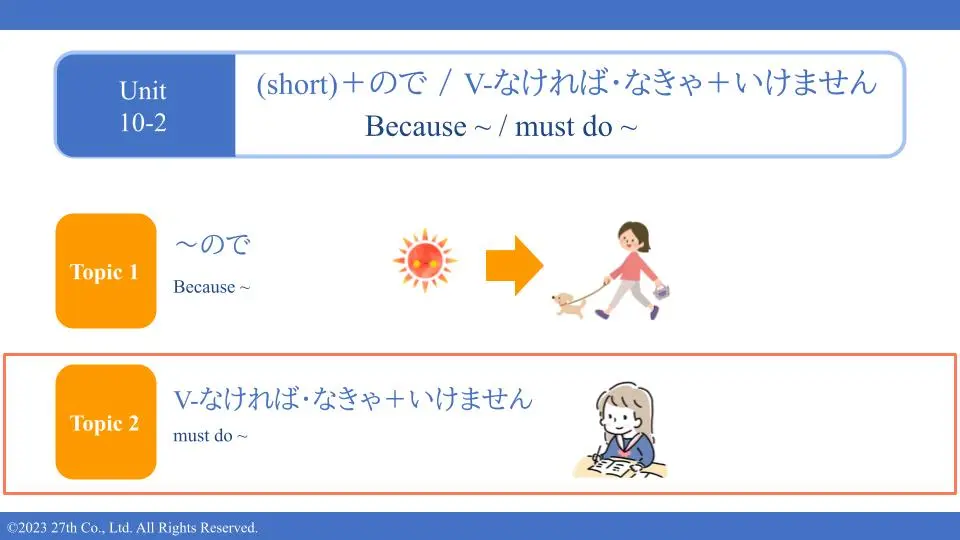
Meet 〜ので — another way to express “because,” often used in formal situations, explanations, and written language.
In this article, you’ll learn:
- How to use ~ので with verbs, adjectives, and nouns
- How it differs from 〜から
- How to sound more natural and polite in Japanese conversation
1. Grammar Pattern
Pattern: Short (Plain) form + ので
Meaning: “because / since / so”
To express “because” using ので, follow these steps:
- Conjugate the verb, adjective, or noun in its short [plain] form (either present or past tense).
- Add ので after the short form.
When using ので with な-adjectives & nouns in present tense, you have to add な before ので.
| Type | Example | Result |
|---|---|---|
| Verb | 帰る | 帰るので (because I’m going home) |
| い-adjective | 忙しい | 忙しいので (because I’m busy) |
| な-adjective | しずかな | しずかなので (because it’s quiet) |
| Noun | 学生 | 学生なので (because [they] are a student) |
2. Example Sentences

頭が痛いので、帰ってもいいですか。
I have a headache, so may I go home?

わたしはベジタリアンなので、肉を食べません。
Because I’m a vegetarian, I don’t eat meat.

今日は日曜日なので、銀行は休みです。
The bank is closed because today is Sunday.

雨が降っているので、出かけません。
Because it’s raining, I won’t go out.
3. How is ~ので Different from ~から?
While both ので and から mean “because,” they differ in tone and level of formality.
- から is more casual and is commonly used in everyday spoken language.
- It can sound more direct and expresses the speaker’s subjective reason.
- ので is generally more polite and formal.
- It is used in both spoken and written language, and it gives a softer, more objective impression.
Because of these differences:
- With friends, classmates, or family, から is far more common.
- With teachers, bosses, or people of higher status, ので often sounds more appropriate and natural.
Example Comparison:
- 時間がないから、行きません。= I’m not going because I don’t have time. (casual)
- 時間がないので、行きません。= Since I don’t have time, I won’t go. (polite)
Context: Two middle schoolers talking about a new game.
A: あのゲーム買った? – Bought that game?
B: いや、お金がないから… – Nah, no money so…
Here, “お金がないので” would sound too polite and unnatural between friends.
In casual conversations like this, から is the default choice.
4. Conjugation Reminders
| Type | ので phrase |
|---|---|
| Verb (present) | 食べる → 食べるので |
| Verb (past) | 食べた → 食べたので |
| い-adjective (present) | たのしい → たのしいので |
| い-adjective (past) | たのしかった → たのしかったので |
| な-adjective (present) | げんき → げんきなので |
| な-adjective (past) | げんきだった → げんきだったので |
| Noun (present) | 先生 → 先生なので |
| Noun (past) | 先生だった → 先生だったので |
When using ので with な-adjectives & nouns in present tense, you have to add な before ので.
5. Practice Time!
Convert the following to 〜ので sentences:
| English | Japanese |
|---|---|
| I’m tired, so I’ll sleep early. | 疲れているので、早く寝ます。 |
| It’s nice weather, so I’ll do laundry. | いい天気なので、洗濯します。 |
| I caught a cold, so I stayed home. | 風邪をひいたので、家で休みました。 |
| I received a gift, so I’m happy. | プレゼントをもらったので、うれしいです。 |
| It’s Sunday, so I’m free. | 日曜日なので、ひまです。 |
FAQ – Frequently Asked Questions
- QCan I use ~ので in casual conversation?
- A
It feels overly polite. In very casual situations, ~から is more common.
- QWhat if I forget the な for な-adjectives or nouns?
- A
Your sentence may sound awkward or grammatically wrong.
In present tense, you have to add な before ので: しずかなので、がくせいなので
- QWhy do I need な before ので with な-adjectives and nouns (e.g., 学生なので)? Why not だ?
- A
This is a specific rule for connecting present affirmative な-adjectives and nouns to ので (and also to んです/の).
While the plain form ends in だ (e.g., 学生だ), this だ changes to な when followed directly by ので.
Think of な as the required linking form in this specific grammatical context. For い-adjectives (e.g., 忙しい) and verbs (e.g., 行く), you use their standard plain forms directly before ので (忙しいので, 行くので).
- QSince ので itself sounds polite, does the final sentence ending also need to be polite (ます/です)?
- A
Generally, yes. Because ので carries a polite and somewhat formal nuance, it naturally pairs best with a polite sentence ending (using ます/です).
While you might occasionally hear it followed by a plain form sentence ending, it’s much more common and standard to maintain the same politeness level.
The examples below are listed in order of formality, from most to least.
- 日本語はおもしろいので、日本語を勉強しています。
- 日本語はおもしろいから、日本語を勉強しています。
- 日本語はおもしろいから、日本語を勉強してる。
Conclusion
Now you can express polite reasons using:
✅ Short-form verbs, adjectives, and nouns + ので
✅ Polite, formal-sounding “because”
✅ Proper use of な with nouns and な-adjectives
🎯 Try this: Write 3 polite sentences using 〜ので to explain why you’re doing (or not doing) something!