
Video
Let’s watch this short video for a quick overview.
Source: gokigen japanese official YouTube Channel
Introduction
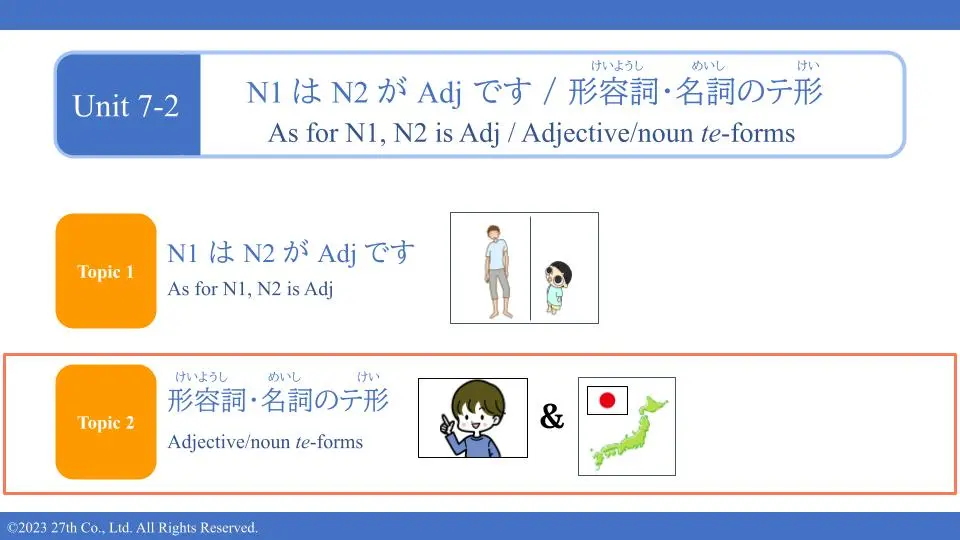
Want to say “Alice has big eyes” or “My sister has long hair” in Japanese?
There’s a simple and powerful sentence structure that lets you describe physical features and personal characteristics clearly:
N1 は N2 が Adj です
“As for N1, N2 is [adjective]”
This is one of the most natural ways to describe parts of someone or something in Japanese. Let’s learn how it works!
1. Sentence Pattern: N1 は N2 が Adj です
This pattern literally means:
“As for N1, N2 is Adj.” or “In the context of N1, N2 is Adj.”
- N1 = the topic (usually a person or thing)
- N2 = a specific part or feature of N1
- Adj = adjective describing N2
Example Sentences:

トムさんは足が大きいです。
Tom has big feet.
= As for Tom, his feet are big.

ゆいさんは髪が長いです。
Yui has long hair.
= As for Yui, her hair is long.

アリスさんは目が大きいです。
Alice has big eyes.

父は背が高いです。
My dad is tall.

先生は頭がいいです。
The teacher is smart.
2. Usage Tips: Why Use が for N2?
The が particle highlights the specific thing being described.
It answers the question: What is big / long / smart?
- Topic は → general context
- Subject が → focus of description
Think of it like this:
“As for [person], [body part or characteristic] is [adj].”
3. Common Mistake: Double “は” ❌
Be careful not to say:
❌ この犬はしっぽは長いです。
✅ この犬はしっぽが長いです。/ This dog has a long tail.
Using が properly ensures your sentence sounds natural and correct.
4. Essential Vocabulary for Describing People
Here are some useful words you can plug into the sentence pattern:
| Japanese | Meaning | Example |
|---|---|---|
| 髪 | hair | 姉は髪が長いです。 |
| 目 | eyes | 妹は目が大きいです。 |
| 足 | legs/feet | トムさんは足が長いです。 |
| 背 | height/back | メアリーは背が高いです。 |
| 頭がいい | smart | ジョンさんは頭がいいです。 |
| 速い | fast | 姉は足が速いです。 |
5. Practice Time!
Try describing these people using the pattern:
| English | Japanese |
|---|---|
| My mother has short hair. | 母は髪が短いです。 |
| My dad has a big mouth. | 父は口が大きいです。 |
| My older sister is fast. | 姉は足が速いです。 |
| Tanaka is short. | 田中さんは背が低いです。 |
6. FAQ – Frequently Asked Questions
- QCan I say “N1 の N2 は Adj です” instead?
- A
Yes, but it has a different nuance. Example:
- トムさんの足は大きいです。= Tom’s feet are big.
- Focus: The noun “feet” itself.
- Nuance: This sentence emphasizes the feet as the topic and simply describes their size — it sounds more objective or explanatory.
- トムさんは足が大きいです。= Tom has big feet.
- Focus: The person Tom.
- Nuance: “Tom” is the broader topic, while “feet” is the more specific thing that you want to describe.
- トムさんの足は大きいです。= Tom’s feet are big.
- QWhat’s the difference between は and が here?
- A
- は marks the topic of the sentence (overall context)
- が marks the subject being described (the detail)
If you want to learn more about these particles, read this article: Japanese Particles: How to Distinguish Between wa (は) and ga (が)
- QIs this structure only for physical appearance?
- A
No! You can also describe character traits or features of objects.
Examples:- このケーキはチョコレートが美味しいです。
The chocolate part of this cake is delicious. - 東京は電車が便利です。
As for Tokyo, the trains are convenient.
- このケーキはチョコレートが美味しいです。
Conclusion
The sentence structure “N1 は N2 が Adj です” is a great tool to:
✅ Describe someone’s appearance or personality
✅ Talk about specific parts or features
✅ Make your Japanese more detailed and natural
🎯 Try this: Describe 3 people around you using this pattern!