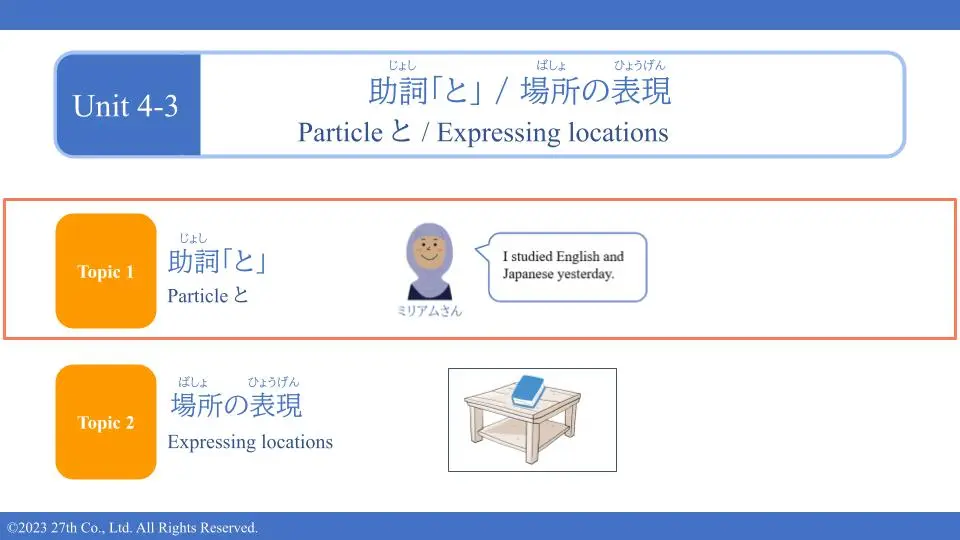

Video
Let’s watch this short video for a quick overview.
Source: gokigen japanese official YouTube Channel
Introduction
Do you want to say things like:
- The book is on the table.
- The hospital is behind the bank.
- Mr. Yamada is between the teacher and Mr. Tanaka.
In Japanese, we use special location words along with the particle に to describe where things are.
In this guide, you’ll learn how to express positions using common words like うえ(on), した(under), まえ(in front of), and many more — and how to use them naturally with に and あります/います.
Expression of location
Here are the most useful location words for describing where something is.
In front of / Behind
| Japanese | Meaning | Example |
|---|---|---|
| 前 | in front of | コンビニは駅の前です。 The convenience store is in front of the station. |
| 後ろ | behind | 駅はコンビニの後ろです。 The station is behind the convenience store. |

Inside of / Outside of
| Japanese | Meaning | Example |
|---|---|---|
| 中 | inside | スマホ は かばん の 中 です。 My smartphone is inside the bag. |
| 外 | outside | スマホ は かばん の 外 です。 The smartphone is outside the bag. |

To the right of / To the left of
| Japanese | Meaning | Example |
|---|---|---|
| 右 | to the right of | いすは テーブルの右です。 The chair is to the right of the table. |
| 左 | to the left of | テーブルは いすの左です。 The table is to the left of the chair. |

Above, On / Under
| Japanese | Meaning | Example |
|---|---|---|
| 上 | on / above | 本は つくえの上です。 The book is on the desk. |
| 下 | under | カバンは つくえの下です。 The bag is under the desk. |

Next to
| Japanese | Meaning | Example |
|---|---|---|
| となり | next to | カフェは 銀行のとなりです。 The cafe is next to the bank. |

Difference Between となり, よこ and そば
These three location words all roughly mean “next to” or “near,” but they have different nuances in Japanese.
| Word | Meaning & Usage | Example |
|---|---|---|
| となり (隣) | Refers to something of the same type or category that is directly next to another, with nothing of the same kind in between. Distance doesn’t matter much. | 隣の駅に行きます。 I’m going to the next station. |
| よこ (横) | Focuses on position or direction — something that is to the side (left or right), not in front or behind. Distance or what’s in between doesn’t matter. | ねこがいすの横にいます。 The cat is next to the chair. |
| そば (側) | Emphasizes closeness or proximity — something that is very near, regardless of exact position or direction. | 先生のそばにケンが立っています。 Ken is standing near the teacher. |
Between / Among
| Japanese | Meaning | Example |
|---|---|---|
| 間 | between | カフェは銀行と郵便局の間です。 The cafe is between the bank and the post office. |

Near
| Japanese | Meaning | Example |
|---|---|---|
| 近く | near | 駅の近くに本屋があります。 |
Useful Phrase: (location) に (object) があります
For most location expressions, you can use the pattern:
(Noun) の (location word) + に + (object) が あります/います
Examples:
- つくえの上に 本が あります。
There is a book on the desk. - いすの下に 猫が います。
There’s a cat under the chair.
Use あります for things, and います for people or animals.
However, when using あいだ (between), the structure is slightly different.
You need to use: (Noun) と (Noun) の あいだ に + (object) が あります/います
- 大学とカフェの間に コンビニが あります。
There is a convenience store between the university and the café.
Practice
Try saying or writing the following in Japanese:
There is a computer on the desk.
→ つくえの上に コンピューターがあります。
The bag is between the umbrella and the bicycle.
→ かさと じてんしゃの間に かばんがあります。
The hospital is behind the bank.
→ 病院は 銀行の後ろです。
The chair is to the right of the table.
→ いすは テーブルの右です。
✏️ Bonus: Look around your room and describe 3 things using the same structure!
Must-Know Location Words
| Japanese | Meaning |
|---|---|
| 上(うえ) | on / above |
| 下(した) | under |
| 中(なか) | inside |
| 外(そと) | outside |
| 前(まえ) | in front of |
| 後ろ(うしろ) | behind |
| 右(みぎ) | right |
| 左(ひだり) | left |
| となり | next to |
| 間(あいだ) | between |
| 近く(ちかく) | near |
Learn these 11 location words to describe almost any scene!
FAQ
- QWhat’s the difference between の and に?
- A
の connects the reference and location (e.g., つくえの上), and に marks the place of existence (e.g., 上にあります).
- QWhen do I use あります vs います?
- A
Use あります for inanimate things (books, desks, buildings), and います for living things (people, animals).
- QCan I use で instead of に?
- A
に is for location of existence, で is for location of action.
- 駅の前にカフェがあります。= There is a cafe in front of the station.
You never say “駅の前でカフェがあります.” - カフェで勉強します。= I’ll study at the cafe.
You never say “カフェに勉強します.”
- 駅の前にカフェがあります。= There is a cafe in front of the station.
Conclusion
With just a few simple patterns, you can now describe where things are in Japanese!
By mastering the sentence:
A の B に C が あります,
you can confidently talk about where objects, buildings, or even people are.
🎯 Practice 3 sentences now about items near you!