
Video
Let’s watch this short video for a quick overview.
Source: gokigen japanese official YouTube Channel
Introduction
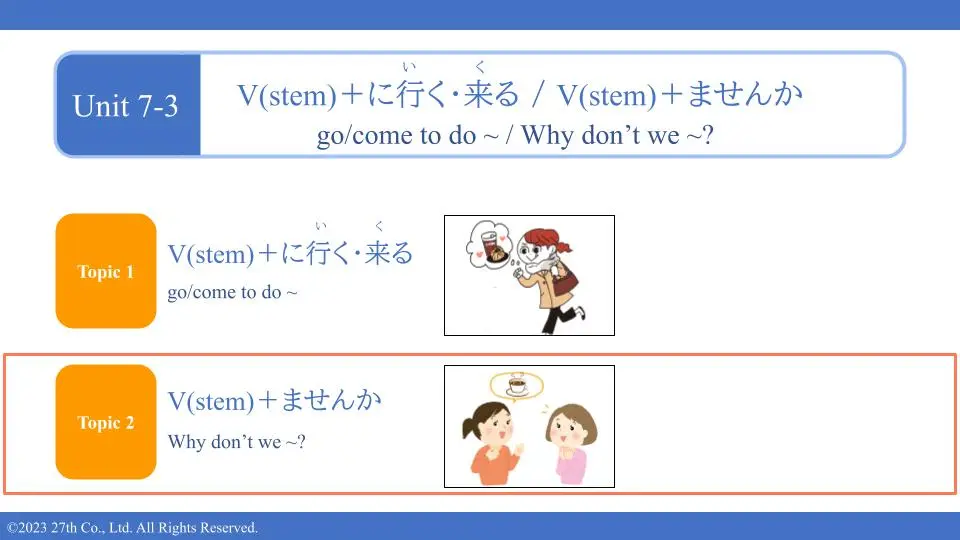
If you’ve ever wanted to say “I go to the gym to exercise” or “I came to Japan to study,” you’re in the right place. In Japanese, we express the purpose of movement using this powerful structure:
V-stem + に 行く(iku) / 来る(kuru)
“go/come to do (something)”
This is a must-know grammar point for beginners. Once you master this, you can talk about your plans, your goals, and even your weekend adventures—all in natural Japanese!
1. What Is “V-stem + に 行く / 来る”?
This structure means “to go (行く) or come (来る) somewhere to do something”.
Structure: [Destination] + に(or へ) + [verb stem] + に + 行く / 来る
For example:
- 今週末、映画を見に行きます。= I will go to see a movie this weekend.
- 私は日本に働きに来ました。= I came to Japan to work.
You’re combining two actions: the movement (go/come) and the purpose (do something).
2. How to Form It
Here’s how to build the sentence step by step:
Step 1: Use the verb stem
Drop ます from the polite form of the verb:
- 食べます (to eat) → 食べ
- 見ます (to see) → 見
Step 2: Add に + 行く or 来る
- 食べに行く → to go to eat
- 見に来る → to come to watch
3. Examples in Action

図書館に本を返しに行きます。
I will go to the library to return a book.

家に母を手伝いに帰ります。
I will return home to help my mom.

デパートに服を買いに行きます。
I’m going to the department store to buy clothes.

塾に英語を教えに行きます。
I go to the cram school to teach English.

明日、友だちが私に会いに来ます。
Tomorrow, my friend is coming to see me.
4. Bonus Tip: に and へ
You can use に or へ to mark the destination:
- 図書館に行きます ✅
- 図書館へ行きます ✅
Both are fine, but に is more direct and commonly used in this structure.
- カフェにコーヒーを飲みに行きます。(more common)
I’m going to a cafe to drink coffee. - カフェへコーヒーを飲みに行きます。
You can also note that the destination marker へ is pronounced “e,” not “he.”
5. Practice Time!
Try making sentences with these hints:
I go to the park to run.
→ 公園に走りに行きます。
I came to Japan to study.
→ 日本に勉強しに来ました。
Ken goes to Kyoto to see temples.
→ ケンさんは京都に寺を見に行きます。
6. FAQ – Frequently Asked Questions
- QCan I use any verb with this structure?
- A
Yes, as long as it expresses an action (not a state). Use the stem form and make sure it’s something someone can go/come to do.
- QWhat’s the difference between 行く and 来る?
- A
The key difference is the speaker’s current location and the direction of movement relative to that location.
- 行く = go (movement away from the speaker’s current location)
- 来る = come (movement toward the speaker’s current location)
In English, “come” often means “come toward the listener,” but in Japanese, 来る is only used when the movement is toward the speaker (or toward the speaker’s location in the future).
Because of this, Japanese and English sometimes choose opposite verbs. If your friend invites you somewhere and you are on your way there, you say:
- 今行きます。= I’m going now.
You are moving away from where you currently are, so Japanese uses 行く.
But in English you would normally say:
- I’m coming (now).
- QCan I use this in past tense?
- A
Absolutely!
- 先日、学校に有名なミュージシャンが演奏しに来ました。= The other day, a well-known musician came to play at our school.
- この前の水曜日、映画を見に行きました。= I went to see a movie last Wednesday.
Conclusion
Using V-stem + に 行く / 来る is an essential grammar tool to express your actions with purpose. It helps you:
✅ Sound natural
✅ Express your goals and movement
✅ Combine actions and destinations fluently