
Video
Let’s watch this short video for a quick overview.
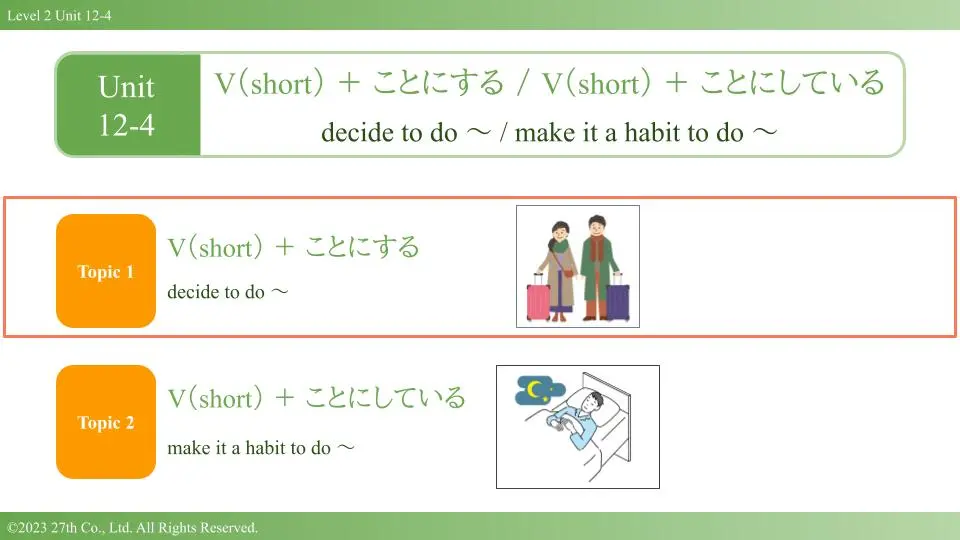
V (short) + ことにしている: How to Say “Make it a Habit to …”
Introduction
Do you know how to express ‘‘do as a regular practice’’?
- “Satoshi makes it a rule to go to bed by twelve every night.”
- “I make it a habit to go jogging every day.”
Use V (short) + ことにしている to say you make something a habit/rule for yourself. It describes an ongoing custom that you have decided to keep.
1. Meaning & Core Pattern
The V(short) + ことにしている construction in Japanese is used to express the idea of making something a habit or having a certain custom.
- V (short, present) + ことにしている
= “I make it a habit to V / I have a rule to V.” - V (short, negative) + ことにしている
= “I make it a habit not to V.”
2. How to Form It
- Put the verb in short/plain present (positive or negative).
- Add ことにしている.
- Adjust politeness/tense on している as needed: しています/していました.
Examples
| Verb | ~ことにしている | Example |
|---|---|---|
| 食べる (to eat) | 食べることにしている | 野菜を食べることにしています。 I make it a habit to eat vegetables. |
| 食べない (to not eat) | 食べないことにしている | 肉を食べないことにしています。 I make it a habit not to eat meat. |
| 飲む (to drink) | 飲むことにしている | 毎朝コーヒーを飲むことにしています。 I make it a habit to drink coffee every morning. |
| 飲まない (to not drink) | 飲まないことにしている | 平日はお酒を飲まないことにしています。 On weekdays, I make it a rule not to drink alcohol. |
3. Nuance & Contrasts
- ことにしている = a self-imposed, ongoing habit you actively maintain.
- ことにする = a one-time decision (“I’ve decided to…”).
- ことになる = a result decided by others/circumstances.
- ことになっている = official rule/established arrangement (not your personal choice).
4. Natural Examples

毎朝八時からメールをチェックすることにしています。
I make it a habit to check my email every morning starting at eight o’clock.

ダイエットのために甘い物を食べないことにしています。
I’m not eating sweets for my diet.

去年から、夜は仕事の通知をオフにすることにしています。
Since last year I silence work notifications at night.

毎日ジョギングすることにしています。
I jog every day as a habit.

24時までに寝ることにしています。
I make it a point to go to bed by midnight.

日曜日にボランティアをすることにしています。
I volunteer on Sundays.
5. Usage Notes
- Time framing: 〜している shows the habit now. For a past period, use していました.
- Reasons: Often paired with ので/から.
- もう若くないので、夜ふかしをしないことにしています。= Since I’m not young anymore, I’ve decided not to stay up late.
6. Practice
Conjugate the following verbs into ことにしている forms.
Example: チェックする → チェックすることにしています
- 食べる → 食べることにしています
- 書く → 書くことにしています
- 説明する → 説明することにしています
- 毎日走る → 毎日走ることにしています
- 週に一度 運動する → 週に一度 運動することにしています
Say what Lisa makes a habit of doing or not doing, using 〜ことにしている.
Example: study in the library on Saturdays → リサさんは毎週 土曜日、図書館で勉強することにしています。
| Clue | Example Answer |
|---|---|
| ask when she doesn’t understand | リサさんは分からない時、人に聞くことにしています。 |
| check messages when she gets up | リサさんは起きた時、メッセージを確認することにしています。 |
| not eat spicy food | リサさんは辛い食べ物を食べないことにしています。 |
7. Common Mistakes
- I make it a rule to go
- ❌ 行きますことにしている → ✅ 行くことにしている [use short form before こと]
- I make it a point to go jogging every single day.
- ❌ ~ことになっている → ✅ ~ことにしている [self-rule, not an official rule]
- I make it a rule to exercise
- ❌ 運動ことにしている → ✅ 運動することにしている [N/Adj directly before ことにしている is incorrect. Use a verb phrase]
FAQ
- QWhat is the difference between ~ている and ~ことにしている?
- A
- ~ている: Simply states a fact
- まいにちコーヒーをのんでいます = I drink coffee every day
- ~ことにしている: Implies a choice
- まいにちコーヒーをのむことにしています = I make it a rule to drink coffee every day [Perhaps for health or to wake up]
- ~ている: Simply states a fact
- QWhat is the difference between ~ようにしている and ~ことにしている?
- A
Grammar Meaning Nuance ~ことにしている I make it a rule to… Strict, 100% commitment ~ようにしている I try to make sure that… Effort, 80% commitment
- QWhat if I used to have a habit but stopped?
- A
You can use the past continuous form: ~ことにしていました
日記を毎日 書くことにしていました。= I used to make it a rule to write in a diary every day (but I stopped).
Conclusion
Use V (short) + ことにしている to describe habits and personal rules you actively keep.
Build it with the short form, choose the right tense on している, and distinguish it from ことにする / ことになる / ことになっている to sound precise and natural.