
Introduction
Have you ever wanted to say “according to the news,” “according to the weather forecast,” or “according to what my friend said” in Japanese?
When you want to report information from a source and make that source clear, Japanese often uses Nによると.
1. Meaning: What does Nによると mean?
Nによると means:
- according to N
- based on N
- from what N says
It is used when you are conveying information you got from another source and want to make that source clear.
Core idea
With this grammar:
- N = the source of the information
- the rest of the sentence = the information you are reporting
Common sources used with Nによると
This pattern is used with nouns such as:
- ニュース = the news
- 天気予報 = the weather forecast
- 新聞 = the newspaper
- 専門家(の話) = what an expert said
2. Formation
Noun + によると、Sentence
This pattern is used with hearsay / reported-information grammar at the end of the sentence, such as:
Grammar breakdown
- に (particle)
Marks the basis or source. - よる (verb)
In this expression, it has the meaning of “to be based on / according to.” - と (particle)
In によると, it forms a set expression meaning “according to.”
3. Useful Examples

天気予報によると、来週から気温が下がるそうです。
According to the weather forecast, temperatures are expected to drop starting next week.

今朝の新聞によると、駅前に新しい図書館ができるみたいです。
According to this morning’s newspaper, it looks like a new library is going to be built in front of the station.

田中部長の話によると、ゆうじさんは来月アメリカへ出張するそうです。
According to Manager Tanaka, Yuuji is going on a business trip to the United States next month.

うわさによると、あの二人は付き合っているらしい。
Rumor has it that those two are dating.
4. Related grammar
Nによれば (A close variation)
You may also see Nによれば, which means the same thing.
Example: According to the weather forecast, it’s supposed to rain this afternoon.
- 天気予報によると、午後から雨だそうです。
天気予報によれば、午後から雨だそうです。
Compared with によると, によれば sounds a little more formal or written, but both are common.
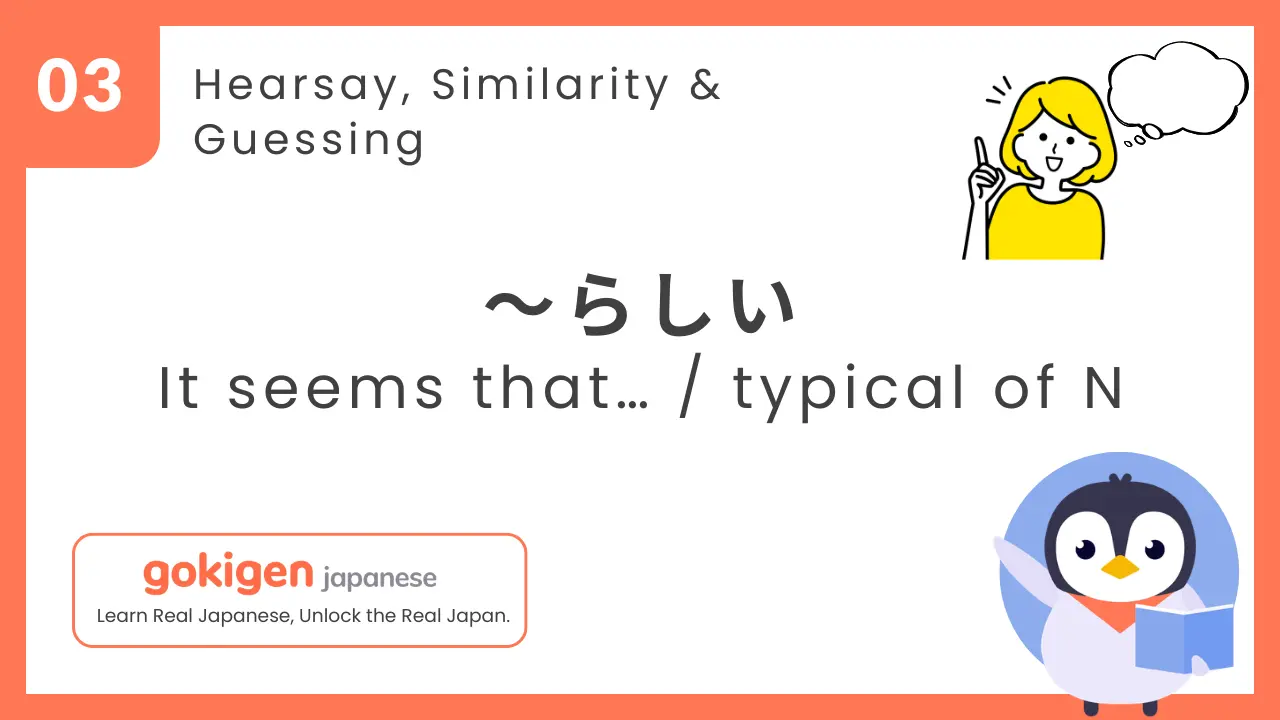
Nによると + ~そうだ / ~らしい / ~ということだ
Nによると shows the source, but it does not by itself fully express hearsay.
That is why it is often used together with grammar such as:
Compare: According to the news, gasoline prices are set to rise starting next week.
- ニュースによると、来週からガソリンの値段が上がるそうだ。
- ニュースによると、来週からガソリンの値段が上がるらしい。
- ニュースによると、来週からガソリンの値段が上がるということだ。
All are natural, but the nuance is slightly different:
- ~そうだ → straightforward hearsay
- ~らしい → slightly softer / “apparently”
- ~ということだ → more formal, often used in reports or business contexts
Nの話では
~の話では can also introduce a source, similar to Nによると. However, there is an important difference: ~の話では can only be used when the source is a person (or group of people) who actually said something. It cannot be used with impersonal sources like newspapers, forecasts, or reports.
- 先生の話では、今回のJLPTは少し難しかったそうです。
According to my teacher, this JLPT was a little difficult. - ✖ 天気予報の話では、明日は雨だそうです。
→ Use 天気予報によると instead.
天気予報によると、明日は雨だそうです。= According to the weather forecast, it’s supposed to rain tomorrow.
Nによって vs. Nによると
While they look similar, their meanings are completely different.
- Nによると = According to N (Source of information)
- Nによって = Depending on N (or “By N” in passive sentences)
- 人によって意見は異なります。= Opinions vary from person to person.
- 大阪城は豊臣秀吉によってつくられました。= Osaka Castle was built by Toyotomi Hideyoshi.
5. Practice
Translate the following English into Japanese using Nによると.
| English | Example Answer |
|---|---|
| According to the weather forecast, it will snow tonight. | 天気予報によると、今夜は雪が降るそうです。 |
| According to my friend, that movie is very interesting. | 友だちによると、あの映画はとてもおもしろいそうです。 |
| According to the newspaper, a new station will be built there. | 新聞によると、そこに新しい駅ができるということです。 |
FAQ
- QCan I say “私によると (watashi ni yoru to)” to mean “according to me”?
- A
No, you cannot use “私によると” in Japanese. Nによると is strictly used for external sources of information (like the news, a friend, or a teacher).
If you want to express your own opinion (“In my opinion / I think”), you should use 私の意見では (watashi no iken de wa) or simply end your sentence with ~と思います (to omoimasu).
- QWhat is the difference between “Nによると” and “Nによって”?
- A
Nによると means “according to N” (used for reporting information).
Nによって means “depending on N” or “by N”.
- QDo I really have to use “~そうです” or “~らしい” at the end of the sentence?
- A
Yes, it is highly recommended! If you say “ニュースによると、明日は雨が降ります,” it sounds slightly unnatural to native speakers. Since you are stating information you got from somewhere else (not a fact you are guaranteeing yourself), pairing it with a hearsay ending like ~そうです or ~ということだ makes your Japanese sound perfectly natural.
Conclusion
In this article, you learned how to use Nによると (N ni yoru to) to show the source of information in Japanese.
With this grammar, you can now:
- say naturally “according to N”,
- make it clear where your information comes from,
- and combine it with hearsay expressions like ~そうだ, ~らしい, and ~ということだ for more natural Japanese.