Japanese grammar

level2 (N4)

How to Use Kureru (くれる) in Japanese | When Someone Gives You Something

Learn how to use the Japanese verb くれる to express when someone gives you something. Understand the structure, usage, and difference from ageru and morau.
level2 (N4)

How to Use Ageru and Morau in Japanese | Express Giving and Receiving

Learn how to use the Japanese verbs あげる and もらう to talk about giving and receiving. Understand sentence structure, perspective, and cultural context with practical examples.
level2 (N4)

Offering Friendly Advice in Japanese: Mastering V-た + らどうですか

How to Use 〜たらどうですか in Japanese | Giving Friendly Suggestions and Advice
level2 (N4)

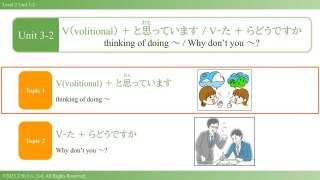
Making Plans in Japanese: Expressing Intentions with V(volitional) + と思っています

Learn how to use the Japanese grammar pattern V-volitional + と思っています to express future plans or intentions. Understand the difference between と思います and と思っています with examples and common mistakes.
level2 (N4)

Getting Ready in Japanese: Mastering V-ておく (te oku)

Learn how to use 〜ておく (te oku) to mean “do something in advance” or “leave something as is,” with examples, 〜とく, and a 〜てある comparison.
level2 (N4)

Mastering the Japanese Volitional Form (意志形): Casual Invitations and Suggestions

Learn how to use the Japanese volitional form (意志形) to casually say “Let's go” or “Shall we eat?” in Japanese. This guide includes conjugation rules, examples, and common mistakes for JLPT N4 learners.
level2 (N4)

Japanese Relative Clauses: Sentence + Noun

Learn how to describe nouns in Japanese with full sentences, like “the book Sakura translated.” Includes relative clauses, が vs は, examples, and practice.
level2 (N4)

How to Say “Could You Please” in Japanese | Using V-te + itadakemasen ka(〜ていただけませんか)

Learn how to politely ask for favors in Japanese using the phrase “V-te + itadakemasen ka(〜ていただけませんか)”. This formal grammar structure is essential for N4-level learners to make respectful requests.
level2 (N4)

How to Use “nanika / nanimo / dokoka ni / doko ni mo (何か・何も・どこかに・どこにも)” in Japanese | Talking about Something or Somewhere

Learn how to use nanika (something), nanimo (not anything), dokoka ni (somewhere), and doko ni mo (not anywhere) in Japanese. Master these common expressions for JLPT N4 level conversations.
level2 (N4)

How to Say “I Hope That 〜” in Japanese | Using (plain present) + to ii(〜といい)

Learn how to say “I hope that…” naturally in Japanese using the grammar pattern (plain form) + to ii. Perfect for JLPT N4 learners. With real examples and tips!