
Video
Let’s watch this short video for a quick overview.
Source: gokigen japanese official YouTube Channel
Introduction
In English, we can turn verbs into nouns by adding “-ing”:
- I like reading.
- Cooking is fun.
- Swimming is hard.
In Japanese, you can do the same thing using:
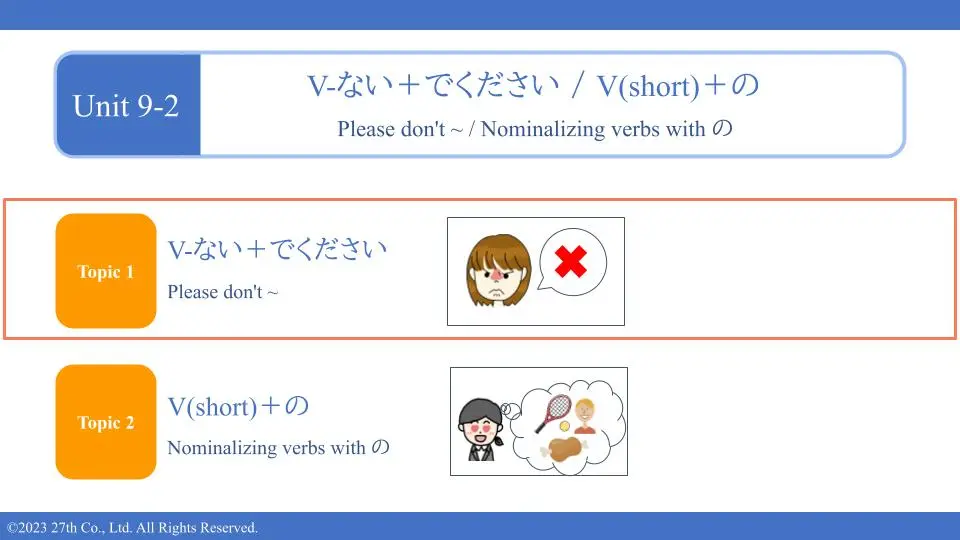
Verb (short form) + の
= “doing something / to do something”
This grammar lets you say things like “I like listening to music” or “Studying Japanese is hard.” Let’s learn how to turn verbs into noun-like phrases using の!
1. Basic Structure
Grammar Pattern: V(short form)+ の
| English | Japanese |
|---|---|
| I like listening to music. | 音楽を聞くのが好きです。 |
| She is good at cooking. | 彼女は料理するのが上手です。 |
| Studying Japanese is difficult. | 日本語を勉強するのは大変です。 |
This pattern turns a verb phrase into a noun phrase, so you can use it as the subject or object in a sentence.
2. How to Nominalize a Verb
Step 1: Conjugate the verb in its short form (either present or past tense).
Step 2: Add the particle の after the verb.
| Verb | Nominalized |
|---|---|
| 勉強する (to study) | 勉強するの = studying |
| 泳ぐ (to swim) | 泳ぐの = swimming |
| 料理する (to cook) | 料理するの = cooking |
| 泣く (to cry) | 泣くの = crying |
3. Example Sentences
I like 〜 / I don’t like 〜

ゲームをするのが好きです。
I like playing games.

勉強するのが好きじゃないです。
I don’t like studying.
Good at 〜 / Bad at 〜

兄は料理をするのが上手です。
My brother is good at cooking.

アリスさんは はしを使うのが下手です。
Alice is bad at using chopsticks.
Other patterns

漢字を書くのは難しいです。
Writing kanji is hard.

本を読むのは楽しいです。
Reading books is fun.

最近太ったので、運動するのが大変です。
I’ve gained weight recently, so exercising is tough.
4. Common Mistakes to Avoid
| ❌ Wrong | ✅ Correct |
|---|---|
| 勉強しますのが好きです。 | 勉強するのが好きです。 I like studying. |
| 歌うが好きです。 | 歌うのが好きです。 I like singing. |
| 泳ぐを嫌いです。 | 泳ぐのが嫌いです。 I dislike swimming. |
💡 Use the short form, and don’t forget the particle の!
5. Practice Time!
Change the following into の-phrases:
| English | Japanese |
|---|---|
| I like drinking sake. | お酒を飲むのが好きです。 |
| Mom is good at playing with children. | お母さんは子どもと遊ぶのが上手です。 |
| I forgot to bring my homework. | 宿題を持ってくるのを忘れました。 |
| Hana loves singing karaoke. | ハナさんはカラオケで歌うのが大好きです。 |
| Ken dislikes walking. | ケンさんは歩くのが嫌いです。 |
6. FAQ – Frequently Asked Questions
- QCan I use this with negative or past tense verbs?
- A
Yes!
- 図書館では、うるさくしないのが大切です。
It is important not to be loud in the library. - 高校三年生の冬、たくさん勉強したのをおぼえています。
I remember studying a lot during the winter of my senior year of high school.
- 図書館では、うるさくしないのが大切です。
- QWhat’s the difference between の and こと?
- A
Both nominalize verbs, but:
- の is more common in daily conversation.
- こと is more formal or written.
Example:
- 日本語を話すのが好きです。✅
- 日本語を話すことが好きです。✅(more formal)
- QCan I use の-phrases as the subject?
- A
Yes! Example: 朝ごはんを食べるのは大切です。= Eating breakfast is important.
- QCan I use particles other than が (ga) or は (wa) after the V+の phrase?
- A
Absolutely! Since V+の turns the verb phrase into a noun phrase, it can take various particles depending on its grammatical function:
- も (mo): Means “also”. Ex: 「本を読むのも好きです」(Hon o yomu no mo suki desu – I also like reading books).
- を (o): Marks it as a direct object. Ex: 「映画を見るのを楽しみにしている」(Eiga o miru no o tanoshimi ni shite iru – I’m looking forward to watching the movie). Ex: 「宿題をするのを忘れた」(Shukudai o suru no o wasureta – I forgot to do my homework / forgot doing homework).
- に (ni): Can mark purpose or time. Ex: 「買い物に行くのに時間がかかる」(Kaimono ni iku no ni jikan ga kakaru – It takes time for going shopping).
- QIs there a difference in meaning between 「本を読むのが好き」 and simply 「本が好き」?
- A
Yes, there’s a difference in focus:
- 「本を読むのが好き」 (Hon o yomu no ga suki) means “I like the act of reading books.” Using V+の specifically emphasizes the action or doing of the verb. If you like the activity, use V+の. If you like the thing itself, use the noun directly.
- 「本が好き」 (Hon ga suki) means “I like books” (the noun, the general concept).
7. Conclusion
Now you can turn verb phrases into noun phrases using:
✅ Short-form verbs + の
✅ Say what you like, dislike, are good at, or forgot!
✅ Use it as subject or object in a sentence
🎯 Try this:
Make 3 sentences using V + のが好きです / 上手です / 大変です.