
Video
Let’s watch this short video for a quick overview.
Source: gokigen japanese official YouTube Channel
Introduction
What if you want to tell someone politely not to do something in Japanese?
Whether it’s “Please don’t smoke,” “Please don’t call,” or “Please don’t wear shoes inside,” there’s a very useful expression you need to learn:
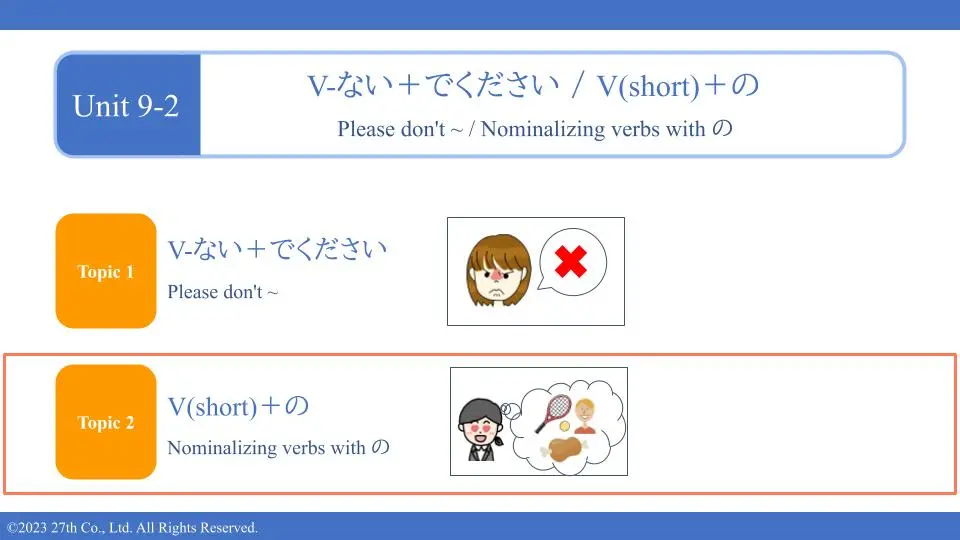
〜ないでください
= Please don’t do 〜
This phrase is essential for making polite requests and expressing boundaries in everyday life. In this article, we’ll break down how to use it, how to conjugate verbs into the correct form, and how to sound natural and respectful in Japanese.
1. Meaning and Grammar Structure
- Meaning: Please do not…
- Structure: Verb(negative short [plain] form)+で ください
| Verb | Meaning | 〜ないでください |
|---|---|---|
| たべる | to eat | 食べないでください Please don’t eat |
| (たばこを)すう | to smoke | 吸わないでください Please don’t smoke |
| でんわする | to call | 電話しないでください Please don’t call |
Example:

ここで食べないでください。
Please don’t eat here.
2. How to Conjugate
Step 1: Convert the verb to the short negative form (V-ない)
Step 2: Add でください after the verb to make it polite
Examples:
| Verb (dictionary) | Negative form | Final expression |
|---|---|---|
| する (to do) | しない | しないでください |
| 来る (to come) | 来ない | 来ないでください |
| 飲む (to drink) | 飲まない | 飲まないでください |
| 捨てる (to throw away) | 捨てない | 捨てないでください |
If you want to review the short [plain] form of verbs, read this article: How to Use Japanese Short Forms (Plain Forms) for Casual Conversations
3. Practical Examples

図書館で食べ物を食べないでください。
Please don’t eat food in the library.

レストランでたばこを吸わないでください。
Please don’t smoke in the restaurant.

電車で電話しないでください。
Please don’t make a phone call on the train.

家の中で靴をはかないでください。
Please don’t wear shoes in the house.

宿題を忘れないでください。
Please don’t forget your homework.
Sample Dialogue

ドアを開けてもいいですか?
Can I open the door?

すみません、今は開けないでください。
Sorry, please do not open it now.
黒板を消してもいいですか?
May I erase the blackboard?
すみません、消さないでください。
Sorry, please do not erase it.
まだノートをとっています。
I am still taking notes.
わかりました。
I see.
4. Practice Time!
Change the following sentences into polite “please don’t” form:
| Verb | 〜ないでください |
|---|---|
| 忘れる (to forget) | 忘れないでください |
| 泳ぐ (to swim) | 泳がないでください |
| 開ける (to open) | 開けないでください |
| 使う (to use) | 使わないでください |
| 消す (to erase, turn off) | 消さないでください |
5. FAQ – Frequently Asked Questions
- QCan I use this with any verb?
- A
Yes! Just make sure to conjugate the verb to its negative short form before adding でください.
- QWhat’s the difference between 〜ないで and 〜なくて?
- A
〜ないで(ください) is a request (don’t do ~).
〜なくて is the negative te-form, and it’s used for explanations or reasons. Example: 勉強しなくて、テストに失敗しました。= I failed the test because I didn’t study.
- QIs this expression polite?
- A
Yes, it’s a polite and natural way to say “please don’t ~.” You can also use it in more casual form as just “〜ないで” with friends.
- QIs 〜ないでください appropriate for telling a boss, teacher, or customer “please don’t”? Is there a more polite or stricter way?
- A
〜ないでください is generally polite for everyday situations. However, when addressing superiors, customers, or in very formal contexts:
- It might sometimes feel too direct. A softer, more formal request is often preferred, like 「ご遠慮ください」 (go-enryo kudasai – please refrain), often seen on signs or used in service settings. Example: 写真撮影はご遠慮ください。= Please refrain from taking photographs.
- For strict prohibitions (rules), you might see 「〜てはいけません」 (te wa ikemasen – you must not do ~), which is stronger than a simple request. For most interactions, 〜ないでください is fine, but be aware these alternatives exist for different levels of formality and strength.
- QHow do I respond if someone tells me 「〜ないでください」?
- A
A polite acknowledgement is best. Common responses include:
- 「失礼しました。」 (Shitsurei shimashita.) – Excuse me / Pardon me. (Especially if you were already doing the action).
- 「はい、わかりました。」 (Hai, wakarimashita.) – Okay, I understand.
- 「あ、すみません。」 (A, sumimasen.) – Oh, I’m sorry. (Even if you weren’t doing it yet, this shows polite acknowledgement).
- QCan I soften the request 〜ないでください even more?
- A
Yes, while 〜ないでください is polite, you can soften it further, especially when asking someone to refrain for your benefit:
- Phrasing it differently, e.g., 「すみません、ちょっとそれは…」 (Sumimasen, chotto sore wa… – Sorry, but that’s a little…) implying refusal of permission. These add layers of indirectness.
- Using 〜ないでくれますか (naide kuremasu ka) / 〜ないでくれませんか (naide kuremasen ka) – “Could you please not do ~ (for me)?”
- Using the very polite 〜ないでいただけますか (naide itadakemasu ka) / 〜ないでいただけませんか (naide itadakemasen ka) – “Would you kindly refrain from doing ~ (for me)?”
- QWhat’s the difference between 〜ないでください and 〜てください?
- A
They have opposite meanings.
- 〜ないでください is a polite negative request meaning “please don’t do ~.”
- Example: ここでタバコを吸わないでください。= Please don’t smoke here.
- 〜てください is a polite request meaning “please do ~.”
- Example: 早く来てください。= Please come quickly.
- 〜ないでください is a polite negative request meaning “please don’t do ~.”
Conclusion
Now you can politely tell someone not to do something in Japanese!
✅ Use the negative short form
✅ Add でください
✅ Practice with everyday situations
🎯 Try making 3 sentences like:
- Please don’t (eat in class).
- Please don’t (open the window).
- Please don’t (use my phone).