
Introduction
Have you ever wanted to say “This is called X” or “A person like that is called Y” in Japanese?
When you want to show the name of a thing, person, or concept, Japanese often uses N1をN2と言う.
1. Meaning: What does N1をN2と言う mean?
N1をN2と言う means:
- N1 is called N2
- N2 is the name for N1
- we call N1 N2
It is used when you want to show the name or label (N2) of a thing, person, action, or concept (N1).
Core idea
- N1 = the thing / matter being explained
- N2 = its name
So the pattern means: “The thing/event/person N1 is called N2.”
This grammar is often used in:
- definitions
- vocabulary explanations
- dictionary-style sentences
- teaching or describing categories
2. Formation
N1 + を + N2 + と言う
Grammar breakdown
- を (particle)
Marks N1 as the thing being named or defined. - と (particle)
Quotation particle. It marks the word/name being said. - 言う (verb)
Means “to say” or “to call.”
Grammar Tip: When N1 is an action
Remember that N1 must be a noun. If you want to describe an action or a verb phrase, you must turn it into a noun by adding こと (koto) or の (no) before を.
Example: When the water supply is cut off, it is called dansui (断水).
❌ 水が止まるを断水と言います。(Incorrect)
✅ 水が止まることを断水と言います。(Correct)
Casual Speech: って言う (tte iu)
In casual, everyday conversation, Japanese people often replace と (to) with って (tte).
- 水が止まることを断水って言うよ。
3. Useful Examples

寝るときに着る服をパジャマと言います。
The clothes you wear when you sleep are called pajamas.

かっこいい男性を二枚目と言います。
A handsome man is called nimaime.
“Nimaime” originally comes from kabuki (歌舞伎). On old theater signboards, the second panel often showed the name of a handsome, gentle male character, so nimaime came to mean “a good-looking man.”

勉強のために海外へ行くことを留学と言います。
Going abroad for study is called ryugaku (studying abroad).
4. Related grammar (comparison)
…という + N / The N that …
…というN means: the N that [Sentence]
It is used when という modifies a noun.
- 子どもが減っているというニュース
The news that the number of children is decreasing - さとし先輩に彼女ができたといううわさ
Rumors that Satoshi-senpai has a girlfriend - 仕事中にスマホを見てはいけないというルール
The rule against looking at your smartphone while working
So:
- N1をN2と言う → gives a name/definition
- …というN → modifies a noun with quoted content or a label
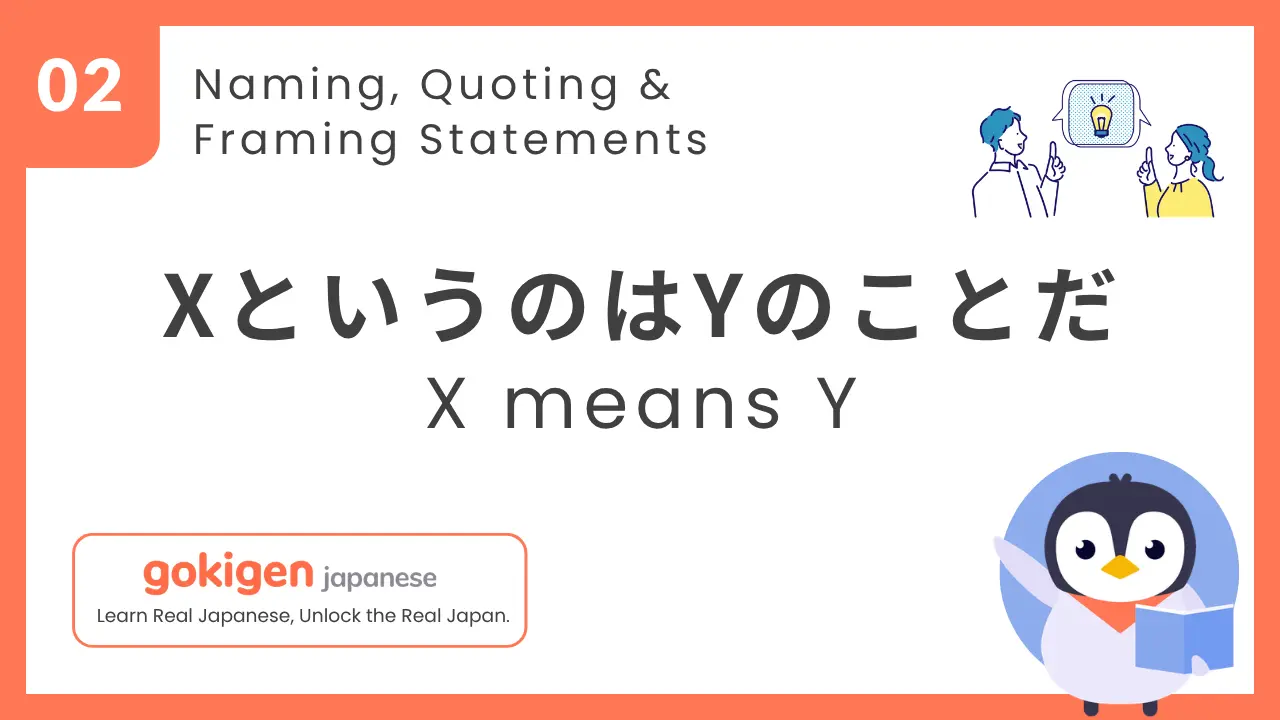
~というのは~のことだ / X means Y
XというのはYのことだ: X means Y, X is the thing called Y.
It is often used to define or explain a term more directly.

「サラリーマン」とは何ですか。
What is a “salaryman”?

サラリーマンというのは、会社で働いて給料をもらう人のことです。
A salaryman is someone who works for a company and receives a salary.

「オタク」って何ですか。
What is an “otaku”?

オタクというのは、アニメやマンガ、アイドルなどに熱中している人のことです。
An otaku is someone who is passionate about anime, manga, idols, and the like.
This is very close in meaning to N1をN2と言う, but the sentence structure is different.
Compare:
- 勉強のために外国へ行くことを留学と言います。
Going abroad for study is called ryugaku. - 留学というのは、勉強のために外国へ行くことです。
Ryugaku is the act of going abroad for study.
Both are natural.
…ということだ / According to …
This pattern has a different meaning. It often means:
- I heard that …
- According to …

天気予報によると、明日は雨だということです。
According to the weather forecast, it will rain tomorrow.
So do not confuse:
- N1をN2と言う = naming / defining
- …ということだ = reported information or interpreted meaning
5. Practice
Translate the following English into Japanese using N1をN2と言う.
| English | Example Answer |
|---|---|
| Going abroad for study is called ryugaku (studying abroad). | 勉強のために海外へ行くことを留学と言います。 |
| Clothes worn in winter are called fuyufuku (winter clothes). | 冬に着る服を冬服と言います。 |
| A person who teaches at school is called a teacher. | 学校で教える人を先生(or 教師)と言います。 |
FAQ
- QCan I use this grammar to introduce myself? (e.g., 私をジョンと言います)
- A
No, that sounds unnatural. When introducing yourself, you simply use 私は[Name]と言います (I am called [Name]) or 私は[Name]と申します (humble form).
The pattern “N1をN2と言う” is used to define objects, concepts, or general categories, not to introduce your own name.
- QWhy does the sentence say “行くことを” (iku koto o) instead of just “行くを” (iku o)?
- A
Because the particle を (o) can only attach to nouns. “行く” (to go) is a verb. To make it a noun phrase so that it can take を, you must attach the nominalizer こと (koto) to the end of the verb phrase.
Conclusion
In this article, you learned how to use N1をN2と言う to show the name of a thing, person, or concept in Japanese.
With this grammar, you can now:
- explain what something is called in Japanese,
- give simple definitions more naturally,
- and understand related patterns with という, such as …というN and ~というのは~のことだ.