
Video
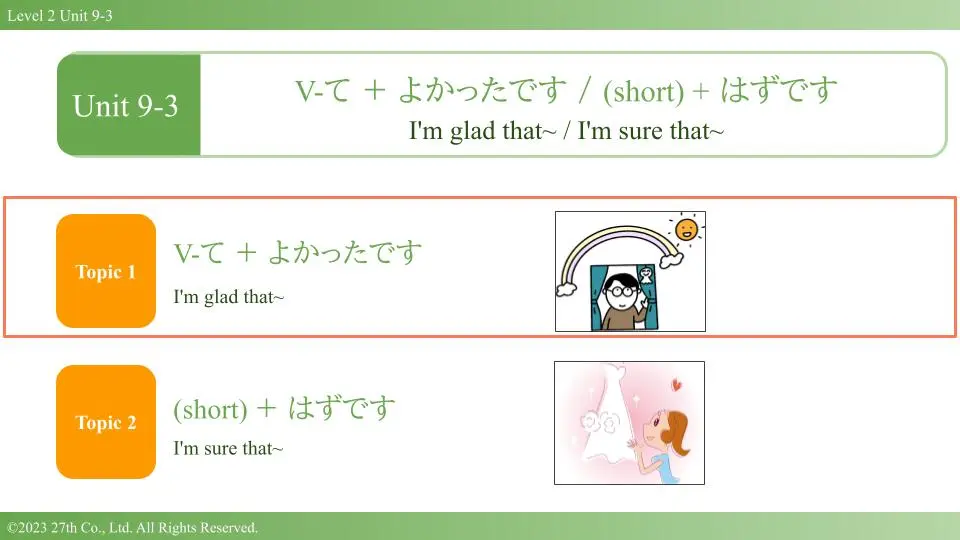
Let’s watch this short video for a quick overview.
Source: gokigen japanese official YouTube Channel
Introduction
Want to say “It should be sunny tomorrow” or “I’m sure he’s a student”?
Use short form + はずです.
This pattern states a strong expectation or logical belief based on what you know (evidence, common sense, schedule, etc.).
It’s stronger than “maybe,” but not 100% certain like a fact.
1. Meaning & When to Use
short (plain) form + はずです = “I’m sure that… / It should be …”
Use it when you have good reasons (information, logic, past statements) to expect something is true or will happen.

明日は晴れるはずです。
It should be sunny tomorrow.

あのドレスは高いはずです。
That dress should be expensive.
Think: “Given X, it really should be Y.” Not a guess out of nowhere.
2. How to Form It (attach はずです to the short form)
Use the plain/short form (not ます-form) right before はずです.
Verbs
| short (plain) form | はずです form |
|---|---|
| 行く (to go) | 行くはずです |
| 行かない (not go) | 行かないはずです |
| 行った (went) | 行ったはずです |
| 行かなかった (didn’t go) | 行かなかったはずです |
| 来る (to come) | 来るはずです |
| 来ない (not come) | 来ないはずです |
| 来た (came) | 来たはずです |
| 来なかった (didn’t come) | 来なかったはずです |
| する (to do) | するはずです |
| しない (not do) | しないはずです |
| した (did) | したはずです |
| しなかった (didn’t do) | しなかったはずです |
adjectives and nouns
i-adjective: 高い (takai = tall / high / expensive)
| short (plain) form | はずです form |
|---|---|
| 高い (tall / expensive) | 高いはずです |
| 高くない (not tall / not expensive) | 高くないはずです |
| 高かった (was tall / was expensive) | 高かったはずです |
| 高くなかった (wasn’t tall / wasn’t expensive) | 高くなかったはずです |
na-adjective: 静かな (shizuka na = quiet)
| short (plain) form | はずです form |
|---|---|
| 静かな (quiet) | 静かなはずです |
| 静かではない / 静かじゃない (not quiet) | 静かではないはずです / 静かじゃないはずです |
| 静かだった (was quiet) | 静かだったはずです |
| 静かではなかった / 静かじゃなかった (wasn’t quiet) | 静かではなかったはずです / 静かじゃなかったはずです |
Noun: 学生 (gakusei = student)
| short (plain) form | はずです form |
|---|---|
| 学生 (a student) | 学生のはずです |
| 学生ではない / 学生じゃない (not a student) | 学生ではないはずです / 学生じゃないはずです |
| 学生だった (was a student) | 学生だったはずです |
| 学生ではなかった / 学生じゃなかった (wasn’t a student) | 学生ではなかったはずです / 学生じゃなかったはずです |
If you’d like to review short [plain] form, please see these articles.
- How to Use Japanese Short Forms (Plain Forms) for Casual Conversations
- How to Use Japanese Plain Form (Short Form) for Adjectives and Nouns
- How to Use Japanese Past Tense Plain Form (Short Form) – Verbs in Casual Conversation
- How to Use Japanese Plain Form Past Tense (Short Form) for Adjectives and Nouns
Past form: ~はずでした
You can also say 〜はずでした to mean “was supposed to…” / “should have…”.
Example: 会議は三時に始まるはずでした。= The meeting was supposed to start at three.
What is はず?
はず is a noun meaning something like “expectation” or “what is naturally expected.”
That is why nouns use の before it, and na-adjectives use な before it.
Also, はず is not usually used by itself. It normally follows a verb, adjective, noun, or a demonstrative expression such as その.
はず can also modify a noun: ~はずの + noun
You can also use ~はずの + noun when you want to modify a noun.
It means “the [noun] that was supposed to…” or “the [noun] that should be…”.
Example: 玄関の前に置いたはずの傘がなくなっていた。= The umbrella that I was sure I had left in front of the entrance was gone.
3. Example Sentences

あっちに東京駅があるはずです。
Tokyo Station should be over there.

会議は三時に始まるはずです。
The meeting should start at three.

その店は、日曜日が休みのはずです。
That shop should be closed on Sundays.

明日は雨が降らないはずです。
It shouldn’t rain tomorrow.
4. Usage Notes
Evidence-based
Use はずです when you have a reason (schedule, rule, what someone said, obvious logic).
It’s not just a random guess; there’s a logical foundation for your belief.
Schedules or plans
会議は4時に始まるはずです。
The meeting should start at 4. → based on the schedule
Rules or common knowledge
そのレストランは水曜日が休みのはずです。
That restaurant should be closed on Wednesdays. → based on their usual hours
Information you heard/were told
彼はもうすぐ来るはずです。
He should be here soon. → based on what he said
Logical deduction
あのカメラは高いはずです。
That camera should be expensive. → based on its appearance/brand
Stronger than だろう/と思う
- はずです = confident expectation
- だろう/でしょう = “probably.”
Politeness
はずです is neutral-polite.
Plain form はずだ is casual.
Nouns take の
If you want to say “That person must be a student”:
学生のはずです
You never say: 学生はずです
Not for the speaker’s own intention
はずです is generally not used for the speaker’s own intentional future actions, because the speaker already knows their own intention.
In that case, use 〜つもりです or 〜ようと思っています instead.
- Mike should go to bed early tonight.
- ✅ 明日の朝は早いので、マイクさんは今夜早く寝るはずです。
- I have to get up early tomorrow morning, so I plan to go to bed early tonight.
5. Practice Time!
Convert each cue into a sentence with はずです.
| Cue | Model answer |
|---|---|
| 明日/晴れる | 明日は晴れるはずです。 |
| 彼/学生です | 彼は学生のはずです。 |
| 会議/三時/始まります | 会議は三時に始まるはずです。 |
| そのコート/高い(negative) | そのコートは高くないはずです。 |
| その服/安い(past) | その服は安かったはずです。 |
6. Common Mistakes (and quick fixes)
| ❌ Wrong | Why it’s wrong | ✅ Say this |
|---|---|---|
| 行きますはずです。 | Must use short (plain) form before はず. | 行くはずです。 |
| 学生はずです。 | Nouns need の before はず. | 学生のはずです。 |
| 便利だはずです。 | With な-adjectives, な is correct for this grammar. | 便利なはずです。 |
7. Related Grammar
~にちがいない
It means “must be / no doubt” (even stronger certainty, written-ish).
~だろう・~だろうと思う
These are used to express:
- a guess or presumption
- a prediction about the future
- probability
Common English translations:
- probably…
- I guess…
- I think…
~でしょう
With “~でしょう“, you can show guess, probability, or prediction.
Using this form lets you sound natural when you’re not 100 % sure but have a reasonable hunch.
はずがない(ないはずだ)
This is used to express “can’t be / there’s no way.”
This is the strong negative form of ~hazu desu, expressing that something cannot possibly be true or happen, based on strong evidence or logic.
Example: そんなことはあるはずがない。
There’s no way such a thing could happen.
Pro Tip: Expressing Unexpected Outcomes with ~hazu nanoni
Sometimes, what should be true isn’t.
When you have a strong expectation based on evidence, but the reality is different, you can use ~hazu nanoni (〜はずなのに) to express surprise or disappointment.
This means “It should be/have been…, but [it’s not/it didn’t happen].”
- 彼が来るはずなのに、まだ来ていません。
He should be here by now, but he isn’t here yet. - 簡単なはずなのに、この問題が解けません。
It should be easy, but I can’t solve this problem.
8. FAQ
- QWhat’s the core difference between ~hazu desu (はずです) and ~darou / ~deshou (だろう / でしょう)?
- A
~hazu desu (はずです): Strong expectation based on evidence/logic.
You have a clear reason (e.g., a schedule, something you heard, common sense) to believe it’s true.
The speaker is quite confident.
~darou / ~deshou (だろう / でしょう): Probability based on general knowledge / feeling.
It’s a softer, more general “probably” or “might.”
The speaker is less certain.
- QHow is ~hazu desu different from ~mitai desu (みたいです) and ~you desu (ようです)?
- A
~はずです (hazu desu) is about logical deduction, while ~mitai desu and ~you desu are about sensory observation or appearance.
Example: 彼はもう家に着いたはずです。
He should have arrived home already. (For example, he left a long time ago, so the speaker logically expects this.)~みたいです (mitai desu) / ~ようです (you desu): “It looks like/It seems that” (based on what you see or hear).
Example: 彼はもう家に着いたみたいです。
It looks like he arrived home already. (For example, his room light is on, or someone said he got back.)
- QCan ~hazu desu be used to express a strong personal hope, like “I really hope it rains”?
- A
No, ~hazu desu is for logical expectation, not personal hope or desire.
If you want to express hope, you’d use patterns like ~といいです (to ii desu) or ~てほしいです (te hoshii desu).
- QWhat if my expectation turns out to be wrong? How do I express that?
- A
This is a very common situation where you use ~hazu nanoni (〜はずなのに).
It means “It should be/have been…, but [it’s not/it didn’t happen],” expressing surprise, disappointment, or confusion.
Example: 彼が来るはずなのに、まだ来ていません。 (He should have come, but he’s not here yet.)
- QWhat’s the connection rule for nouns and na-adjectives before hazu desu?
- A
Nouns: You must add の (no) between the noun and はずです.
Example: 学生のはずです (gakusei no hazu desu) – I’m sure he’s a student.
Na-adjectives: You must add な (na) between the na-adjective stem and はずです.
Example: 静かなはずです (shizuka na hazu desu) – It should be quiet.
- QWhat if I want to say “It can’t be true” or “There’s no way”?
- A
For a strong statement of impossibility or disbelief, you use ~hazu ga nai (〜はずがない) or ~nai hazu da (〜ないはずだ).
Example: 彼がそんなことを言うはずがない。 (He can’t possibly say such a thing.)
Conclusion
You can now:
- ✅ Attach はずです to the short form of verbs/い-adjs, な + はず for な-adjs, and N + の + はず for nouns.
- ✅ Use it to express a confident, evidence-based expectation: “I’m sure… / It should be…”.
- ✅ Avoid common slip-ups (ます-form, missing の after nouns, mixing polite forms before はず).
Practice by writing three things you’re sure about this week (based on schedules, rules, or what you heard) using はずです—it’ll click fast.