
Video
Let’s watch this short video for a quick overview.
Source: gokigen japanese official YouTube Channel
Introduction
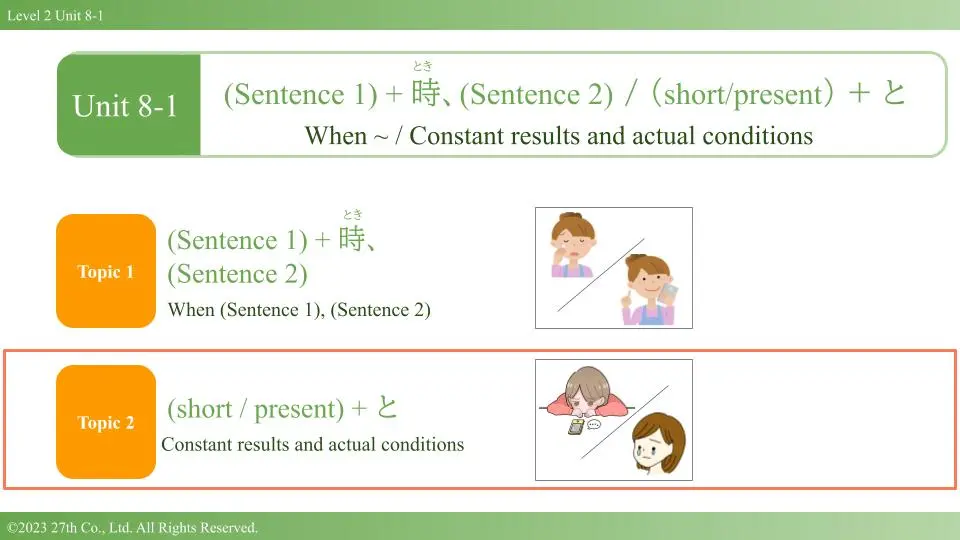
Need to say “When I study, I listen to music” or “When I went to Japan, I skied”? Use the clause pattern (Sentence 1) + 時(とき), (Sentence 2).
The first clause (before 時) shows when the second happens. This guide teaches the form, the special tense rule, and how it differs from the “A と B” pattern.
1. Structure and Basic Meaning
The Japanese grammar pattern (Sentence) + 時 is used to express “when” something happens or happened. It is often used with short form verbs, adjectives, or nouns to indicate the time or condition when an action or event takes place or took place.
時 connects two sentences and expresses the time when the state or action described in the main sentence takes place.
Example: 日本に行きます。ビザを取ります。= I’m going to Japan. I’m getting a visa.
| Part | Form | Role | Example |
|---|---|---|---|
| Sentence 1 | short [plain] form of verb / adj. / noun + 時 | Time or condition | 日本に行く時 When I go to Japan |
| Sentence 2 | any tense | Main action / result | ビザを取ります。 I will get a visa. |
Core meaning: Sentence 1 + 時 sets the time / occasion for Sentence 2.
how to form 時 sentence
| pattern | example | 時 sentence |
|---|---|---|
| Verb | 見る 見た [past] | 見る時 = when I see 見た時 = when I saw |
| い-Adjective | たのしい たのしかった [past] | たのしい時 = when it is fun たのしかった時 = when it was fun |
| な-Adjective | げんきな げんきだった [past] | げんきな時 = when I am healthy げんきだった時 = when I was healthy |
| Noun | 学生 学生だった [past] | 学生の時 = when I was a student 学生だった時 = when I was a student |

- な-Adjective takes な before 時.
- Nouns take の before 時.
Verb tense before 時: present form vs. past form
With verbs, the tense before 時 changes depending on whether the action in Sentence 1 is completed or not at the time of Sentence 2.
- Use V-る 時 if Sentence 1 is not completed yet at the time of Sentence 2.
- Use V-た 時 if Sentence 1 is already completed at the time of Sentence 2.
| Example | Note |
|---|---|
| 日本に行く時、ビザを取ります。 I will get a visa when I go to Japan. | At the time of getting the visa, the trip has not happened yet. |
| 日本に行く時、新しいスーツケースを買いました。 When I went to Japan, I bought a new suitcase. | At the time of buying the suitcase, the trip has not happened yet. So the suitcase is something I bought before the trip. |
| 日本に行った時、新しいスーツケースを買いました。 When I went to Japan, I bought a new suitcase. | At the time of buying the suitcase, the trip has happened already. So the suitcase is something I bought in Japan. |
| 日本に行った時、すしを食べたいです。 When I go to Japan, I want to eat sushi. | At the time of eating sushi, the trip has happened already. This sentence means: 1. (Someday) I will go to Japan 2. Then, I will eat sushi |
2. The Tense in Sentence 1 — Key Rule

| Japaese | English |
|---|---|
| 教室を出るとき、電気を消します。 | When I leave the classroom, I turn off the light. |
| 教室を出るとき、電気を消しました。 | When I left the classroom, I turned off the light. |
The tense of Sentence 1 depends on the relative timing between Sentence 1 and Sentence 2.
If the content of Sentence 1 is present or future (i.e. has not yet occurred) at the time the content of Sentence 2 occurs, Sentence 1 takes present tense. It does not depend on the tense of the verb in Sentence 2 (e.g. 消します / 消しました).

In Japanese, the verb before とき stays in the present tense if that action hasn’t occurred yet at the time of the second action—even if both happened in the past.
Therefore, even if the two events both happened in the past, Sentence 1 may take the present tense! This is one of the big differences between English and Japanese.
3. Example Sentences

日本に行く時、ビザを取ります。
When I go to Japan, I’ll get a visa.

気分が悪い時、病院に行きます。
When I don’t feel well, I go to the hospital.

友だちが来る時、お菓子を買います。
When a friend comes over, I buy snacks.

渋谷に行った時、有名人に会いました。
When I went to Shibuya, I met a celebrity.

暇な時、絵を描きます。
When I’m free, I draw pictures.

学生の時、夏になると海へ行きました。
When I was a student, I would go to the sea whenever summer came.
4. Practice Drill
Translation
Convert each cue into a 「Sentence 1 時、Sentence 2」 sentence. Use the short form rule!
| Cue | Example answer |
|---|---|
| leave the classroom / turn off lights | 教室を出る時、電気を消します。 |
| feel sleepy / drink coffee | 眠い時、コーヒーを飲みます。 |
| tired / go to a hot spring | 疲れた時、温泉に行きます。 |
| sad / call a friend | 悲しい時、友だちに電話します。 |
Choose V-る時 or V-た時
Choose the correct form: V-る時 or V-た時.
| Question | Answer | Note |
|---|---|---|
| 風邪を(ひく / ひいた)時、薬を飲みます。 When I have a cold, I take medicine. | ひいた | You take medicine after catching a cold. |
| (寝る / 寝た)時、「おやすみなさい」と言います。 I say “good night” when I go to sleep. | 寝る | You say it before going to sleep. |
| 誰かの家に(入る / 入った)時、「おじゃまします」と言います。 When entering someone’s home, I say, “Excuse me for intruding.” | 入る | You say it as you enter. |
| プレゼントを(もらう / もらった)時、うれしかったです。 I was happy when I received the gift. | もらった | You felt happy after receiving it. |
| 日本に(行く / 行った)時、旅館に泊まりました。 When I went to Japan, I stayed at a ryokan. | 行った | You stayed at the ryokan after arriving. |
5. Common Mistakes
| ❌ Wrong sentence | Why it’s wrong | ✅ Correct form |
|---|---|---|
| 友だちが来ました時、映画を見ました。 | After short form, 時 never takes です/ました. | 友だちが来た時、映画を見ました。 When my friends came, we watched a movie. |
| 暇です時、寝ます。 | な-adjectives need な, not です. | 暇な時、寝ます。 When I have free time, I take a nap. |
6. Comparison with the “A と B” Pattern
| Pattern | Core use | Form in A | Example |
|---|---|---|---|
| A 時、B | Single event: “When A happens, B happens.” | Short-form verb/adj/noun (tense chosen by order) | さむい時、コートをきます。 When it’s cold, I wear a coat. |
| A と、B | Constant result / natural law / habitual outcome | Always present short form | 春になると、桜が咲きます。 When spring comes, cherry blossoms bloom. |
Keep と for whenever-type facts; use 時 for specific time references or one-off events.
7. FAQ
- QHow do I really know when to use V-ru toki (present) vs. V-ta toki (past)?
- A
It’s the most confusing part! Here’s the key: think about the main action (the second part of the sentence).
- Use V-ru toki (present form) if the first action is about to happen or is happening at the same time as the main action. Example: 家を出る時、鍵を閉めます。 (I lock the door as I am leaving the house).
- Use V-ta toki (past form) if the first action is a completed experience that happened before the main action. Example: 日本に行った時、お寿司を食べました。 (My trip to Japan was a past event. During that event, I ate sushi).
- QWhat is the difference between 日本に行く時 and 日本に行った時?
- A
This is a classic example that perfectly illustrates the rule.
- 日本に行く時、お土産を買います。 (Nihon ni iku toki, omiyage o kaimasu.) This means “When I go to Japan, I will buy souvenirs.” The buying happens before or in preparation for the trip. The “going” is not yet a completed action.
- 日本に行った時、お土産を買いました。 (Nihon ni itta toki, omiyage o kaimashita.) This means “When I went to Japan, I bought souvenirs.” The buying happened after arriving in Japan. The trip was already underway; it was a completed action.
- QHow is toki different from tara and to for expressing “when”?
- A
- toki (時): Focuses on the time or occasion. It’s the most neutral way to set a temporal background for an action.
- to (と): Expresses a natural consequence or an automatic result. If A happens, B always happens. Think of scientific facts or vending machines. Example: 春になると、暖かくなる。 (When spring comes, it gets warm.)
- tara (たら): Focuses on the completion of the first action as a condition for the second. It has a stronger “if/after A is done, then B” feeling. Example: 仕事が終わったら、電話します。 (After my work is finished, I’ll call you.)
- QHow does the tense rule work for nouns and adjectives like 学生 (student) or 暇 (free)?
- A
With nouns and adjectives, the idea is a little simpler than with verbs. They do not usually show the same “before vs. after” contrast as V-ru 時 / V-ta 時. Instead, they describe the state or situation at that time.
- [Past] 暇な時、図書館で勉強しました。
When I had free time, I studied at the library. [Past Habit] - [Present] 暇な時、図書館で勉強します。
When I have free time, I study at the library. [Present Habit]
- [Past] 暇な時、図書館で勉強しました。
Conclusion
Now you can:
- ✅ Attach 時 to a short-form verb, adjective, or noun to say “when …, ….”
- ✅ Pick present vs. past in Sentence 1 based on relative timing.
- ✅ Avoid mix-ups with the constant-result 「A と、B」 pattern.
Write three real-life examples describing what you do when certain situations arise—your Japanese timelines will sound natural and precise!