
How to introduce yourself in Japanese — basic template:
| Japanese | Romaji | Meaning |
|---|---|---|
| はじめまして | Hajimemashite | Nice to meet you |
| わたしは [名前] です | Watashi wa [namae] desu | I am [name] |
| [国・町] からきました | [Kuni / Machi] kara kimashita | I am from [country / hometown] |
| [しごと] です | [Shigoto] desu | I am a [occupation] |
| よろしくお願いします | Yoroshiku onegaishimasu | Nice to meet you / I look forward to speaking with you |
👇 Read on for example self-introductions, useful vocabulary, and cultural tips for jikoshoukai.
Video
Let’s watch this short video for a quick overview.
Source: gokigen japanese official YouTube Channel
Introduction
Introducing yourself is one of the first skills you need when learning a new language.
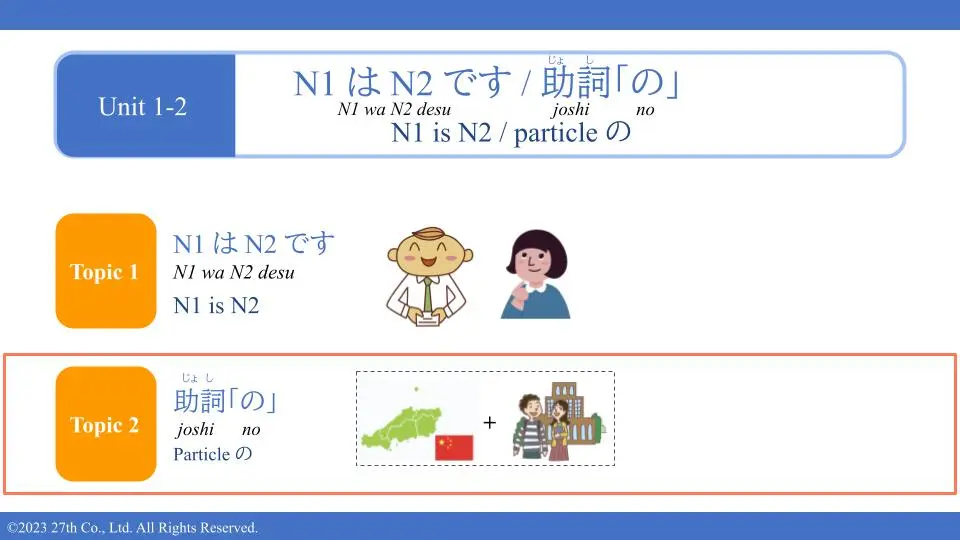
In Japanese, the sentence pattern “N1 は N2 です” (N1 wa N2 desu) is a fundamental structure that allows you to describe yourself and others.
In this guide, you will learn:
- How to introduce yourself using “N1 は N2 です“
- Common expressions and examples
- How to omit subjects for natural conversation
- Useful vocabulary for self-introductions
- FAQ to clear up common beginner mistakes
- Practice exercises to reinforce learning
Let’s get started!

For a quick visual summary, check out our Japanese Grammar N5 “N1 は N2 です” infographic on Instagram.
1. Understanding “N1 は N2 です” (N1 is N2)
Sentence Structure
The basic structure “N1 は N2 です“ means “N1 is N2”.
It is used to describe or define something.
- N1 is the topic of the sentence, marked by the particle は (wa).
- は is a topic marker particle. Although it’s written as “ha” in romaji, it’s pronounced “wa.”
- For more details, see our guide on how to distinguish between wa (は) and ga (が).
- N2 is the information or description that is being given about N1.
- です (desu) is the copula verb, which connects the topic and the description to express “is” or “are” in English.

Examples
| Japanese | Romaji | Meaning |
|---|---|---|
| わたし は がくせい です。 | Watashi wa gakusei desu. | I am a student. |
| ジョンさん は アメリカじん です。 | Jon-san wa Amerikajin desu. | John is an American. |
| たなかさん は せんせい です。 | Tanaka-san wa sensei desu. | Mr. Tanaka is a teacher. |
Want to say “I was…” in Japanese?
You learned わたしは学生です = “I am a student.” To say “I was a student,” use でした: わたしは学生でした.
Read next: How to Say “Was” and “Wasn’t” in Japanese Using でした
2. Common Self-Introduction Expressions
A typical self-introduction in Japanese follows this pattern:
Basic Self-Introduction
🔹 はじめまして。
(Hajimemashite.)
👉 “How do you do?”
🔹 わたし は [Name] です。
(Watashi wa [Name] desu.)
👉 “I am [Name].”
E.g., わたしはエマです。= I am Ema.
🔹 [Country / hometown] から きました。
([Country / hometown] kara kimashita.)
👉 “I am from [Country / hometown].”
E.g., アメリカからきました。= I’m from the United States.
🔹 [Occupation] です。
([Occupation] desu.)
👉 “I am a [occupation].”
E.g., 医者です。= I am a doctor.
🔹 よろしくおねがいします。
(Yoroshiku onegaishimasu.)
👉 “Nice to meet you.”
Examples
わたし は エミリー です。
(Watashi wa Emiri desu.)
“I am Emily.”
アメリカ から きました。
(Amerika kara kimashita.)
“I am from America.”
せんせい です。
(Sensei desu.)
“I am a teacher.”
3. Omitting the Subject for Natural Conversation
Japanese is a high-context language, meaning that subjects are often omitted if they are clear from context.
🔹 In English:
👤 A: “Are you a student?”
👤 B: “Yes, I am a student.”
🔹 In Japanese:
👤 A: がくせい です か? (Gakusei desu ka?)
👤 B: はい、がくせい です。 (Hai, gakusei desu.)
Here, “わたし は (watashi wa)“ is omitted because it is already understood that the speaker is referring to themselves.
4. Useful Vocabulary for Self-Introductions
| Meaning | Japanese | Romaji |
|---|---|---|
| Student | 学生 | Gakusei |
| Teacher | 先生 | Sensei |
| Doctor | 医者 | Isha |
| Engineer | エンジニア | Enjinia |
| Office Worker | 会社員 | Kaishain |
| High School Student | 高校生 | Kōkōsei |
| University Student | 大学生 | Daigakusei |
| American | アメリカ人 | Amerikajin |
| British | イギリス人 | Igirisujin |
| Japanese | 日本人 | Nihonjin |
🔹 Example Sentences:
わたし は かいしゃいん です。
(Watashi wa kaishain desu.)
“I am an office worker.”
マイクさん は いしゃ です。
(Maiku-san wa isha desu.)
“Mike is a doctor.”
5. Practice Exercises
Translate into Japanese
- I am a university student.
- My friend is a high school student.
- Lisa is an American.
- John is a teacher.
Answer Key
- わたし は だいがくせい です。 (Watashi wa daigakusei desu.)
- わたし の ともだち は こうこうせい です。 (Watashi no tomodachi wa kōkōsei desu.)
- リサさん は アメリカじん です。 (Risa-san wa Amerikajin desu.)
- ジョンさん は せんせい です。 (Jon-san wa sensei desu.)
In わたし の ともだち, the particle の shows possession or relationship.
Learn more in our guide to the Japanese particle の.
6. FAQ (Frequently Asked Questions)
- QCan I say “です” without using “は” (wa)?
- A
Yes, in very short responses. For example:
がくせい です。 (Gakusei desu.) → “I am a student.”
- QWhat’s the difference between “わたし は” and just “わたし”?
- A
わたし (watashi) alone means “I,” but わたし は introduces a topic. For example:
わたし は せんせい です。 (Watashi wa sensei desu.) → “I am a teacher.”
- QHow do I ask someone about their job?
- A
Use 何 (なん / nani) for “what”:
おしごと は なん です か? (Oshigoto wa nan desu ka?) → “What is your job?”
7. Conclusion: Your Next Steps!
Mastering “N1 は N2 です“ is an essential step in learning Japanese.
Once you feel comfortable, try introducing yourself and others naturally.