
Video
Let’s watch this short video for a quick overview.
Source: gokigen japanese official YouTube Channel
Introduction
Want to say things like:
- “Sushi is the most popular food.”
- “Among my friends, Yuka is the funniest.”
- “Winter is the coldest season.”
Japanese uses a clear and useful structure for superlatives — when something is the best, the most, or #1 within a group.
That structure is:
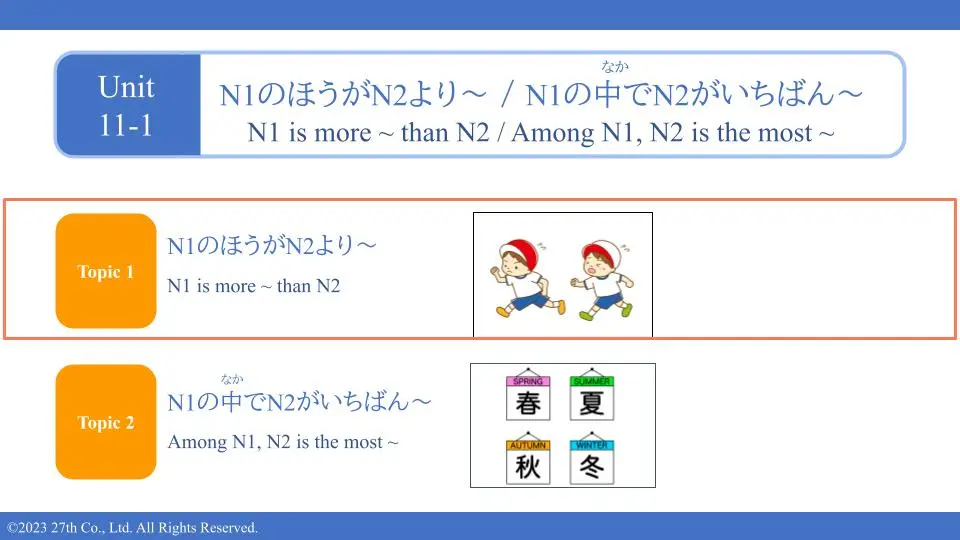
N1 の中で N2 がいちばん + adjective
= Among N1, N2 is the most ~
Let’s break down how to use this grammar to talk about “the best” things in your life!
1. Basic Grammar Structure
Grammar Pattern: N1 の中で N2 がいちばん + adjective
| English | Japanese |
|---|---|
| John is the tallest in his family. | 家族の中で、ジョンさんがいちばん背が高いです。 |
| Among my friends, Yuka is the funniest. | 友だちの中で、ゆかさんがいちばんおもしろいです。 |
When you want to name multiple items (= 3 or more items) as options, you can do this by connecting the items with と.
| English | Japanese |
|---|---|
| Among milk, coffee and tea, I like coffee the best. | 牛乳とコーヒーとお茶の中で、コーヒーがいちばん好きです。 |
| Among baseball, soccer, and basketball, I’m best at soccer. | 野球とサッカーとバスケットボールの中で、サッカーがいちばん得意です。 |
This pattern is used when comparing three or more items.
When comparing only two items, you cannot use いちばん.
In that case, use the pattern N1 のほうが N2 より ~ (N1 is More ~ Than N2) instead.
2. How It Works
- N1 の中で = “among N1 (a group / category)”
- N2 = the item that is the best
- いちばん + adjective = “the most ~” (いちばん = number one)
This structure helps you say what or who is the best in a group.
3. Asking “Which is the Best?”
To ask “Which one is the best ~?” use:
N1 の中で、どれ(or なに/だれ)がいちばん〜ですか。
| English | Japanese |
|---|---|
| Among fruits, which do you like best? | 果物の中で、どれ(なに)がいちばん好きですか。 |
| Among your friends, who is the most interesting? | 友だちの中で、だれがいちばんおもしろいですか。 |
| Among countries, which do you like best? | 国の中で、どこがいちばん好きですか。 |
4. Answering the Question

果物の中で、どれがいちばん好きですか。
Among fruits, which do you like best?

りんごがいちばん好きです。
I like apples best.
ともだちの中で、だれがいちばん背が高いですか。
Who is the tallest among your friends?
サトシさんだと思います。
That would be Satoshi.
季節の中で、いつがいちばん好きですか。
When is your favorite season?
春がいちばん好きです。夏は苦手です。
I like spring the best. I don’t like summer.
5. Practice Time!
Compare among three or more items using N1の中でN2がいちばん~.
| Prompt | Example Answer |
|---|---|
| – milk, tea, coffee – I like coffee best | 牛乳とお茶とコーヒーの中で、コーヒーがいちばん好きです。 |
| – Japanese, English, Chinese – Chinese is most difficult | 日本語と英語と中国語の中で、中国語がいちばん難しいです。 |
| – sports – soccer is my favorite | スポーツの中で、サッカーがいちばん好きです。 |
| – sports – tennis is what I’m best at | スポーツの中で、テニスがいちばん得意です。 |
FAQ – Frequently Asked Questions
- QWhat’s the difference between いちばん and もっと?
- A
- いちばん = the most (superlative)
- もっと = more (comparative)
Use いちばん when talking about the best or number one in a group.
- QCan I use いちばん alone?
- A
Yes, it is often natural not to say “~の中で”.
Example: すしがいちばん好きです。= I like sushi the best.
However, from this sentence alone, it is not clear whether sushi is the favorite of all foods or the favorite of all Japanese foods (和食 washoku). If the comparison is clear in the context before and after, it can be omitted, but if not, it would be more accurate to state “~の中で“.
- QWhy do we use the particle 「で」 in 「〜の中で」?
- A
The particle 「で」 indicates the scope or setting in which the comparison is made. It means “within” or “among,” and it sets the boundaries for choosing the “most.” Example: 家族の中で、ジョンさんがいちばん背が高いです。= John is the tallest in his family.
- When N1 refers to a group, 「の中」 is sometimes optional. Including it emphasizes the group more clearly, but omitting it still sounds natural.
- けんたさんはこのサッカーチーム(の中)でいちばんシュートが上手です。
Kenta is the best shooter on this soccer team.
- けんたさんはこのサッカーチーム(の中)でいちばんシュートが上手です。
- When N1 refers to a place, country, organization, or institution, 「の中」 is often not used, and 「で」 alone is more natural.
- ロシアは世界でいちばん大きいです。
Russia is the largest in the world. - スミスさんはアニメクラブでいちばんアニメについてよく知っています。
Mr. Smith knows the most about anime in the anime club.
- ロシアは世界でいちばん大きいです。
- When N1 refers to a group, 「の中」 is sometimes optional. Including it emphasizes the group more clearly, but omitting it still sounds natural.
- QHow can I say “N2 is the least ~ in N1”?
- A
To express the opposite of the superlative, you can use the structure 「N1 の中で N2 がいちばん〜ないです」 (N1 no naka de N2 ga ichiban ~ nai desu – N2 is the least ~ in N1). For example:
- ハリーポッターシリーズの中で、最後の映画がいちばんおもしろくなかったです。
Of all the Harry Potter movies, the last one was the least interesting.
- ハリーポッターシリーズの中で、最後の映画がいちばんおもしろくなかったです。
- QWhat if I want to say “This is one of the most ~”?
- A
To express that something is one of the most ~, you can use the structure 「N1 の中で、N2 はもっとも〜の一つです」 (N1 no naka de, N2 wa mottomo ~ no hitotsu desu). 「最も」 (mottomo) is a more formal way of saying “most,” and 「一つ」 (hitotsu) means “one.” For example:
- 日本の都市の中で、大阪はもっとも(=いちばん)にぎやかな都市の一つです。(Among Japanese cities, Osaka is one of the most lively cities.)
Conclusion
Now you can:
✅ Say what’s the most ~ in a group
✅ Use “N1 の中で N2 がいちばん ~” naturally
✅ Ask and answer superlative questions in Japanese
🎯 Try this:
Write 3 sentences using 〜の中で〜がいちばん〜です.
Example: 「スポーツの中で、バスケがいちばん好きです。」