
Video
Let’s watch this short video for a quick overview.
Source: gokigen japanese official YouTube Channel
Introduction
Want to compare things in Japanese?
Whether you’re saying:
- “Coffee is more delicious than tea.”
- “Spring is warmer than winter.”
- “I like cats more than dogs.”
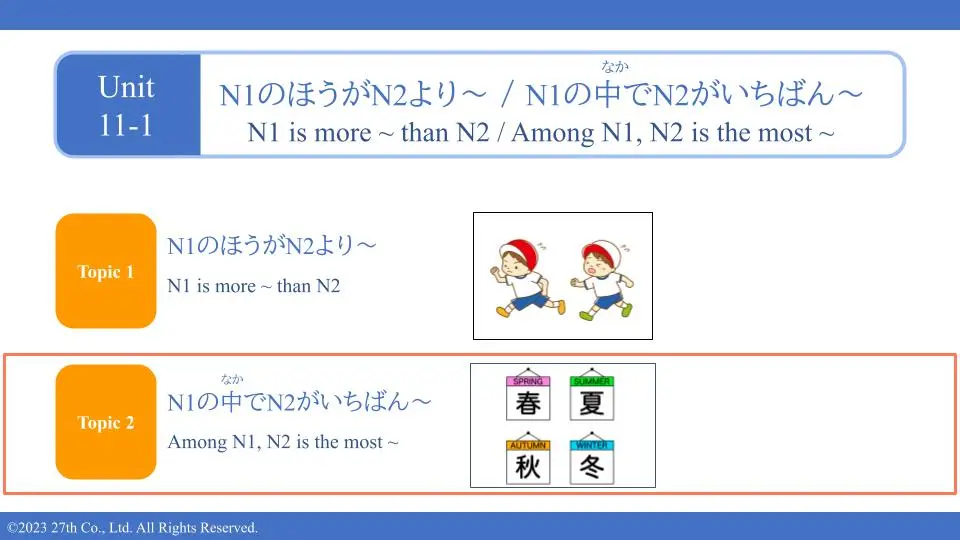
Japanese has a clear, simple way to say “N1 is more ~ than N2” using:
N1 のほうが N2 より + adjective
Let’s dive into how to compare two things naturally and accurately in Japanese!
1. Grammar Structure
Grammar Pattern: N1 のほうが N2 より + adjective
| English | Japanese |
|---|---|
| Spring is warmer than winter. | 春のほうが冬より暖かいです。 |
| I like sushi more than tempura. | すしのほうが天ぷらより好きです。 |
| Canada is colder than Japan. | カナダのほうが日本より寒いです。 |
This structure means: N1 is more ~ than N2.
2. How It Works
- N1 のほうが = “As for N1, comparatively speaking…”
- N2 より = “compared to N2”
- Add an adjective like たかい (expensive), はやい (fast), or おいしい (delicious)
Example:

カタカナのほうがひらがなより難しいです。
Katakana is more difficult than Hiragana.

ジョンさんのほうがエミリーさんより元気です。
John is more energetic than Emily.
[Note] The word order can be changed without changing the meaning
You can say: “N2 より N1 のほうが~“
The following sentences mean the same: Katakana is more difficult than Hiragana.
・カタカナのほうがひらがなより難しいです。
・ひらがなよりカタカナのほうが難しいです。
3. Asking “Which is more ~?”
How to ask
To ask which one is more ~, use:
N1 と N2 と、どちらのほうが 〜 ですか。
| English | Japanese |
|---|---|
| Dogs or cats — which do you like better? | 犬と猫と、どちらのほうが好きですか。 |
| Flying or taking the train — which is cheaper? | 飛行機と電車と、どちらのほうが安いですか。 |
| English or Japanese — which is more difficult? | 英語と日本語と、どちらのほうが難しいですか。 |
[Note] In natural Japanese, the second と (after N2) is often omitted in conversation and writing.
For example: 犬と猫、どちらのほうが好きですか。/飛行機と電車、どちらのほうが安いですか。
Casual version
In casual speech, どちら is often replaced with どっち.
Example:
[formal] 犬と猫、どちらのほうが好きですか。
[casual] 犬と猫、どっちのほうが好き?
How to answer
You can answer:
猫のほうが犬より好きです。= I like cats more than dogs.
電車のほうが飛行機より安いです。= Trains are cheaper than airplanes.
日本語のほうが英語より難しいです。= Japanese is more difficult than English.
When the comparison is clear from context, the 〜より part can be omitted.
- 猫のほうが好きです。= I like cats better.
- 電車のほうが安いです。= Train is cheaper.
- 日本語のほうが難しいです。= Japanese is more difficult.
If your preference is unclear or applies to both (or neither), you can answer like this:
どちらかというと猫のほうが好きです。= If I had to choose, I like cats more.
犬も猫も好きです。= I like both dogs and cats.
犬も猫も好きじゃありません。= I don’t like either dogs or cats.
4. Practice Time!
Compare the following pairs using N1 のほうが N2 より〜:
| Comparison | Answer |
|---|---|
| 秋と冬/暖かい (fall, winter / warm) | 秋のほうが冬より暖かいです。 |
| すしとそば/高い (sushi, soba / expensive) | すしのほうがそばより高いです。 |
| 飛行機とバス /速い (Planes, buses / fast) | 飛行機のほうがバスより速いです。 |
FAQ – Frequently Asked Questions
- QCan I drop のほう? Ex: いぬがねこよりすきです。= I like dogs rather than cats.
- A
Technically yes, but it’s clearer and more natural with のほうが, especially in beginner and polite speech. Ex: いぬのほうがねこよりすきです。
- QIs there a difference in nuance between using 「~より」 and 「~に くらべて」 (ni kurabete – compared to)?
- A
While both 「より」 and 「に くらべて」 can be used for comparisons, 「より」 is generally more direct and common in this specific grammar pattern (N1 のほうが N2 より + adjective). 「に くらべて」 is a bit more formal and often used to set up a broader comparison. In most cases with this structure, 「より」 is the more natural choice.
Example: 昨年にくらべて、今年の気温は2℃上昇した。= Compared to last year, temperatures this year increased by 2°C.
- QHow can I say “N1 is much more ~ than N2”?
- A
You can add adverbs of degree before the adjective to express the extent of the difference. Common adverbs include:
- ずっと (zutto): much more, far more
- わたしより、田中先生のほうがずっと年上です。= Dr. Tanaka is much older than I am.
- はるかに (haruka ni): far more, greatly
- 今回のJLPTのほうが、前回のよりはるかにかんたんでした。= This JLPT was much easier than the last one.
- もっと (motto): more (can also be used in place of 「のほうが」 in informal speech when asking for preference)
- カレーのほうが、ラーメンよりもっと好きです。= I like curry more than ramen.
- ずっと (zutto): much more, far more
- QCan I use this pattern with verbs, not just adjectives?
- A
Yes. This pattern can also be used with verbs to compare actions or habits.
Instead of comparing how something is, you compare which action you do more.
- マクドナルドとモスバーガーと、どちらのほうによく行きますか。= Which do you go to more often, McDonald’s or MOS Burger?
- 平日と週末と、どちらのほうがよく勉強しますか。= On weekdays or on weekends, which do you study more?
In verb comparisons, expressions like よく (often), たくさん (a lot), or ながく (for a long time) are often used to show degree or frequency.
Conclusion
Now you can:
✅ Compare two things in Japanese
✅ Ask “which is more ~?”
✅ Use のほうが and より like a pro!
🎯 Try this: Make 3 comparisons using this pattern. For example:
- 夏と冬、どちらのほうが好きですか。
- コーヒーと紅茶、どちらのほうが高いですか。