
Video
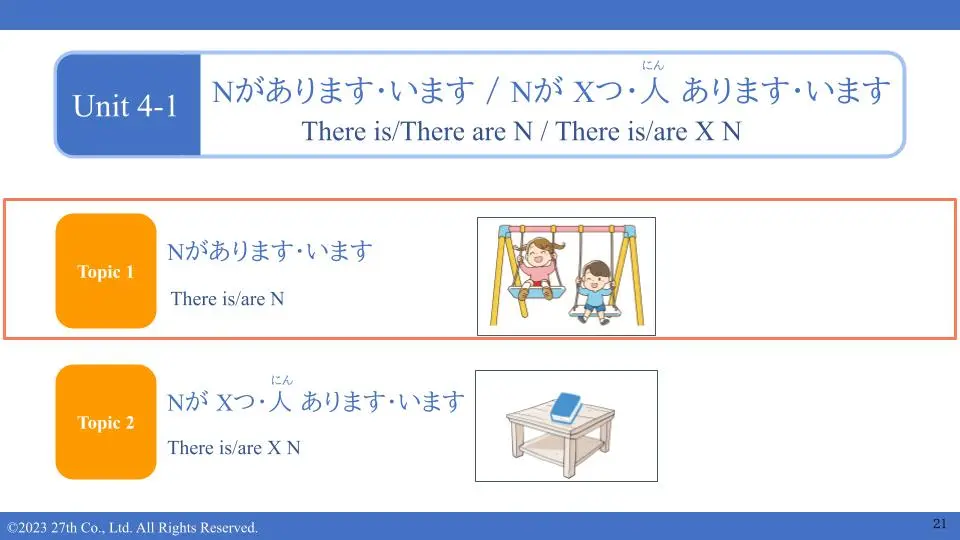
Let’s watch this short video for a quick overview.
Source: gokigen japanese official YouTube Channel
Introduction
Want to say “There are two kids in the park” or “I have three brothers”?
In Japanese, saying how many people or things there are involves a little grammar magic — especially with the verbs あります and います.
In this article, you’ll learn:
- How to say “There are X people/things” in Japanese
- The correct counters for people and general objects
- How to form questions like “How many…?”
- Sentence patterns with real-world examples
- Common pronunciation tips and an FAQ
Let’s start counting — Japanese style!
1. Sentence Structure: N が X つ・人 あります/います
Japanese uses different counters depending on what you’re counting:
| Use | Counter | Verb |
|---|---|---|
| People | 人(にん) | います |
| General objects | つ | あります |
Sentence Patterns
- [Noun] が X人(にん) います → “There are X people”
- [Noun] が Xつ あります → “There are X things”
| Japanese | Meaning |
|---|---|
| 公園に子どもが二人います。 | There are two children in the park. |
| この町に病院が三つあります。 | There are three hospitals in this town. |
| 私のクラスに韓国人が六人います。 | There are six Korean people in my class. |
| 机の上にりんごが四つあります。 | There are four apples on the desk. |
2. Counting People in Japanese
| Number | Japanese (~にん) |
|---|---|
| 1 person | ひとり |
| 2 people | ふたり |
| 3 people | さんにん |
| 4 people | よにん |
| 5 people | ごにん |
| 6 people | ろくにん |
| 7 people | ななにん / しちにん |
| 8 people | はちにん |
| 9 people | きゅうにん |
| 10 people | じゅうにん |

ひとり (1 person), ふたり (2 people) and よにん (4 people, not よんにん) are irregular. Be careful!
Pro Tip: These are useful at restaurants when answering “Nan-mei sama desu ka?” (How many people?). Learn more dining tips in How to Order in Japanese: Mastering Every Type of Japanese Dining.
3. Counting Things in Japanese with ~つ
The counter つ is used for general, everyday objects — like apples, bags, desks, etc.
Tips:
- If you’re not sure which specific counter to use, つ is usually a safe choice.
- It can even be used for abstract things — such as questions, ideas, or topics — not just physical objects.
| Number | Japanese (~つ) |
|---|---|
| 1 thing | ひとつ |
| 2 things | ふたつ |
| 3 things | みっつ |
| 4 things | よっつ |
| 5 things | いつつ |
| 6 things | むっつ |
| 7 things | ななつ |
| 8 things | やっつ |
| 9 things | ここのつ |
| 10 things | とお |
4. Asking Questions: How Many?
To ask “How many people?” → Use なんにん
To ask “How many things?” → Use いくつ
| Japanese | Meaning |
|---|---|
| クラスに留学生は何人いますか。 | How many international students are in the class? |
| りんごはいくつありますか。 | How many apples are there? |
| 兄弟は何人いますか。 | How many siblings do you have? |
5. Real-Life Examples

私のクラスにオーストラリア人が一人います。
(watashi no kurasu ni oosutoraria-jin ga hitori imasu)
There is one Australian in my class.

公園に子どもが二人います。
(kouen ni kodomo ga futari imasu)
There are two children in the park.

私の町に病院が三つあります。
(watashi no machi ni byouin ga mittsu arimasu)
There are three hospitals in my town.

家にスマホが一つあります。
(ie ni sumaho ga hitotsu arimasu)
There is one smartphone at home.
6. Practice Time: Try These!
Translate into Japanese:
There are three schools in this town.
→ この町に 学校が 三つあります。
I have five Japanese coworkers.
→ 私の会社に 日本人が 五人います。
There are two tables.
→ テーブルが 二つあります。
There is one person in the park.
→ 公園に 人が 一人います。
7. FAQ – Frequently Asked Questions
- QWhat’s the difference between あります and います?
- A
Use あります for things (inanimate), and います for people and animals (animate).
- QCan I use ひとつ, ふたつ, etc. for people?
- A
No — use ひとり, ふたり, さんにん… for people.
- QCan I say “I have ___” using this pattern?
- A
Yes! In Japanese, saying “I have 3 siblings / 私には兄弟が3人います” is the same as saying “There are 3 siblings (in my family).”
- QWhat other counters are there?
- A
There are many other counters in Japanese.
- “匹” (hiki) is used for counting small animals, like 猫 (neko, cat).
- “本” (hon) for long objects, like 傘 (kasa, umbrella).
- “枚” (mai) for flat items, like 紙 (kami, paper).
- “台” (dai) for machines, like テレビ (television).
- “円” (en) for money, meaning “yen.” For example: 百円 (hyaku en) = 100 yen.
- “階” (kai) for floors or levels of a building. For example: 三階 (sankai) = the third floor.
8. Conclusion: Start Counting Naturally in Japanese
Now you can say how many people or things there are — just like a native speaker!
Use X にん います for people, and X つ あります for objects.
These patterns are essential for everyday Japanese, from shopping to describing your family.
🎯 Practice today: Try saying how many family members and objects are around you!