
Video
Let’s watch this short video for a quick overview.
Source: gokigen japanese official YouTube Channel
Introduction
Want to say “I’m about to leave,” “I’m in the middle of cooking,” or “I’ve just finished homework” in Japanese? All three ideas use the same grammar core: V(short) + ところ.
By changing the verb form right before ところ you pinpoint the stage of the action—just before, during, or right after. Let’s break it down!
1. Structure & Meaning
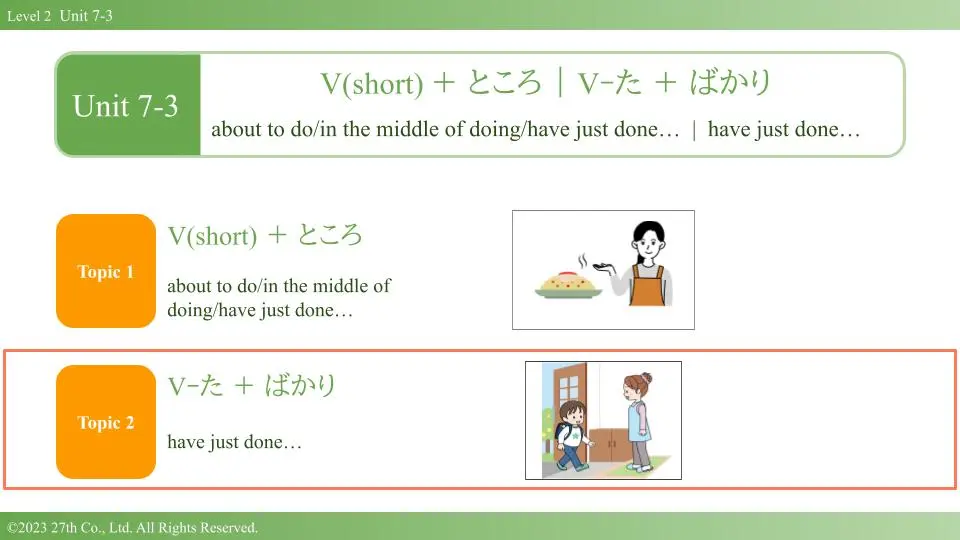
The grammar point V(short) + ところ has three meanings: it can be used to express that something is about to happen, is happening right now, or has just happened.
| Stage | Form before ところ | Meaning | Example |
|---|---|---|---|
| About to do | V (dictionary form) + ところ です | “just about to…” | 今から家に帰るところです。 I’m about to go home now. |
| In the middle of doing | V (te-form) + いる + ところ です | “in the middle of …-ing” | 今、夕飯を作っているところです。 I’m cooking dinner right now. |
| Have just done | V (short, past) + ところ です | “have just …” | さっき宿題をしたところです。 I’ve just done my homework. |

Think of ところ as “point in time.” The verb form in front tells the listener when that point is.
If you want to review V (te-form) + いる and V (short, past), read these articles:
- How to Use te iru(〜ている) in Japanese | Ongoing Action vs Ongoing Result Explained
- How to Use Japanese Past Tense Plain Form (Short Form) – Verbs in Casual Conversation
2. Conjugation Quick-View
| Verb | About to | In the middle | Have just |
|---|---|---|---|
| 書く (to write) | 書くところ | 書いているところ | 書いたところ |
| 話す (to speak) | 話すところ | 話しているところ | 話したところ |
| 食べる (to eat) | 食べるところ | 食べているところ | 食べたところ |
| する (to do) | するところ | しているところ | したところ |
3. Example Sentences

- 今からバスに乗るところです。
I’m just about to get on the bus. - 今、バスに乗っているところなので後で電話します。
I’m on the bus now, so I’ll call you later. - たった今バスを降りたところです。五分で着きます。
I just got off the bus. I’ll arrive in five minutes.
4. Usage Notes: ところ vs. ばかり
Both V-たところです and V-たばかりです can mean that something happened recently, but they are not always interchangeable.
- V-たところです focuses on the action as just completed at this point in time. It often sounds more tied to the immediate moment or the speaker’s current situation.
- V-たばかりです also means “just did,” but it is often used more broadly to mean recently, and it can still sound natural even when a little more time has passed. It is also common when the speaker wants to emphasize that the action feels “fresh” or “recent” in context.
So, the difference is often not only about clock time, but also about context and how the speaker feels about the timing. Compare these examples:
- 今朝のフライトで日本に来たところです。= I just arrived in Japan on a flight this morning.
- The arrival is very close to “now.”
- You can also say 今朝のフライトで日本に来たばかりです。
- 1か月前に日本に来たばかりです。= I only came to Japan a month ago.
- A month has passed, but it still feels recent in context.
- In this case, “1か月前に日本に来たところです” is unnatural.
More examples:
| Example | English | Note |
|---|---|---|
| ジェイコブさんとは三日前に会ったばかりです。 | I just met Jacob three days ago. | ばかり is natural because the speaker sees three days ago as still recent. |
| 先週買ったばかりの車をこすってしまいました。 | I scratched the car I had just bought last week. | ばかり is natural because it emphasizes “I only just bought it.” |
| 今ちょうど電車に乗ったところです。 | I just got on the train. | ところ is natural because the action happened right now. |
| 少し前にお会計を済ませたところです。 | I just finished paying a little while ago. | ところ is natural when the action is closely connected to the present moment. |
5. Practice Drill
Rewrite each cue with the correct V + ところ form.
| Cue | About to | In the middle | Have just |
|---|---|---|---|
| 手紙を書く write a letter | 手紙を書くところです | 手紙を書いているところです | 手紙を書いたところです |
| 朝ごはんを食べる have a breakfast | 朝ごはんを食べるところです | 朝ごはんを食べているところです | 朝ごはんを食べたところです |
| 日本語を勉強する study Japanese | 日本語を勉強するところです | 日本語を勉強しているところです | 日本語を勉強したところです |
6. Common Adverbs for Each Stage
To make your sentences sound natural, pair ところ with these common adverbs:
V(dictionary) + ところです (About to do)
- 今から (imakara – from now on)
- これから (korekara – from now on, shortly)
- ちょうど (chōdo – just, exactly)
Example: 今から、お昼ごはんを食べるところです。= I am about to have lunch.
V-ている + ところです (In the middle of doing)
- 今 (ima – now)
- ちょうど (chōdo – just, exactly)
- まさに (masani – precisely, exactly)
Example: 今、レポートを 書いている ところ です。後で部長にメールします。= I’m writing the report right now. I’ll email the department manager later.
V(past short) + ところです (Have just done)
- さっき (sakki – a little while ago)
- たった今 (tatta ima – just now, a moment ago)
- ちょうど (chōdo – just, exactly)
Example: ちょうど仕事が 終わった ところ です。疲れました。= I’ve just finished work. I’m tired.
7. FAQ
- QCan I use ところ with negative verbs?
- A
Rare—because you describe an action point. Instead say まだ〜ていません for “haven’t done yet.”
- QHow formal is ところです?
- A
Neutral-polite. Works in daily conversation, business chat, and writing.
- QCan I use 〜ところです for future actions that are not immediate, like “I’m going to travel next month”?
- A
No, V(dictionary) + ところです specifically refers to an action you are just about to start (within seconds or minutes). For future plans that are not immediate, use other future tense expressions like 〜つもりです (intend to), 〜予定です (plan to), or simply the plain form of the verb.
- QWhat’s the difference between 〜ているところです and just 〜ています?
- A
〜ています: This is the general progressive tense, meaning “I am doing X” or “I am in a state of X.” It can describe an ongoing action or a state.
〜ているところです: This specifically emphasizes that you are currently in the very middle of performing an action. It narrows the focus to the precise “point” or “moment” of the action’s execution. It’s often used in response to a question like “What are you doing now?”
- 今、レポートを書いています。= I’m writing a report now. (A normal statement of ongoing action.)
- 今、レポートを書いているところです。= I’m in the middle of writing a report right now. (More emphasis on the exact timing.)
Conclusion
Now you can:
- ✅ Use V(dictionary) + ところ です to say “about to …”
- ✅ Use V (te-form) + いる + ところ です for “in the middle of …-ing”
- ✅ Use V (short, past) + ところ です for “have just …” (pin-point moment)
Grab three actions in your day and describe them with each stage—about to, doing, just done. Your Japanese timeline talk will feel natural and precise!