
Video
Let’s watch this short video for a quick overview.
Source: gokigen japanese official YouTube Channel
Introduction
Asking questions is one of the most useful skills in any language — and in Japanese, it’s easier than you think!
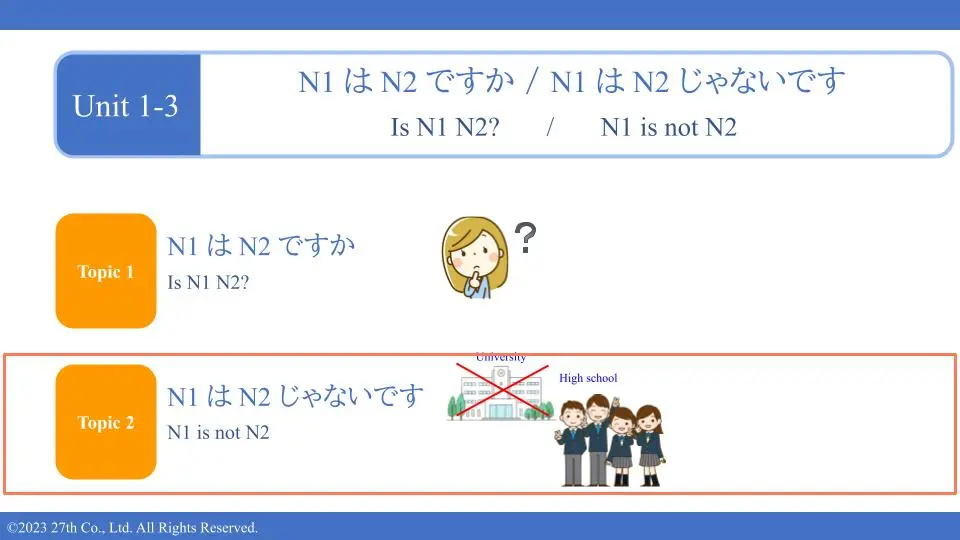
In this lesson, we’ll introduce the essential question pattern “N1 は N2 ですか”, which means “Is N1 N2?”
Whether you want to ask someone’s name, age, nationality, or job, this pattern will help you start real conversations in Japanese from day one.
Let’s get started!
1. Meaning and Structure
N1 は N2 ですか
(N1 wa N2 desu ka?)
→ “Is N1 N2?”
This sentence structure is used to ask yes/no questions like:
- “Are you a student?”
- “Is this a dictionary?”
- “Is he Japanese?”
| Japanese | Romaji | Meaning |
|---|---|---|
| たなかさん は せんせい ですか。 | Tanaka-san wa sensei desu ka? | Is Mr. Tanaka a teacher? |
| エマさん は アメリカじん ですか。 | Ema-san wa Amerikajin desu ka? | Is Emma American? |
| これは じしょ ですか。 | Kore wa jisho desu ka? | Is this a dictionary? |
How to Answer Yes/No Questions in Japanese
When answering yes/no questions (〜ですか), you can respond like this:
Yes
はい、[N1は] N2です。
Hai, [N1 wa] N2 desu.
or simply:
はい、そうです。
Hai, sō desu.
→ “Yes, that’s right.”
No
いいえ、N2じゃないです。
Iie, N2 ja nai desu.
→ “No, (it) is not.”
Example:

けんさん は せんせい ですか。
(Ken-san wa sensei desu ka?)
Are you a teacher, Ken?

はい、そうです。 (Hai, sō desu.) / いいえ、せんせい じゃないです。 (Iie, sensei ja nai desu.)
Yes, I am. / No, I am not a teacher.
2. Pronunciation Tip: Rising Intonation
When asking yes/no questions in Japanese, raise your intonation slightly at the end of the sentence on “か” (ka) — just like when you ask a question in English.
Example:
ロバートさん は 27さい ですか。
(Robaato-san wa nijuu-nana sai desu ka?)
→ “Is Robert 27 years old?”
⤴️ Intonation goes up at the end!
3. Using “なん (nan)” for question-word questions
You can also use “なん” (nan) to ask question-word questions like:
| Question | Romaji | Meaning |
|---|---|---|
| おなまえ は なん ですか | Onamae wa nan desu ka? | What is your name? |
| せんこう は なん ですか | Senkou wa nan desu ka? | What is your major? |
| いま なんじ ですか | Ima nanji desu ka? | What time is it now? |
| おにいさん は なんさい ですか | Oniisan wa nansai desu ka? | How old is your older brother? |
“なん(何)” = what, and it can be combined words like:
- なんさい(何歳) = how old
- なんねんせい(何年生) = what grade
- なんばん(何番) = what number (e.g., phone number)
Extra Notes
Polite Alternative for “なんさいですか”
The phrase 「なんさいですか」 (nansai desu ka) means “How old are you?”
In polite situations — for example, when speaking to someone older or in formal settings — it’s better to say:
「おいくつですか」 (oikutsu desu ka) → a more respectful way to ask someone’s age.
Word Order with Question Words
In Japanese, the question word (like なん / なに) appears in the same position where the answer would go — usually where N2 is in the sentence. Example:
せんこう は なん ですか。(Senkou wa nan desu ka?) – “What is your major?”
→ The question word なん replaces the answer (e.g., けいざい = economics).
This is different from English, where the question word usually comes at the beginning of the sentence.
Difference Between “なん” and “なに”
Both なん (nan) and なに (nani) mean “what” in Japanese, but they are used differently depending on (1) pronunciation flow and (2) meaning or context.
(1) Based on Pronunciation (Sound Flow)
Originally, “nan” came from “nani” — the final vowel -i was dropped because it’s easier to pronounce.
That’s why “nan” often appears before words that start with the sounds d, t, or n, since “nani” would sound awkward or difficult to say in those cases. For example:
| Following Sound | Example | Meaning |
|---|---|---|
| d | なんで (nande) | why |
| なんですか (nan desu ka) | what is it? | |
| なんじ (nanji) | what time | |
| t | なんとなく (nantonaku) | somehow |
| なんと (nanto) | what (an expression of surprise) | |
| なんて (nante) | such / what a … | |
| n | なんの (nan no) | what kind of … |
| なんのこと (nan no koto) | what (thing) |
In these cases, “nan” sounds smoother and more natural than “nani.”
(2) Based on Meaning (What vs. How Many)
Sometimes, “nan” and “nani” are also used differently depending on what the speaker wants to ask — what something is vs. how many (of something) there are.
| Meaning | Example | Reading | Translation |
|---|---|---|---|
| What (kind) | 何人 | nani-jin | what nationality |
| 何色 | nani-iro | what color | |
| How many | 何人 | nan-nin | how many people |
| 何色 | nan-shoku | how many colors |
So, if you’re asking “What color is it?” you say なにいろ (nani-iro).
But if you’re asking “How many colors are used in that painting?” you say なんしょく (nan-shoku).
(3) Exceptions
Like many Japanese grammar rules, there are exceptions. For instance, 何曜日 (what day of the week) is read なんようび (nan’yōbi), even though it doesn’t mean “how many.”
This is simply because there is no alternative reading (nani-yōbi doesn’t exist).
4. Practice Sentences: Try It Yourself!
Translate the following into Japanese:
1️⃣ Are you a college student?
2️⃣ Is Satou-san a lawyer?
3️⃣ What grade is Kenji in?
4️⃣ How old is your older sister?
Answers:
1️⃣ (あなた は)だいがくせい ですか
(Anata wa daigakusei desu ka?)
Note: Use the person’s name if possible instead of “anata.”
2️⃣ さとうさん は べんごし ですか
(Satou-san wa bengoshi desu ka?)
3️⃣ けんじさん は なんねんせい ですか
(Kenji-san wa nan nensei desu ka?)
4️⃣ おねえさん は なんさい ですか
(Oneesan wa nansai desu ka?)
5. Common Vocabulary for Practice
| Japanese | Romaji | Meaning |
|---|---|---|
| がくせい | gakusei | student |
| せんせい | sensei | teacher |
| こうこうせい | koukousei | high school student |
| かいしゃいん | kaishain | company employee |
| べんごし | bengoshi | lawyer |
| せんこう | senkou | major (field of study) |
| でんわばんごう | denwa bangou | phone number |
| にほんじん | nihonjin | Japanese (person) |
| アメリカじん | amerikajin | American |
| だいがくせい | daigakusei | university student |
6. FAQ – Frequently Asked Questions
- QCan I use “anata” for “you”?
- A
It’s possible, but in most cases, use the person’s name + さん to sound more natural and polite. “Anata” can sound distant or overly formal in many situations.
- QCan I just raise my voice to make it a question like in English?
- A
Not exactly. Japanese relies on grammar (like か), not just tone, to indicate questions. Still, rising intonation helps signal you’re asking.
- QWhat if I want to ask “Who” or “Where”?
- A
Use other question words:
- だれ = who
- どこ = where
- いつ = when
- QDo Japanese sentences use a question mark (?) for questions?
- A
Not usually. In Japanese, the question particle か (ka) already shows that the sentence is a question, so a question mark isn’t required. However, in casual writing (like emails, LINE messages, or social media), you might see ? used for a softer or more conversational tone — similar to how English speakers use it in chat.
7. Conclusion: Your First Japanese Questions!
With “N1 は N2 ですか”, you now have the power to start conversations, ask about people, and find out useful information — all in natural Japanese!
📝 Next Step: Practice by making your own questions:
- Is your friend a student?
- What’s your teacher’s name?
- How old is your classmate?
Want to ask about the past?
Now that you can ask “Is N1 N2?” in Japanese using N1 は N2 ですか, try learning how to ask “Was N1 N2?” using でしたか.
Read next: How to Say “Was” and “Wasn’t” in Japanese Using でした